


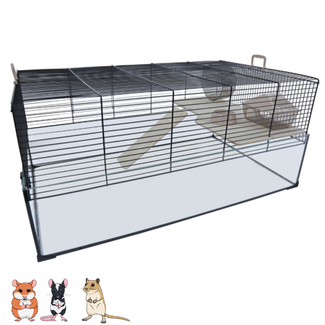


Mouse cage: a spacious, safe enclosure with room to dig and climb
The enclosure is the place where your mice spend their whole lives. They sleep there, eat there, build their nests and are active there for hours every night. A good mouse cage is therefore spacious, has a deep base for a thick layer of bedding, offers room to climb and is completely escape-proof. Mice are small and squeeze through openings you would never think possible.
In this category you will find enclosures with a glass or acrylic base, wooden enclosures with acrylic panels and levels, and stands on wheels. Fill the enclosure with a thick layer of Zooply bedding and Zooply Nesting Material, from our own brand that we use every day for our own mice, and you have the basis for an enclosure in which your mice can really be mice.
At a glance
- ✓ The bigger, the better: a cage from the shop is often the minimum basis.
- ✓ Choose a tall, solid base, so a thick layer of bedding fits in for digging.
- ✓ Check the bar spacing and all gaps: a mouse squeezes through very small openings.
- ✓ Place the enclosure in a quiet, draught-free spot, out of the sun and not next to the radiator.
- ✓ Make sure there is good ventilation; mice have sensitive airways.
What will you find in the Cages category?
Enclosures with a glass base
The rodent enclosure with a glass base of 80 × 50 × 40 cm is made for hamsters, gerbils and mice. The glass base gives room to dig and nest, and you can also see your mice in their little tunnels. The Ferplast rodent cage with a glass base (78.5 × 45.5 × 52.5 cm) has several levels and, according to the product information, is suitable for hamsters, gerbils, mice and rats. The Zolux rodent enclosure on legs (78 × 48 × 36 cm) is made for hamsters and mice and stands on its own legs.
Wooden enclosures with acrylic panels
Trixie has wooden enclosures with acrylic walls. The enclosure with levels of 100 × 50 × 50 cm is intended for Syrian hamsters, gerbils and mice. The roomy enclosure of 100 × 80 × 50 cm with several platforms is made for mice and rats: thanks to the height and platforms, there is plenty of climbing room. The roomy enclosure of 115 × 60 × 60 cm with acrylic panels is made for Syrian hamsters and gerbils and offers lots of floor space. The luxury Ferplast rodent cages with an acrylic base come in 100 × 61 × 50 cm and 120 × 61 × 52 cm, with wooden platforms and ladders.
Rat enclosure
The Flamingo rat enclosure (77 × 47 × 60 cm) with wooden platforms is made for dwarf rats. Whether it is suitable for mice depends on the bar spacing; check that carefully before you put mice in it.
Stands on wheels
The stands from Ferplast fit under the Ferplast enclosures of 80, 100 and 120 cm. Thanks to the wheels, you can easily move the enclosure to clean behind it. The enclosure is also raised to a comfortable height.
How big should a mouse cage be?
Mice are small, but very active. They run, climb and dig for hours every night. A small enclosure gets dirty quickly, starts to smell sooner and causes more tension in the group. So choose the largest enclosure that fits in your home. Look mainly at the floor area: that is where your mice dig and rummage. Levels and platforms are a nice addition, especially for mice that love to climb, but they don't replace floor area.
An enclosure of around 80 cm long is a good basis for a small group of mice. With 100 or 120 cm, you have room for a digging corner, several hiding places, a running wheel and a feeding spot without it getting overcrowded. More space also means more calm when cleaning: you can spot-clean without turning the whole enclosure upside down.
What should you look for in a mouse cage?
Escape-proof
With mice, this is the most important thing of all. An adult fancy mouse can squeeze through an opening of less than a centimetre, a young mouse through even less. In an enclosure with bars or mesh, the bar spacing must therefore be very narrow. In practice, mouse keepers usually stick to a maximum of about 7 mm, and even less for young mice. Also check gaps by doors, flaps, ventilation grilles and where the top joins the base. Mice also gnaw at plastic and wooden edges; check regularly that no little hole is forming.
A deep, solid base
Mice love to dig tunnels and nests underground. For that, they need a thick layer of bedding. A tall base of glass or acrylic keeps that layer inside. With a shallow base with bars above it, the bedding flies out and you can't make the layer as thick.
Ventilation
Mice have sensitive airways. In an enclosure without enough air circulation, ammonia from the urine lingers. An enclosure with a mesh top or ventilation grilles ensures fresh air. A fully closed glass terrarium needs a mesh lid.
Accessibility
Large doors or a removable top make feeding, cleaning out and furnishing a lot easier. Your mice are also less startled when you don't have to put your whole arm through a small door.
The right spot in your home
Place the mouse cage in a quiet spot, free of draughts, out of full sun, not next to the radiator and not next to a TV or speakers. Mice cope badly with heat; an enclosure with glass heats up quickly in the sun. Preferably don't put the enclosure in the bedroom either. Mice are mainly active in the evening and at night, with gnawing and running in the wheel. At table height or on a stand, you can see your mice better and they are less startled by things coming from above.
Furnishing the enclosure
Start with a thick layer of low-dust bedding, mixed with some hay or nesting material, so that dug tunnels stay up. Put several hiding places spread across the enclosure, connect them with tunnels and add a running wheel of at least about 20 cm in diameter. Create climbing routes with ladders, bridges and platforms, always with a soft surface underneath. A food bowl, a water bottle and some gnawing material complete it. Mice love a richly furnished enclosure, but also leave open areas to walk and dig.
Setting up a new enclosure
Assemble the enclosure and furnish it completely before your mice go in. Then check all doors, flaps and corners for gaps one more time. If your mice are moving from an old enclosure to a new one, take a handful of used nesting material and some old bedding with them. That familiar smell helps them feel at home more quickly.
Cleaning
Mice mark their enclosure with urine and get stressed if their familiar scent disappears all at once. So remove wet and dirty spots several times a week, especially in the usual pee corner. Refresh the rest of the bedding in sections and, during a big clean, always leave part of the old, dry nesting material in place. If the enclosure smells sharply of ammonia, it is time to clean out more often.
Useful combinations
An enclosure only becomes a home with the right furnishings. These categories go with it:
- Bedding: Zooply Hemp Fibre, Cotton Fibre or Cardboard Shreds for a thick, low-dust digging layer.
- Nesting materials: Zooply Nesting Material to mix through the bedding and build nests from.
- Hideouts: enough hiding places for every mouse.
- Running wheels: a wheel with a solid running surface in the right size.
- Mouse scaping: Zooply sprinkle mixes, moss and natural materials to finish off the enclosure.
Frequently asked questions about mouse cages
Is a cage with bars or an enclosure with glass better?
Both can work, as long as they are escape-proof. An enclosure with a tall glass or acrylic base keeps the bedding inside and lets you create a deep digging layer. Bars give more ventilation and climbing options, but the bar spacing then has to be very narrow. Many mouse keepers choose a combination: a solid, tall base with mesh or bars above it.
Can I use a hamster enclosure for mice?
Often, yes, because hamsters and mice have similar needs: lots of floor space and a deep digging layer. Do watch the bar spacing and gaps, though. Mice are smaller and slimmer than hamsters, and an enclosure that keeps a hamster in doesn't automatically keep a mouse in.
How many mice can live in one enclosure?
That depends on the size of the enclosure and on the mice. Females live well in a small group; males are often territorial and usually live alone or, if neutered, with females. Make sure there is a hiding place for every mouse and enough space to avoid each other. If in doubt, feel free to ask us for advice.
My enclosure starts to smell quickly. What can I do?
First look at the size: an enclosure that is too small for the number of mice starts to smell faster. Use a thick layer of highly absorbent bedding, clean out the pee corner more often and make sure there is enough ventilation. Don't make everything odour-free in one go; that actually leads to more marking.
How do I furnish an enclosure with levels safely?
Make sure every level can be reached via a ladder or bridge and that there are no big drops. Put a soft layer of bedding under platforms. Check that there are no gaps between platforms and walls where a mouse could get stuck.
Buying mouse cages at Knaagplaza
At Knaagplaza, the webshop of 't Knaagplein, you will find spacious enclosures for mice with a deep base and room to climb. Furnish the enclosure with Zooply bedding and Zooply Nesting Material, our own premium brand that we use every day for our own animals in the shop and the breeding facility. That way you give your mice a safe home in which they can dig, climb and nest.