


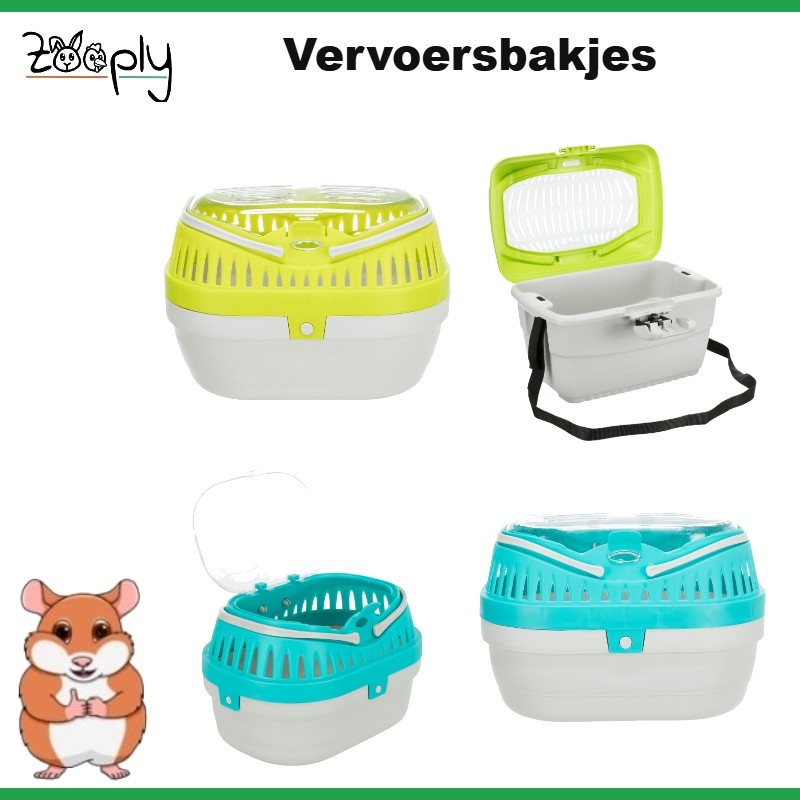
Transport box for your hamster: safe and calm on the move
Even if your hamster hardly ever leaves home, a transport box is part of the basic kit. You need it when you collect your new hamster, for a visit to the vet, when moving house or if your hamster goes to a sitter during a holiday. It is also handy during a big clean of the enclosure: your hamster sits safe and sheltered for a while, while you can work in peace.
A hamster is small, fast and easily frightened. In your hands or in an open box, it can jump away or escape. In a transport box that closes properly, with some familiar bedding, it is safe, sheltered and a lot calmer. In this category you will find transport boxes from Trixie in three sizes and a larger carrier. A handful of Zooply bedding and some nesting material from its own enclosure make the box feel familiar straight away.
At a glance
- ✓ Choose a box that closes securely and is well ventilated, but not draughty.
- ✓ Put a layer of bedding and some nesting material from its own enclosure in the box.
- ✓ Bring some hamster food; on a longer journey, also a small piece of cucumber for moisture.
- ✓ Never put the box in full sun or in a warm, closed car.
- ✓ One hamster per box: transport Syrian hamsters and dwarf hamsters separately.
What will you find in the Transport boxes category?
Transport boxes from Trixie in three sizes
The transport boxes from Trixie come in three sizes and in various colours. The smallest box measures 18 × 12 × 13 cm and is handy for a dwarf hamster and for short trips, such as to the vet. The medium box of 23 × 16 × 17 cm gives a Syrian hamster a little more room and is also suitable for a slightly longer journey. The largest box of 30 × 21 × 23 cm offers even more room. That is nice if your hamster has to stay in it a bit longer, for example during a house move or a big clean. The boxes are made of sturdy plastic, have ventilation holes for fresh air and are easy to carry. According to the product information, the medium box has a transparent lid, so you can see your hamster without opening the box.
Midi Capri carrier
The Midi Capri carrier from Trixie measures 40 × 22 × 30 cm and is mainly made for guinea pigs and dwarf rabbits. For a hamster it is roomy. If you want to use it as a temporary place during a clean, put a generous layer of bedding in it with a hiding place, so your hamster doesn't feel lost in the space.
Which size suits your hamster?
A transport box doesn't need to be big. During transport, shelter is more important than space. In a box that is too big, your hamster slides back and forth at every bend or when the car brakes. In a box in which it can just turn around, lie down and burrow into some bedding, it feels safer. For short trips, the smallest box is fine for a dwarf hamster, and the medium box for a Syrian hamster. For longer trips, or if your hamster has to stay in it for a few hours, choose one size up.
Setting up the transport box
Put a layer of bedding in the box, preferably with a handful of clean material from its own enclosure. The familiar smell is calming. Add a tuft of safe nesting material or hay, so your hamster can hide. Bring a small amount of its usual hamster food. Hamsters don't always eat during transport, but it is good to have something there.
It is better not to hang a water bottle in the box while driving: the shaking makes it leak and the floor gets wet. On a short trip, water is not needed. If the journey takes longer, give a small piece of cucumber or another juicy piece of vegetable. That provides moisture without leaking. Remove leftover fresh food after arrival.
How to transport your hamster safely
Temperature
Hamsters are sensitive to heat and to big changes in temperature. Never put the box in full sun, not even briefly on the back seat. Never leave your hamster in a parked car: even on a mild day it gets too hot in there within a short time. In winter, don't leave the box standing in the cold for long. A cloth over part of the box helps against draughts and gives extra calm, but don't cover it completely, so there is still enough fresh air.
Placing it securely
In the car, place the box on the floor behind a seat or secure it with the seat belt, so it can't slide or fall in an emergency stop. If you carry the box, keep it horizontal and don't swing it. If you cycle with your hamster, secure the box firmly in a pannier or basket and ride calmly.
Quiet and dark
Hamsters sleep during the day. A daytime journey is therefore extra unsettling for your hamster. Keep things calm around the box: no loud music, no children constantly coming to look and as little opening as possible. By keeping the lid closed and covering part of the box, you create a dark, sheltered spot where your hamster can hide.
Putting your hamster in and taking it out of the box
Many hamsters don't like being picked up. A handy way to get your hamster into the box is via a tunnel or a cup: let it walk in, keep the opening closed with your hand and put it in the box that way. Or place the open box in the enclosure with a few pieces of food inside, and wait until your hamster walks in by itself. Do this in the evening, when it is awake.
When you arrive, put your hamster straight back in its own enclosure or a prepared enclosure. Then leave it alone so it can recover. Expect it to mainly sleep or hide for the first few hours. That is a normal reaction to a journey.
To the vet
A transport box is especially important if your hamster seems ill. If your hamster isn't eating, is lethargic, has diarrhoea or a wet bottom, or is breathing with difficulty, go quickly to a vet with knowledge of rodents. If you already have the box at home, you won't have to go looking for one in a situation like that. Preferably bring some of the food your hamster is used to, and tell the vet what it eats and how the enclosure is set up.
Plastic and gnawing
The transport boxes in this category are made of plastic. That is light and easy to clean. Hamsters can gnaw on plastic, though, especially if they are in it for a long time. So use the box for transport and short periods, not as a replacement for the enclosure. After use, check that there is no gnawing damage to the ventilation holes or the lid, so the box closes safely again next time.
Cleaning
After use, throw away the bedding, rinse the box with warm water and let it dry thoroughly. Don't use strong-smelling cleaning products. Keep the box in a fixed place, so you can grab it quickly when you need it.
Useful combinations
- Bedding: a layer of Zooply bedding for the bottom of the box.
- Nesting materials: Zooply nesting material to give your hamster a place to hide.
- Food for hamsters: some Zooply Syrian Hamster Food or Dwarf Hamster Food to take along.
- Tunnels: handy for letting your hamster walk into the box without picking it up.
- Runs: temporary extra space during cleaning, for hamsters that stay calm in one.
Frequently asked questions about transport boxes for hamsters
How long can a hamster stay in a transport box?
As briefly as possible. For a trip to the vet or a short journey, a transport box is fine. If your hamster has to travel for more than a few hours, choose a larger box, give food and a piece of cucumber for moisture, and make sure it gets back into an enclosure with a thick layer of bedding as soon as possible.
Can I put two hamsters together in one transport box?
No. Syrian hamsters are solitary and fight with their own kind. Dwarf hamsters are also best kept apart; in a small space with stress, fights break out quickly. Transport each hamster in its own box.
Should there be a water bottle in the transport box?
Not on short trips. A water bottle leaks while driving and makes the floor wet. On longer journeys, give a small piece of cucumber for moisture. If you will be somewhere for a longer time, such as with a sitter, put your hamster in an enclosure with a normal water bottle.
My hamster is very quiet after the journey. Is that a problem?
Usually not. A journey is exciting, and many hamsters hide and sleep a lot afterwards. Give it peace and quiet in its own enclosure. If it still isn't eating after a day, is very lethargic or you see other symptoms, contact a vet with knowledge of rodents.
Can I use the transport box while cleaning?
Yes, that is a good use for it. Put some bedding and nesting material from its own enclosure in it, place it somewhere quiet and put your hamster back as soon as you are done. For hamsters that get stressed easily, a sheltered transport box is often calmer than an open run.
Transport boxes at Knaagplaza
At Knaagplaza, the webshop of 't Knaagplein, you will find transport boxes in various sizes for Syrian and dwarf hamsters. Set up the box with a layer of Zooply bedding and some nesting material, our own premium brand that we use every day for our own animals in the shop and the breeding facility. That way your hamster travels safely and calmly.