


Tunnels for ferrets: crawling, hiding and playing
Ferrets are originally hunters that crawl into burrows and passages. You can see that in their play: they dart through every opening, hide, drag things away and stalk each other. A tunnel matches that behaviour perfectly. It is one of the simplest ways to keep your ferret busy, in the cage and during daily free-roaming time.
In this category you will find play tunnels from Trixie in various shapes. With a few tunnels you can turn an ordinary room into a playground.
At a glance
- ✓ Tunnels suit the natural crawling and hiding behaviour of ferrets.
- ✓ Choose a diameter your ferret can easily get through without getting stuck.
- ✓ Check tunnels regularly for tears, loose threads and chewed parts.
- ✓ Do not use toys with small parts or soft rubber that a ferret could swallow.
- ✓ Rotate tunnels and toys, so they stay new.
What will you find in the Accessories category?
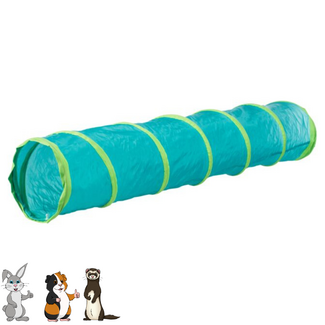
Trixie play tunnel ø 19 × 117 cm
A long play tunnel of 117 cm with a diameter of 19 cm which, according to the product information, is for rabbits, guinea pigs and ferrets and suitable for indoor and outdoor use. A long tunnel is ideal for racing through and for hiding in.
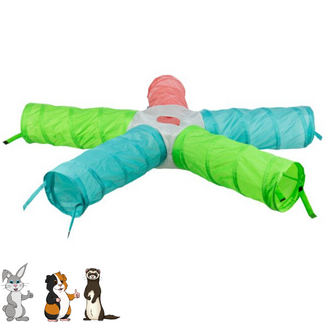
Trixie play tunnel with 5 exits
This tunnel has five entrances and exits with a diameter of 18 cm and a length of 47 cm. Several exits make the game more exciting: your ferret can dart in and out, and with two ferrets it soon turns into a game of tag.
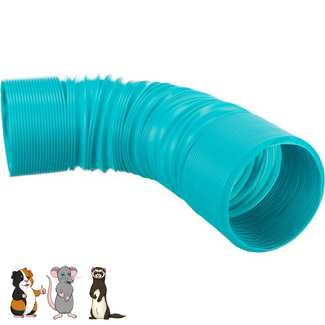
Trixie extendable tunnel
An extendable tunnel in grey and blue which, according to the product information, is for guinea pigs, rats and ferrets. You set the length yourself, so it fits in the cage or in the free-roaming area.
Tunnels in the cage and during free-roaming time
In the cage, a tunnel can be a connection between levels or an extra hiding and sleeping spot. Do not place it so that it serves as a step up to a door or the top of the cage.
During free-roaming time you can combine tunnels into an obstacle course: a long tunnel, linked to the tunnel with exits, with a few cardboard boxes in between. Change the layout regularly. Ferrets are curious and discover a new route straight away.
Making the free-roaming area ferret-proof
Tunnels are most fun in a room where your ferret can roam freely. First make that room ferret-proof. Ferrets crawl through any opening big enough for their head: block off gaps behind cupboards, under the sofa and around pipes. Remove cables, small objects, plants and cleaning products or put them out of reach. Keep windows and doors closed and take care with armchairs and sofa beds with a mechanism a ferret could crawl into. Also put one or more litter trays in the free-roaming area. With those basics in place, you can let your ferret play, hide and race through its tunnels with peace of mind.
Playing with treats
Hide a few pieces of a ferret treat, such as the Zooply Ferret Snack Mix, in a tunnel. Your ferret will search and sniff around. That way you combine exercise with foraging. Keep the amount small and count it as that day's treat.
Safety
Ferrets gnaw and pull at fabric and plastic. Check tunnels after play for tears, loose seams and holes. Throw a tunnel away if pieces have been bitten out of it. Choose toys without small parts, bells or soft rubber: a ferret can swallow such pieces, and that can be dangerous. If you notice your ferret has swallowed something, or it is vomiting, not eating or lethargic, go straight to a vet with knowledge of ferrets.
Handy combinations
- Ferret cages with levels in which you can include tunnels.
- Ferret treats to hide in tunnels.
- All products for ferrets, including hammocks, sleeping bags, play posts and snuffle mats.
Frequently asked questions about tunnels for ferrets
What diameter does a ferret tunnel need?
Your ferret must be able to crawl through it easily and turn around inside it. The Trixie tunnels with a diameter of 18 and 19 cm offer plenty of room for that. With the extendable tunnel, choose a setting that is taut enough not to sag.
Can I use tunnels for rabbits or guinea pigs?
Yes, if the diameter is large enough and the material is sturdy. The tunnels in this category are also sold for rabbits and guinea pigs, but according to the product information they are suitable for ferrets. With ferrets, pay extra attention to chewing damage.
How do I clean a tunnel?
Follow the manufacturer's washing instructions. Fabric tunnels can often be washed; plastic tunnels are cleaned with warm water and a mild cleaning product for animal enclosures, rinsed thoroughly and left to dry.
How many toys does a ferret need?
Better a few things you rotate regularly than everything at once. A ferret quickly gets used to whatever is always there. Put out a few tunnels and a box, and change the layout every few days. More important than the number of toys is that your ferret gets free-roaming time every day.
Can a ferret sleep in a tunnel?
It can. Many ferrets crawl into a tunnel after playing to have a rest. Do also provide proper sleeping spots in the cage, such as hammocks and a sleeping bag, where it is dark and warm.
Accessories for ferrets at Knaagplaza
With a few good tunnels you make the cage and the free-roaming area a lot more interesting for your ferret. Combine them with treats to hide and change the layout regularly, and playing will be an adventure for your ferret every day.