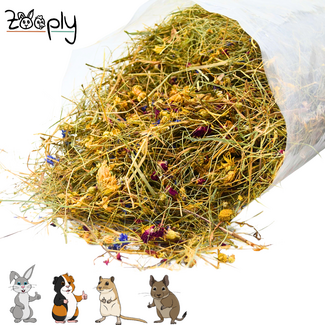
Herbal hay: variety in your rabbit's or guinea pig's most important food
For rabbits and guinea pigs, hay is by far the most important part of the menu. They need it all day long: for their gut and to wear down their teeth, which keep growing throughout life. Precisely because they eat so much of it, variety is welcome. Herbal hay is hay with herbs, leaves, flowers or pieces of vegetable mixed through it. That gives a different scent, taste and texture, and invites them to search and pull.
In this category you will find four kinds of herbal hay from Zooply, our own premium brand. All four are based on alpine hay and are packed loose in the bag, not compressed. We use them ourselves to vary the hay of our own rabbits and guinea pigs in our shop and breeding facility.
At a glance
- ✓ Herbal hay is simply hay with extras: you can give it without limit, just like other hay.
- ✓ Alternate between the four kinds and your regular hay so your animal stays interested.
- ✓ Introduce a new kind gradually by first mixing it into the familiar hay.
- ✓ Offer hay in a hay rack so it stays clean and dry.
- ✓ Store herbal hay dry and airy, never in a sealed plastic box.
What will you find in the Herbal hay category?
Zooply Oat Meadow
Oat Meadow is alpine hay with green oats, dill, raspberry leaf, birch leaf and rose flower. The green oat stalks give a slightly different, sturdier texture than grass, and dill and raspberry leaf provide a fresh, aromatic scent. A great choice if you want to give hay that offers just a little more to chew and search for.
Zooply Field Meadow
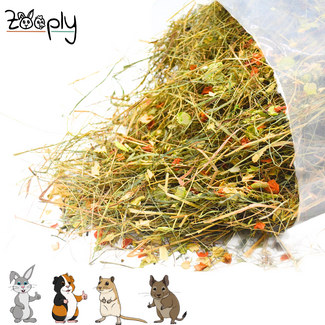
Field Meadow is alpine hay with dried vegetables, including peas, carrot, parsnip, pumpkin, celery, cucumber and bell pepper. Many rabbits and guinea pigs love the vegetable pieces and actively search for them. Because carrot, pumpkin and peas contain a bit more sugar and starch than grass, use Field Meadow as variety and not as the only type of hay.
Zooply Woodland Meadow
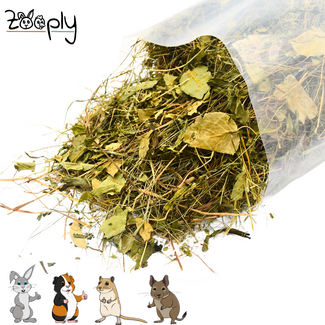
Woodland Meadow is alpine hay with leaves: lime leaf, strawberry leaf, apricot leaf, nettle leaf, plantain and apple leaf. In the wild, leaves are part of the menu of rabbits and guinea pigs. They give a different, slightly sturdier texture and a scent of their own. This variant is suitable if you want to give hay with few sweet extras.
Zooply Flower Meadow
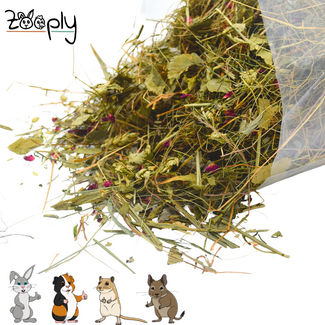
Flower Meadow is alpine hay with marigold, chamomile, rose flower, blue cornflower and sunflower. It is a colourful mix with a soft, floral scent. The flowers are especially fun to search for. Flower Meadow is an easy way to add a little extra experience to the daily portion of hay.
Why herbal hay makes sense
A rabbit or guinea pig that eats less hay often eats more pellets or snacks. That is exactly what you do not want: hay is needed for good gut function and for wearing down the teeth. Herbal hay helps keep their interest in hay high. The scent of herbs, leaves or flowers makes a fresh portion appealing, and the pieces in between encourage your animal to search and pull instead of only picking out the easiest hay.
That searching is also enrichment. Rabbits and guinea pigs naturally spend a large part of the day looking for food. In an indoor enclosure, much of that disappears. A rack of herbal hay gives that behaviour a place.
How to use herbal hay
As part of the daily hay portion
You can simply put herbal hay in the hay rack, replacing part of the regular hay. Many owners fill the rack with their regular hay and put a handful of herbal hay on top. Your animal then starts with the herbal hay and afterwards works its way through the regular hay too.
Alternating by day or by week
Alternate between the four kinds. For example, a few days of Woodland Meadow, then a few days of Flower Meadow, then Oat Meadow again. That way it stays new for your animal. You can use Field Meadow with vegetables now and then as an extra tasty variant, for instance for an animal that is eating a little less hay for a while.
As enrichment
Hide a handful of herbal hay in a cardboard box, a tunnel or a toy from which your animal has to pull it out. That way you combine eating with activity. This also works well for animals that are often home alone.
Rabbit and guinea pig: small differences
Rabbits like to pull hay from a rack hung higher up, and sometimes jump or stand on their hind legs to do so. Guinea pigs prefer to eat at a low height and often take hay from a low rack or a hay ball on the floor. Make sure your rack suits the animal, so the hay is easy to reach and the animal cannot get trapped.
For guinea pigs it is extra important that they keep eating their hay well, because they are sensitive to stress and a changed menu. For them, herbal hay mainly helps to hold their interest. With guinea pigs, also remember their daily vitamin C: it is not in hay, but comes from guinea pig food with vitamin C and fresh vegetables.
Introducing new herbal hay
Even though it is hay, a new kind is a small change for the gut. Start with a handful mixed into the familiar hay and increase the share over 1 to 2 weeks. Keep an eye on the droppings: round, dry and regular is good. If they are softer than normal, take a step back. If your animal stops eating altogether or no droppings appear, go straight to a vet with knowledge of rabbits or guinea pigs.
How do you recognise good herbal hay?
Good herbal hay looks green and smells aromatic and fresh, not musty or sour. The stalks are long and airy, so your animal can pull and search. The herbs, leaves or flowers are recognisable and spread throughout the hay, not lying as powder at the bottom of the bag. A little dust at the bottom is normal with hay; throw that away and only give the airy part. Because Zooply herbal hay is packed loose in the bag and not compressed, the structure of the stalks and herbs is well preserved and it is easy to take out of the packaging.
Storage
Herbal hay stays at its tastiest if you store it dry, cool and airy, out of the sun. Do not use a sealed plastic box, because it can then heat up or go mouldy. If hay smells musty, feels damp or you see mould, throw it away. Fresh herbal hay smells aromatic and fresh.
Handy combinations
- Zooply hay and straw for the daily basis of unlimited hay, and straw for a warm enclosure.
- Zooply rabbit and guinea pig food: the pressed pellets that go alongside the hay.
- Zooply dried herbs to mix through the hay yourself or as separate enrichment.
- Zooply bedding to keep the spot under the hay rack dry.
Frequently asked questions about herbal hay
Can herbal hay completely replace regular hay?
It is hay too, so in principle it can. Still, we recommend alternating with plain hay and between the different kinds of herbal hay. Field Meadow in particular, with vegetables, is better not used as the only type of hay. By alternating, your animal gets variety without one kind of extras becoming the main part of its diet.
My rabbit only eats the herbs and flowers out of it. Is that a problem?
That is normal: the tastiest bits always go first. Leave the remaining hay in the rack and only top up once most of it has gone. If your rabbit consistently leaves the hay itself, check that you are not giving too many pellets or snacks. If your animal is genuinely eating less hay than normal, have its teeth checked by a vet.
Which kind suits a fussy eater best?
Many animals respond well to Field Meadow because of the vegetable pieces, or to Oat Meadow because of the fragrant herbs. Start with a handful on top of the regular hay and see which kind your animal likes best. Use that kind as a tempter and slowly mix more plain hay back in.
Is herbal hay suitable for young rabbits and guinea pigs?
Young animals should have unlimited hay from the start. Herbal hay can be part of that, but build up new kinds very gradually, because young animals have an extra sensitive digestion. Start with the variant with the fewest extras, such as Woodland Meadow, and keep giving their familiar hay alongside it.
Can I also give herbal hay to hamsters or degus?
The four Zooply kinds are intended for rabbits and guinea pigs. Hamsters and mice mainly use hay as nesting material and to nibble on; you can use a tuft of Woodland Meadow or Oat Meadow for that. Do not give degus Field Meadow, because it contains carrot, pumpkin and peas, and degus must eat sugar-free.
How do I store an opened bag?
Keep the bag in a dry, cool place with the top open or loosely closed, so air can get to it. That way the hay cannot heat up. Do not put it in the shed if it is damp, and not in the sun. Use an opened bag within a reasonable time, so the scent of the herbs is preserved.
Zooply herbal hay at Knaagplaza
With the four kinds of Zooply herbal hay, you give your rabbits and guinea pigs a different experience with their most important food every day. We use them ourselves to keep the hay intake of our own animals high. Combine them with your regular hay, alternate regularly and see which kind your animal likes best.