




Hamster scaping: a natural landscape in the hamster enclosure
Hamster scaping means furnishing your hamster's enclosure like a little piece of nature. Instead of a few loose accessories on a thin layer of bedding, you create a landscape: a thick digging layer, moss and leaves, branches and cork, hiding places in the ground and scattered food to search for. An enclosure like this looks lovely, but the most important thing is that your hamster can show its natural behaviour in it. Digging, foraging, hiding food and taking shelter then naturally become part of its night.
In this category you will find everything to build a scape, based on the scaping products from Zooply, our own brand: forest mixes with leaves, scatter herbs and scatter flowers for foraging, stone moss and rodent moss. We use them ourselves for our own animals. You will also find natural materials from Esve, Back Zoo Nature and Trixie, and decorative glass bowls on a wooden base.
In short
- ✓ The basis of every scape is a thick layer of bedding: at least about 20 cm, preferably more.
- ✓ Only use untreated, natural materials that are suitable for rodents.
- ✓ Sprinkle a small handful of Zooply scatter herbs or forest mix through the top layer, so your hamster starts foraging.
- ✓ Do not give dwarf hamsters mixes with fruit or other sweet pieces.
- ✓ Create fixed zones: a nesting area, a sand bath, a feeding spot and open digging space.
What will you find in the Hamster scaping category?
Zooply Forest Mix
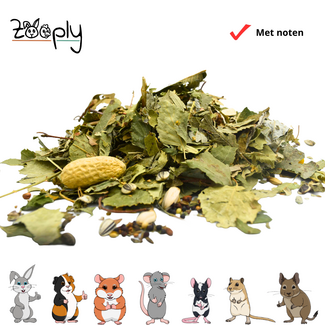
The Zooply Forest Mixes consist of various kinds of dried leaves. They give your enclosure a natural woodland look and a loose top layer that your hamster can snuffle through. You can choose from the Forest Mix with various leaves (100 grams), purely as decoration and top layer, the Forest Mix with leaves and walnuts and the Forest Mix with leaves and hazelnuts (100 grams each), and two foraging mixes of 250 grams: the Forest Mix with leaves and seeds and the Forest Mix with leaves and nuts. Scatter the leaves over moss, along a little path or under a cork bridge. With the mixes containing nuts and seeds, the tasty bits disappear between the leaves, so your hamster has to search. Nuts are high in fat; so use these mixes in moderation.
Zooply Scatter Herbs
Zooply Scatter Herbs are 250 gram foraging mixes, made for hamsters, mice, rats and gerbils. The basis consists of leaves, such as apple and birch leaves, and flowers, supplemented with seeds. There are five varieties: with seeds, with nuts, with millet, with peas and with fruit. Scatter a small handful over the bedding and mix it lightly into the top layer. For dwarf hamsters, choose a variety without fruit, because they are sensitive to sugar.
Zooply Scatter Flowers
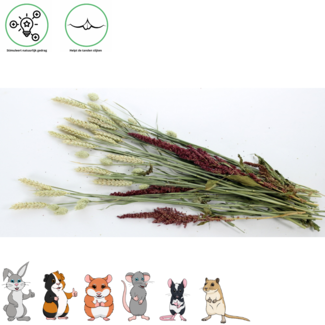
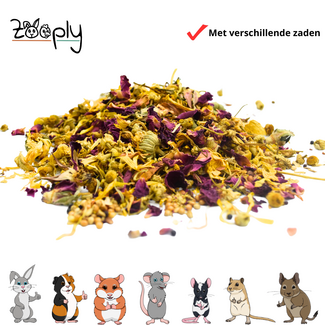
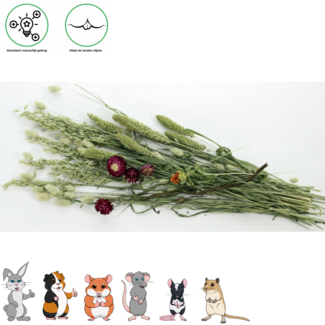
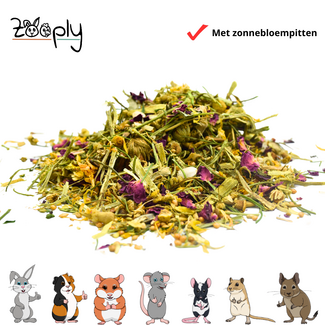
The Zooply Scatter Flowers (200 grams) are colourful foraging mixes of dried flowers with seeds. You can choose from Scatter Flowers with alfalfa and sunflower seeds, with alfalfa and seeds, with peas and seeds, with sunflower seeds and seeds and with various seeds. They brighten up the enclosure and give your hamster a fragrant treasure hunt. Rotate between the varieties for variety.
Zooply Stone Moss, Rodent Moss and Millet Spray Pieces
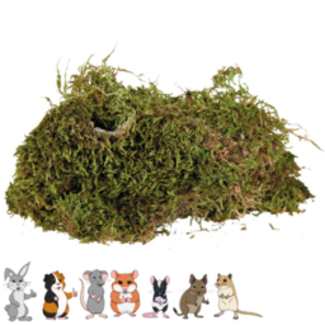
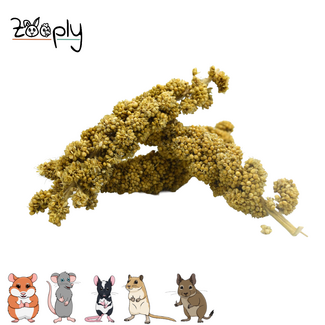
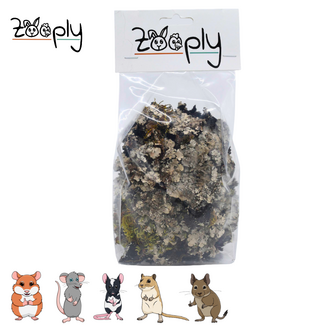
Zooply Stone Moss (75 grams) and Zooply Rodent Moss (250 grams) are dried moss for hamsters, gerbils, mice and rats. According to the product information they are rodent-friendly, so your hamster may nibble on them. Use moss as green accents in the bedding, along edges and tunnels, or as a soft layer in a spot where you want a woodland feel. Zooply Millet Spray Pieces (125 grams) are short sprigs with seeds on them. Push them halfway into the bedding, then your hamster has to find them and gnaw the seeds off itself.
Natural decoration from Esve
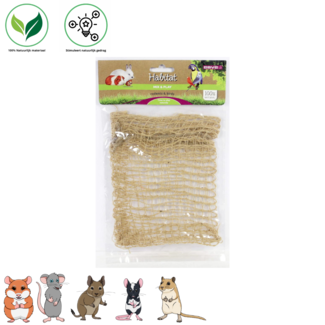
Esve has an extensive line of scaping materials: pine cones (small, large and Australian pine cones), nut shells, maize herb, Babla plant, rattan sticks, coconut pieces, palm bark and Buddha nuts. For hiding places there is a coconut house and a set of two coconuts that are a quarter open. For climbing there is a bamboo ladder, a jute net and a banana fibre rope. Esve also sells fibrous materials such as silk cotton, cotton shells, palm fibres and jute fibres, and Pet Bouquets: bunches of grains, grasses, herbs and flowers, such as Knaagveld, Weidegewas and Tarweakker.
Moss, leaves and topping from Back Zoo Nature
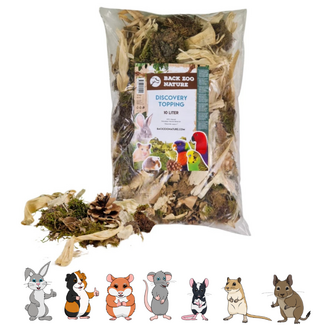
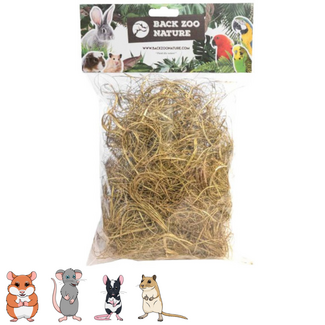
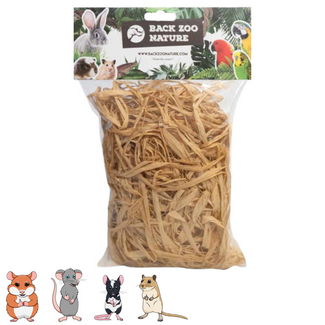
Back Zoo Nature supplies branch moss (50 grams), palm leaves (50 grams), palm grass (40 grams) and tree leaves (65 grams). The Discovery topping (10 litres) is a mix of maize leaf, moss and pine cones that you scatter as an extra layer over the bedding.
Cork, branches and tunnels from Trixie
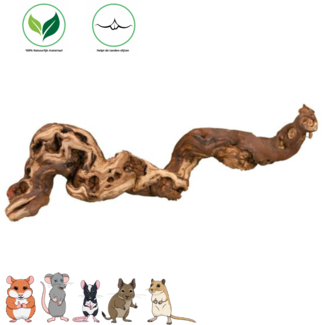
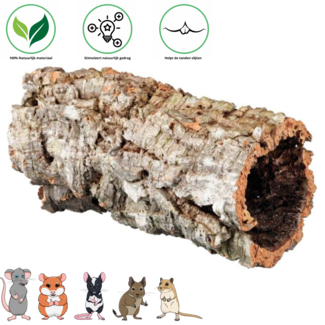
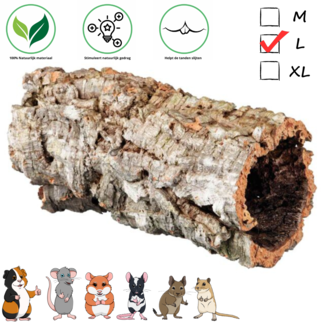
From Trixie you will find cork tunnels made of 100% natural cork (up to ø 14 × 40 cm and up to ø 19 × 55 cm), grapevine branches in three lengths, a grass tunnel with three entrances (25 × 9 × 18 cm) and naturally dried moss (200 grams). The coconut with a hole from Happy Pet also fits nicely into a scape.
Glass bowls on a wooden base
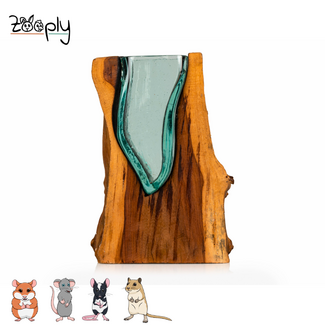
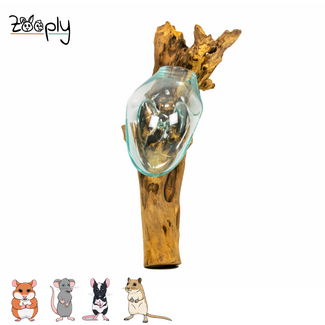
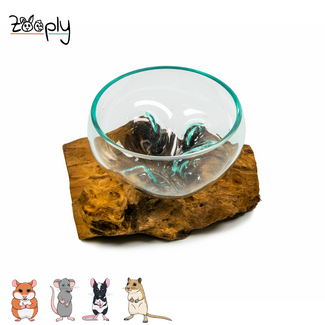
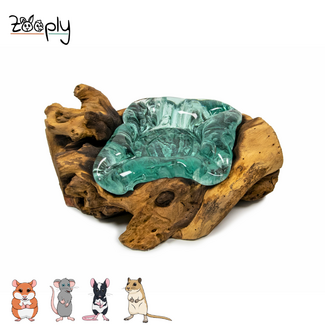
The glass bowls from Gigan Garden & Deco stand on a base of Gamal root or trunk. They come in different sizes, including 15, 20 and 25 cm. You use them as a sand bath, digging box or food bowl, and they fit beautifully in a naturally furnished enclosure.
How to build a hamster scape
Start with the floor
A scape starts at the bottom. Fill the enclosure with a thick layer of bedding of at least about 20 cm, and make one part even deeper. Mix hay or straw through it, so the tunnels your hamster digs stay firm. Zooply bedding is suitable for this. Press the layer down lightly, so it is less likely to collapse.
Create zones
Divide the enclosure into a few fixed spots. A quiet nesting area with a buried house or coconut, a sand bath with fine bathing sand, a feeding spot and open areas for digging and running. Place the wheel on a firm base, so it does not sink. Fixed zones make the enclosure easy to navigate for your hamster and make cleaning easier, because you know where the toilet and nesting spots are.
Add structure
Arrange cork, branches and tunnels so that sheltered routes are created, especially along the edges. Hamsters prefer walking alongside something rather than across an open plain. Half-bury cork tunnels, lean a branch at an angle against a piece of cork and use moss and leaves to create transitions between the zones. Keep everything low: a hamster is not a climber and can fall from high elements.
Scatter the finishing touch
Finally, scatter the top layer: Zooply forest mix, scatter flowers, moss and a small handful of scatter herbs. Mix it lightly through the top few centimetres. Your hamster then immediately has something to search for, and the enclosure looks natural.
Scaping safely
Only use materials intended for rodents: untreated, without varnish, paint or glue. Branches, moss and leaves from your own garden or the woods can contain moulds, parasites or pesticides; preferably do not use them. Be careful with long, thin fibres such as silk cotton, jute fibres and palm fibres. Use them in small amounts and check that no long threads end up in the nest that could wrap around a little leg. If in doubt, choose nesting material made of paper, hay or hemp.
Also keep an eye on the amount of treats. Scatter herbs, forest mixes with nuts and millet spray are enrichment, not main food. A small handful at a time is enough. Do not top up before your hamster has eaten its main food and most of the previous portion, otherwise it will only search for its favourites.
Maintaining a scape
Hamsters are strongly scent-oriented. So you do not tear a scape down every week. Refresh the toilet spots and the sand bath regularly, remove perishable fresh food and leave the nest and the dry food store in place. Top up the top layer with new leaves, flowers or moss now and then. That keeps the enclosure fresh and interesting, without your hamster losing its familiar surroundings.
Useful combinations
- Bedding: Zooply hemp fibre, wood fibre, cotton fibre or coconut shreds as a thick digging layer.
- Dried flowers & grasses: even more Zooply flowers and grasses for colour and foraging fun.
- Houses: hiding places to bury, such as the multi-chamber house.
- Tunnels: cork and willow tunnels as routes through the scape.
- Sand & sand baths: Zooply bathing sand for the sand bath zone.
Frequently asked questions about hamster scaping
What do I need at minimum for hamster scaping?
A spacious enclosure with a thick layer of bedding, a few hiding places, a sand bath, a wheel of the right size and some natural materials such as cork, moss and leaves. That already gives you a good basis. A handful of Zooply scatter herbs or forest mix finishes it off. You do not have to buy everything at once: you can expand a scape step by step.
Can my hamster eat the moss and leaves?
The products in this category are intended for rodents, and according to the product information Zooply Stone Moss and Rodent Moss are rodent-friendly: your hamster may nibble on them. They are not food products, though. Your hamster gets its nutrition from its hamster food. Do not use moss or leaves from the wild, because you do not know what is on them.
How often should I scatter scatter herbs or forest mix?
A small handful a few times a week is enough for most hamsters. It is meant for foraging, not as an extra meal. Make sure your hamster keeps eating its usual food well. If it gets heavier or leaves its main food, give less. Rotate between varieties for variety.
Which scaping products are suitable for dwarf hamsters?
Almost all decoration is suitable, as long as the size fits. With foraging mixes, watch out for sugar: do not give Zooply Scatter Herbs with fruit or products with dried fruit to dwarf hamsters. For them, choose the varieties with seeds, millet or peas, the scatter flowers or the forest mix with leaves.
Do I need to renew the scape often?
No. The less you disturb the scape, the calmer your hamster stays. Refresh toilet spots and the sand bath, remove perishable food and top up the top layer now and then. Only do a major makeover when it is really necessary. In that case, keep part of the old, clean material aside and mix it back in, so the enclosure keeps smelling familiar.
Hamster scaping at Knaagplaza
At Knaagplaza, the webshop of 't Knaagplein, you will find everything to build a natural hamster enclosure. Start with the Zooply forest mixes, scatter herbs, scatter flowers and Zooply moss, our own premium brand that we use every day for our own animals in the shop and breeding facility. Combine them with cork, branches and a thick digging layer, and your hamster gets an enclosure in which it has something to discover every night.