
A run for hamsters: safe extra space under supervision
A run for your hamster is a fenced-off area where your hamster can wander around and sniff outside its enclosure for a while. Handy when you are cleaning the cage, changing the set-up or want to practise contact with your hamster calmly. A run is, however, always a temporary extra. A hamster's real home remains a spacious cage with a thick layer of bedding, in which it can dig, hide and build up its food store.
In this category you will find a metal playpen, a wooden indoor run with separate panels and a fleece blanket for the floor. In a run, a thin layer of Zooply bedding from your hamster's own cage works well: it provides grip and a familiar scent.
In short
- ✓ A run is temporary extra space, never a replacement for a spacious hamster cage.
- ✓ Always stay with your hamster: hamsters climb and escape faster than you think.
- ✓ Always put a hiding place in the run, such as a house or tunnel.
- ✓ Use the run when your hamster is awake by itself, usually in the evening.
- ✓ One hamster per run: never let Syrian hamsters and dwarf hamsters roam together.
What will you find in the Runs & Fencing category?
Metal playpen from Trixie
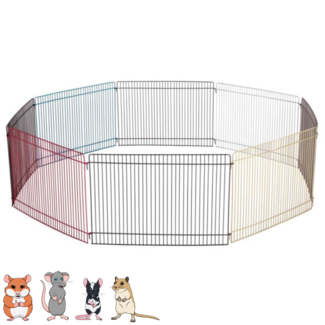
The metal playpen from Trixie is round, with a diameter of 86 cm and a height of 23 cm. You set it up indoors on the floor and quickly have a defined play area. The run is made for various rodents. For a hamster, the 23 cm height is the most important point to watch: do not put anything against the wall that your hamster can climb on, and stay with it the whole time.
Wooden indoor run from Trixie
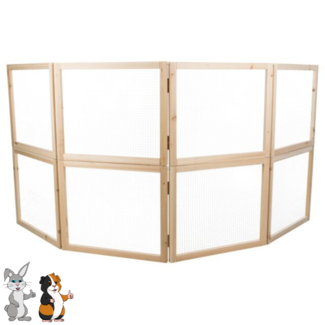
The wooden indoor run consists of four panels of 50 × 60 cm. According to the product information, it is mainly intended for rabbits and guinea pigs. If you want to use it for a hamster, check carefully that the panels fit together well at the corners and that there are no gaps at the bottom. A dwarf hamster fits through surprisingly small openings.
Fleece blanket for the floor of the run
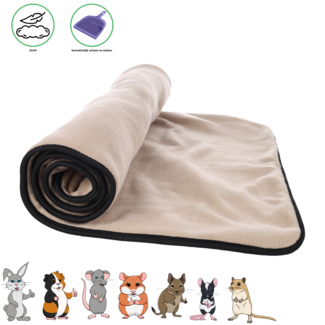
The fleece blanket from Flamingo measures 100 × 55 cm and is 0.4 cm thick. You lay it on the floor of the run, so your hamster is not walking on a slippery or cold floor. A soft surface provides grip and also protects your floor. Check the blanket regularly for loose threads and wash it after use, so no smell of urine lingers.
When is a run handy?
A run is mainly a tool for short moments. While you clean the cage, your hamster can stay safely in the run for a while, so you can calmly refresh wet patches and top up the sand bath. When you change the set-up, for example adding a new wheel or an extra house, it is also nice if your hamster is somewhere else for a while.
You can also use a run to build up contact calmly. Sit in or next to the run, keep your hand still and let your hamster come to you by itself. A small piece of a suitable snack in your hand helps. That way your hamster learns that your hand is nothing to be scared of, without being able to run off anywhere straight away.
Setting up a run safely
An open space feels unsafe to a hamster. It is a prey animal that naturally walks along edges and quickly darts off to a hiding place. So always put a house or tunnel in the run, and preferably more than one. Lay down a thin layer of bedding or a fleece blanket for grip. A handful of bedding from its own cage gives a familiar scent, which helps your hamster feel at ease more quickly.
Sprinkle a few grains of its usual hamster food or some dried herbs through the bedding. Then your hamster will start searching and sniffing instead of just walking along the edge. Otherwise, keep the run uncluttered. Do not put tall objects by the wall: a house with a flat roof against the edge is a stepping stone to freedom for a hamster.
Where do you put the run?
Use the run indoors, in a quiet room without draughts and out of the sun. Pay attention to what is around the run: cables, gaps under furniture and other pets are a risk if your hamster does escape. A cat or dog in the same room also causes a lot of stress, even if they cannot get to the run. Choose a moment when the house is quiet.
Do not let a hamster run around outdoors in a run. Hamsters are sensitive to temperature changes and are startled by unfamiliar sounds, and outdoors there are more dangers than you can keep track of.
How long can a hamster stay in the run?
Briefly. See the run as a moment of extra space, not as a permanent spot. Fifteen minutes to half an hour is enough for many hamsters. Above all, watch your hamster's behaviour. If it sniffs around calmly, uses the hiding places and goes exploring, all is well. If it sits still, keeps running along the edge or keeps trying to climb up, it does not feel safe. In that case, put it back in its familiar cage.
Take your hamster's rhythm into account. Hamsters are crepuscular and nocturnal animals. Do not wake your hamster during the day to play in the run, but wait until it becomes active by itself. That is usually in the evening.
Run or carrier?
A run is open and spacious, a carrier is small and sheltered. For a calm, curious hamster, a run during cleaning is fine. If your hamster stresses easily, or you just want to put it somewhere safe for a moment, a carrier with some bedding and a handful of nesting material is often calmer. There it feels protected and cannot escape.
Useful combinations
With these categories you make the run safe and interesting:
- Houses: a hiding place belongs in every run.
- Tunnels: safe routes your hamster can walk through.
- Bedding: a thin layer of Zooply bedding for grip and a familiar scent.
- Dried herbs: Zooply herbs to sprinkle through the bedding, so your hamster starts foraging.
- Carriers: a calm alternative for hamsters that get stressed easily.
Frequently asked questions about runs for hamsters
Can a run replace the hamster cage?
No. A hamster needs a permanent enclosure with a thick layer of bedding of at least about 20 cm, in which it digs tunnels and builds its nest and food store. That is not possible in a run. If you feel your hamster has too little space, choose a bigger cage rather than more time in the run.
Can my hamster climb out of a run?
It can. Hamsters are stronger and more agile than they look. They use anything standing by the wall as a stepping stone and can sometimes climb up mesh. So do not put anything against the edge, check the corners and the bottom for gaps and always stay with your hamster. With a dwarf hamster, pay extra attention to small openings.
Can two hamsters be in the run together?
No. Syrian hamsters are solitary and fight when they meet another hamster. Dwarf hamsters are also best kept apart, because keeping them together often leads to fights. So let them each have their own turn in the run. Clean the run in between, so the second hamster does not smell the first one.
What do I put on the floor of the run?
A fleece blanket or a thin layer of bedding. Both provide grip, so your hamster does not slip, and protect your floor. A handful of bedding from its own cage makes the run smell familiar. Check a fleece blanket for loose threads and wash it after use.
My hamster sits still in the run. What does that mean?
It probably feels unsafe. Sitting still is a way for prey animals not to be noticed. Provide more hiding places, such as a tunnel and a house, and make the run smaller or quieter. If it does not improve, put your hamster back in its cage and try again another time, or use a carrier during cleaning.
A run for your hamster at Knaagplaza
At Knaagplaza, the webshop of 't Knaagplein, you will find runs and a fleece blanket that let you give your hamster some extra space safely. Combine the run with a house, a tunnel and a thin layer of Zooply bedding, our own premium brand that we use every day for our own animals in the shop and breeding facility. That way a moment in the run becomes a calm little outing, and the hamster's own cage remains its safe base.