


Runs for guinea pigs: extra room to roam, indoors and outdoors
Guinea pigs are more active than many people think. With enough space, they run laps along the edges, explore every corner, and young guinea pigs sometimes make little jumps of joy (popcorning). A run gives your guinea pigs that space, alongside their regular hutch. That is good for their fitness, their weight and the peace within the group, because in a spacious run guinea pigs can easily avoid each other.
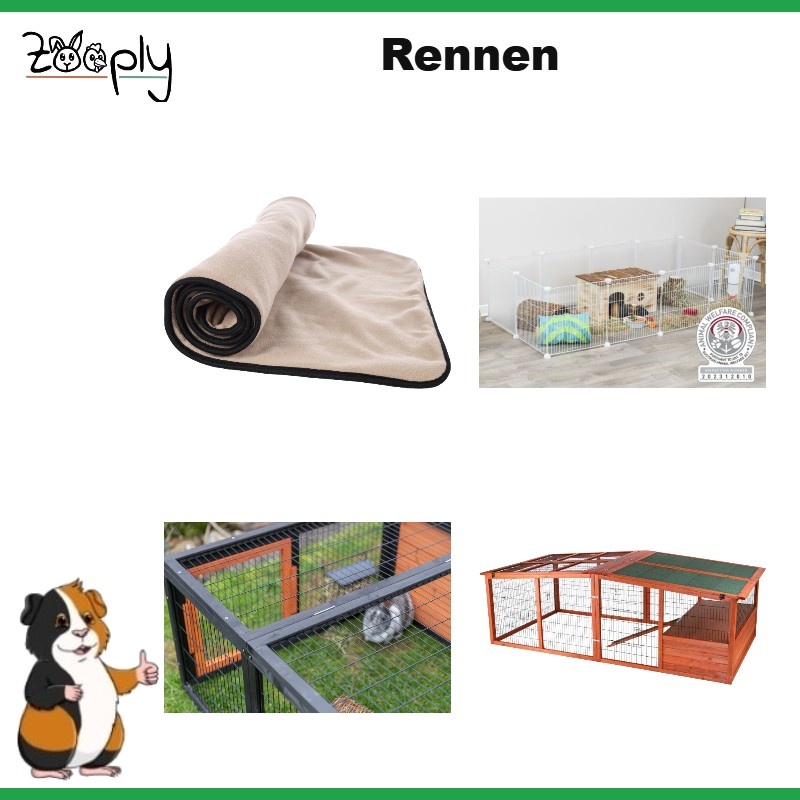
In this category you will find wooden and metal indoor runs, outdoor runs with a protective net or roof, an extendable guinea pig enclosure with separate panels and fleece blankets for the floor. For our own guinea pigs, every run has a spot with Zooply hay, our own premium brand. Guinea pigs eat all day long, even when they are pottering about.
In short
- ✓ Always put at least one hiding place per guinea pig in the run, plus hay and water.
- ✓ Outdoors: a run with a net or roof, never open, not even in a fenced garden.
- ✓ Place an outdoor run in the shade; guinea pigs cope badly with heat.
- ✓ Let guinea pigs that aren't used to fresh grass learn to eat it gradually.
- ✓ Guinea pigs don't jump high, but they do squeeze through gaps: check the bottom of the run.
What will you find in the Runs & Fencing category?
Wooden outdoor runs
The Trixie Natura run with cover XL (233 × 79 × 116 cm) is the largest run in this category, made of pine with a cover. You will also find a wooden outdoor run from Trixie measuring 174 × 48 × 109 cm in stained pine, and a wooden run with a house (150 × 53 × 150 cm, black/brown). The latter already has a built-in hiding place. Wooden runs feel sheltered and fit well in a garden.
Metal outdoor runs with net or roof
Trixie has a round metal play run with protective net (ø 150 × 57 cm, green) and a smaller round outdoor run with protective net (ø 116 × 38 cm). The net closes off the top. The metal run with roof (114 × 58 × 116 cm, grey) has a fixed cover. Metal runs are light, easy to move and handy for putting your guinea pigs on a different patch of grass every day.
Indoor runs
For indoors, there are two wooden runs from Trixie with four panels: one with panels of 50 × 60 cm and one with panels of 60 × 30 cm, made of untreated wood. A low run of 30 cm high is usually sufficient for guinea pigs, because they don't jump high. The Flamingo rodent run is a metal play run measuring 140 × 35 × 35 cm in black.
Extendable guinea pig enclosure with panels
The extendable guinea pig enclosure from Trixie (140 cm long, white) consists of separate panels. With the set of four extension elements (35 × 35 cm) you can make it bigger. A separate floor of 140 × 70 cm (grey/white) is also available for this enclosure, which protects the surface underneath from urine and bedding.
Fleece blankets
The fleece blankets from Flamingo come in 100 × 55 cm, 140 × 70 cm and 125 × 125 cm, in taupe. You put them on the bottom of an indoor run as a soft, non-slip surface, so guinea pigs don't slip on a smooth floor. A blanket is washable; guinea pigs also wee in a run, so keep a second blanket handy and wash them regularly.
Indoors: a run for daily exercise
An indoor run is the easiest way to give your guinea pigs extra space every day. Place it somewhere without draughts, out of the sun and not next to the radiator. Put a fleece blanket or a layer of bedding on the floor; on a smooth laminate or tiled floor, guinea pigs slip and are less willing to walk around.
Furnish the run with a few houses or tunnels, some hay and a bowl of water. Guinea pigs are prey animals and only walk around in a relaxed way when they know where they can hide. An empty, open run feels unsafe to a guinea pig. Place the hiding places along the edges; guinea pigs like to walk along a wall.
You can also place an indoor run directly against the indoor cage, with the cage door open. Then your guinea pigs decide for themselves when to come out. That way the run becomes a permanent part of their living space.
Outdoors: safe on the grass
An outdoor run on the grass is a treat for guinea pigs: they graze, potter about and lie in the sun or the shade. Still, being outdoors calls for extra attention. Cats, dogs, birds of prey, foxes and martens can attack a guinea pig, even in a garden that seems safe to you. So always use a run with a closed top, such as a net or a roof. Check that the bottom fits snugly against the ground; a guinea pig can crawl through a surprisingly small gap.
Place the run in the shade, and move it along as the sun moves. Guinea pigs cope badly with heat; above roughly 25 °C, it is better to keep them indoors or in a cool, shaded spot. Wet and cold weather isn't suitable either: guinea pigs can't cope with draughts, damp and frost. Always put a covered hiding place in the run, plus hay and water.
Fresh grass: build up slowly
Fresh grass is an excellent addition to the menu, but only if your guinea pigs are used to it. A guinea pig that has been indoors all winter and is suddenly out on the grass for an afternoon can get digestive problems. In spring, start with a quarter of an hour a day and build that up over one to two weeks. Only use grass that hasn't been sprayed or fertilised and where no dogs or cats come. Hay remains the basis outdoors too: always put Zooply hay in the run.
A run for the whole group
Guinea pigs should live at least in pairs, and for a group, a run is the place where the pecking order can play out calmly. Make sure there are more hiding places in the run than guinea pigs, and spread hay and vegetables over two or three spots. Then nobody has to wait and a calmer animal can always eat somewhere else. A house with two exits prevents a guinea pig from getting trapped when another one is chasing it.
A run on neutral territory is also handy if you want two guinea pigs to get used to each other. Neither of them then sees the space as its own territory. Put two houses, plenty of hay and some vegetables inside, and keep a close eye on the first meeting.
Cleaning
After each session in an indoor run, remove the droppings and wet bedding, and wash the fleece blanket regularly at a low temperature without strongly scented detergent. Move an outdoor run regularly to a different patch of grass, so the grass can recover and no muddy or dirty patches develop. Check wooden runs for rot, loose parts and sharp nails.
Handy combinations
With these products you complete the run:
- Houses: hiding places for in the run, at least one per guinea pig.
- Tunnels: safe walking routes and hiding spots along the edges.
- Hay: Zooply hay, always available in the run as well.
- Indoor cages: the permanent home base that you can place the run against.
- Outdoor hutches: a sheltered hutch in the garden with a run for exercise.
Frequently asked questions about runs for guinea pigs
How high should a run for guinea pigs be?
Guinea pigs don't jump high, so an indoor run of 30 to 35 cm high is usually sufficient. Outdoors, it isn't about the height but about the top: it must be closed with a net or roof, so predators and cats can't get in. An open run is never safe outdoors.
How long can guinea pigs stay in the run?
Indoors they can stay in it as long as you like, as long as there is hay, water and hiding places. If the run is connected to the cage, they can even be in it all day. Outdoors it depends on the weather: on a mild day with shade, a guinea pig can spend a large part of the day outside, but in heat, rain or cold you bring it indoors.
Can I leave my guinea pigs outside in the run when I'm not at home?
Only in a run that is fully enclosed, on all sides and at the top, with a fixed hiding place, hay, water and shade that lasts all day. The weather can change quickly. A run with only a net isn't suitable for leaving guinea pigs unsupervised for hours.
Is a fleece blanket a good floor covering?
In an indoor run, yes. Fleece is soft and non-slip, so guinea pigs don't slide around. It does absorb urine less well than bedding. Put some bedding or an extra layer on the regular wee corner, and wash the blanket regularly. Keep a second blanket ready for when the first is in the wash.
My guinea pigs hide in the run and won't come out. Is that normal?
At first, yes. A new space feels exciting to a guinea pig. Put enough hiding places in it, place some hay and a few pieces of vegetable along the edges, and give them time. After a few days, most guinea pigs start exploring the run by themselves.
Runs for guinea pigs at Knaagplaza
At Knaagplaza, the webshop of 't Knaagplein, you will find runs that give your guinea pigs safe extra space indoors and outdoors. Furnish the run with hiding places, water and Zooply hay, our own premium brand that we use every day for our own guinea pigs. That way your guinea pigs feel at home outside their regular hutch too.