



Buying a hamster cage: room to dig, run and hide
A hamster spends almost its whole life in its enclosure. That is where it sleeps, builds up its food store, digs tunnels and runs its rounds at night. So the hamster cage largely determines how your hamster feels. A cage with plenty of floor space and a deep base gives room for natural behaviour. A small or shallow cage is more likely to lead to restlessness, bar chewing and running back and forth along the wall.
In this category you will find enclosures for Syrian hamsters and dwarf hamsters: models with a glass or acrylic base, wooden enclosures with an acrylic front and cages with a deep base and bars above it. You will also find stands on wheels to place a Ferplast enclosure on. The cage itself is just the start. Only with a deep layer of bedding, such as the bedding from Zooply, our own brand, does it become a place where a hamster can really dig.
At a glance
- ✓ Choose based on floor space and the depth of the base, not on height or the number of levels.
- ✓ The bigger the cage, the better; for a Syrian hamster, preferably choose one of the larger models.
- ✓ Make sure a layer of bedding of at least about 20 cm fits in, preferably more.
- ✓ Always keep a Syrian hamster on its own; dwarf hamsters are also best kept alone.
- ✓ Put the cage in a quiet, draught-free spot, out of the sun and not in the bedroom.
What will you find in the Cages category?
Enclosures with a glass base
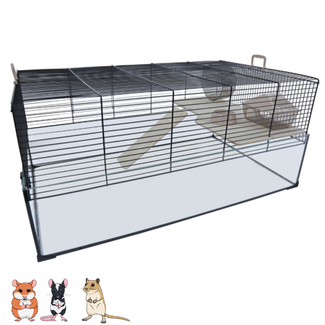
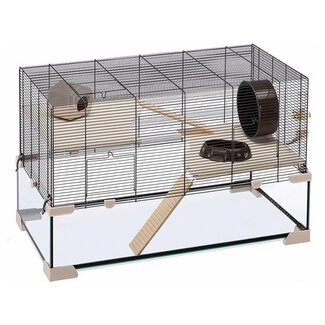
The small animal enclosure with a glass base, measuring 80 × 50 × 40 cm, is intended for hamsters, gerbils and mice. Glass gives a clear view of the tunnels your hamster digs along the side, does not scratch easily and is easy to keep clean. The Ferplast rodent cage with a glass base measures 78.5 × 45.5 × 52.5 cm and has a barred section above the base. Both enclosures are about 80 cm wide. That size suits a dwarf hamster better than an adult Syrian hamster.
Zolux enclosures on legs
The Zolux small animal enclosure on legs comes in black and in grey and measures 78 × 48 × 36 cm. Because it stands on legs, your hamster sits a little higher and you can see inside more easily. The enclosure is made for hamsters and mice. Here too: with a width of about 80 cm, it is mainly an enclosure for a dwarf hamster.
Trixie wooden enclosures with acrylic
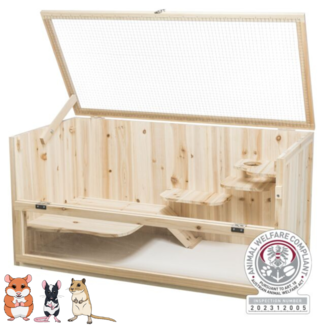
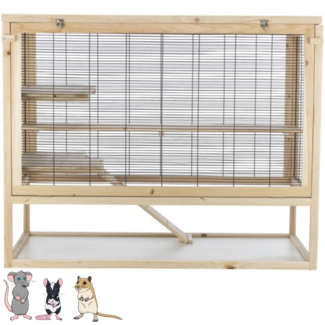
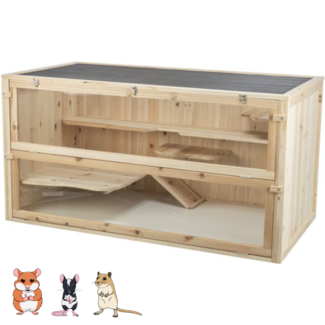
Trixie makes wooden enclosures with an acrylic front. The small animal enclosure with levels measures 100 × 50 × 50 cm and, according to the product information, is intended for Syrian hamsters, gerbils and mice. The spacious small animal enclosure with acrylic is the largest model in this category: 115 × 60 × 60 cm, made for Syrian hamsters and gerbils. A wooden enclosure does need some attention: keep moisture to a minimum, clean wet patches in good time and check that your hamster is not gnawing at edges or corners.
Ferplast cages with an acrylic base
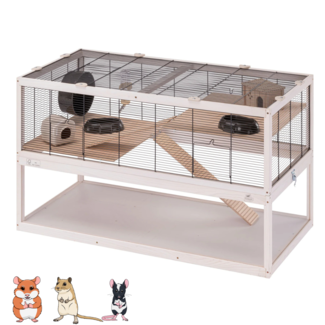
The Ferplast luxury rodent cages have a wooden frame with an acrylic base and come in two sizes: 100 × 61 × 50 cm and 120 × 61 × 52 cm. They are intended for hamsters, gerbils and mice and come with platforms and ladders. The 120 cm model is a good choice if you want to give a Syrian hamster plenty of room to run and dig.
Stands on wheels
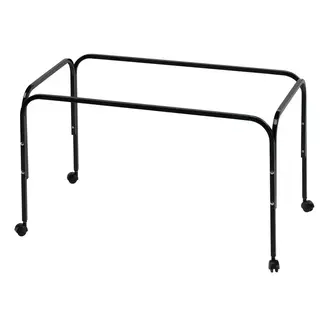
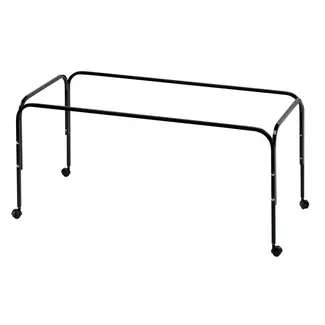
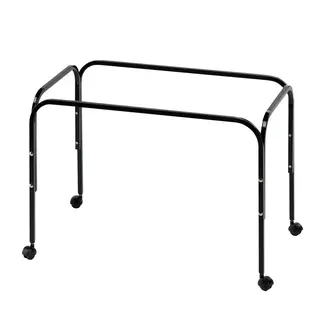
For the Ferplast enclosures there are stands on wheels in three sizes: for 80 cm enclosures (73.5 × 44 × 50 cm), 100 cm (91 × 53 × 49 cm) and 120 cm (114.5 × 53 × 49.2 cm). The enclosure then stands in a sturdy, higher position and you can easily roll it aside for cleaning.
What should you look for in a hamster cage?
Floor space comes before height
Hamsters mainly live on and under the ground. They run long routes, dig tunnels and build a nest deep under the bedding. Levels and platforms can be fun, but they do not replace floor space. So compare cages on the length and width of the floor. A cage from the shop is often the minimum; the more space you can provide, the better.
A deep base for bedding
A hamster wants to dig. For that it needs a layer of bedding of at least about 20 cm, and more is better. That is why a cage with a shallow base cannot be filled properly: the bedding is then pushed out through the bars. A glass or acrylic base keeps a deep layer in place better.
Safe and escape-proof
Hamsters are strong and resourceful. With a barred cage, check that the bar spacing is small enough, especially for a dwarf hamster, and that doors close properly. Do not place high platforms above a hard surface your hamster could fall onto; hamsters are poor at judging heights. A platform above a deep layer of bedding is safer.
Syrian hamster or dwarf hamster: which size fits?
A Syrian hamster is larger and needs more space than a dwarf hamster. Its wheel, houses and tunnels are also bigger, and they take up room. So for a Syrian hamster, preferably choose one of the larger enclosures in this category, such as the 115 cm Trixie or the 120 cm Ferplast. For a dwarf hamster, an enclosure of around 80 cm can be a starting point, but dwarf hamsters are active too and cover great distances at night. A bigger cage is just as welcome for them.
Always keep a Syrian hamster on its own: it is a solitary animal that does not tolerate others of its kind in its enclosure. Dwarf hamsters are also best kept alone, because keeping them together often leads to fights and injuries. So a second hamster means a second cage.
Setting up the hamster cage
Start with a deep layer of bedding. Zooply bedding comes in different types, such as hemp fibre, wood fibre, cotton fibre and coconut chips. Hemp fibre and wood fibre are low in dust and absorb moisture well. Mix some hay or safe nesting material through it: this gives the tunnels strength, so they are less likely to collapse.
Then put down at least one house, preferably one extra, and connect spots with tunnels. A wheel with a solid running surface belongs in every hamster cage: at least about 28 to 30 cm in diameter for a Syrian hamster and at least about 20 cm for a dwarf hamster, so the back stays straight. A sand bath with fine, low-dust bathing sand gives your hamster a place for coat care; many hamsters also use it as a toilet. Also provide a heavy food bowl and a water bottle or water bowl, and give chew wood and dried herbs or flowers for foraging and gnawing.
Where should you put the hamster cage?
Hamsters are crepuscular and nocturnal. They sleep during the day and are active in the evening and at night. Put the cage in a quiet room where your hamster is not disturbed during the day. The bedroom is not a good place: your hamster makes noise at night and you disturb its rhythm when you walk in and out during the day.
Choose a spot without draughts, not in full sun and not next to the radiator, the TV or speakers. A stable temperature and peace and quiet are important. Preferably do not put the cage directly on the floor, where it is colder and where other pets can easily reach it. A stand or a sturdy piece of furniture brings the cage to a comfortable height.
Cleaning without stress
Hamsters are strongly scent-oriented. If you empty the entire cage in one go, nothing smells familiar any more and the store your hamster has carefully built up disappears too. That causes stress. So mainly refresh the pee spots and the sand bath, remove perishable fresh food and leave the nest and the dry store alone as much as possible. If the cage does need a thorough clean, set aside some of the old, clean bedding and mix it back into the new layer.
Useful combinations
A cage only becomes a good hamster home with the right furnishings. These categories belong with it:
- Bedding: Zooply hemp fibre, wood fibre, cotton fibre and coconut chips for a deep digging layer.
- Nesting material: safe material for your hamster to line its nest chamber with.
- Wheels: a wheel with a solid running surface in the right diameter.
- Houses: hiding places made of wood, bark or coconut.
- Sand & Sand baths: a sand bath with fine bathing sand for coat care.
Frequently asked questions about hamster cages
How big should a hamster cage be?
As big as you can fit. Look mainly at the floor space and the depth of the base. A Syrian hamster needs more space than a dwarf hamster, because it is bigger and has bigger accessories. So for a Syrian hamster, choose one of the larger models, for example 100 cm or wider. A cage from the shop is often the minimum; extra space is always better.
Is an enclosure with a glass base better than a barred cage?
Both can work well. A glass or acrylic base keeps a deep layer of bedding inside and lets you see your hamster digging its tunnels. A barred section on top gives extra ventilation. With bars, check for small bar spacing and watch for bar chewing. More important than the material is that there is enough floor space and room for a deep layer of bedding.
My hamster chews the bars. What can I do?
Bar chewing is often a sign of boredom or stress. Check whether the cage is roomy enough, whether there is a deep layer of bedding to dig in and whether there are enough hiding places. A wheel that is too small or runs poorly can also play a part. In addition, give chew wood and hide food in the bedding, so your hamster has more to do.
Can I keep two hamsters in one cage?
Syrian hamsters never: they are solitary and fight with others of their kind. Dwarf hamsters are also best kept alone, because keeping them together often ends in fights, sometimes only after months. If you have two hamsters, give each its own cage.
How often should I clean the hamster cage?
Refresh wet patches and the sand bath a few times a week and remove perishable food daily. Leave the nest and the dry store alone as much as possible. Only do a big clean when it is really necessary, and then mix some of the old, clean bedding back in, so the cage keeps smelling familiar.
Buying a hamster cage at Knaagplaza
At Knaagplaza, the webshop of 't Knaagplein, you choose a hamster cage together with everything to furnish it. Combine the enclosure with a deep layer of Zooply bedding, our own premium brand that we use every day for our own animals in the shop and breeding facility. With a suitable wheel, houses and a sand bath, you create an enclosure where your hamster can dig, run and sleep peacefully.