


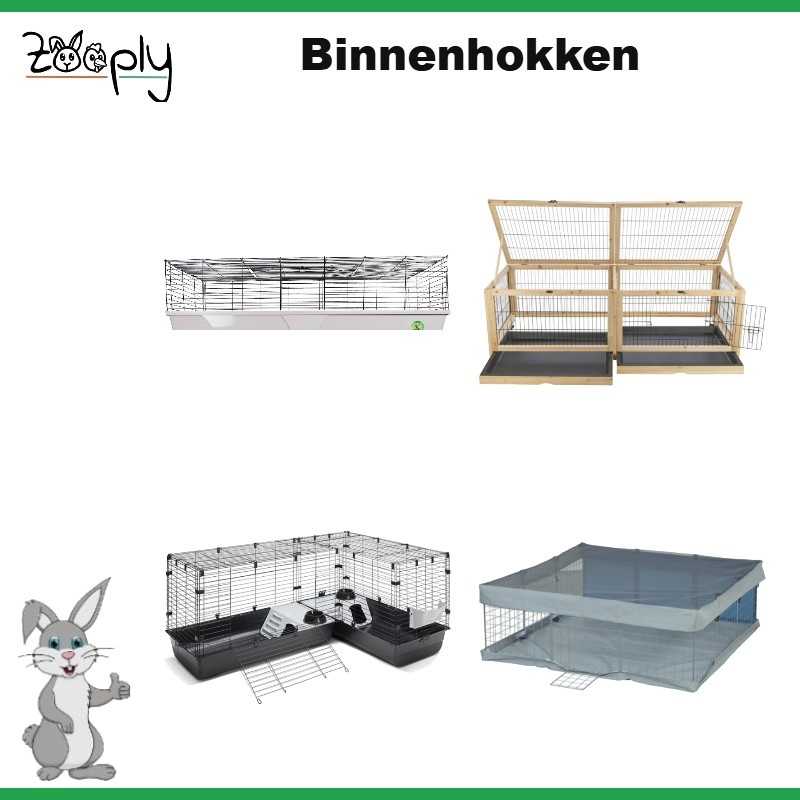
Indoor cage for rabbits: a safe base in the home
More and more rabbits live indoors. That has its advantages: you see your rabbit every day, you quickly notice when something is not right and your rabbit is protected from heat, frost and predators. An indoor cage is the fixed base. That is where the hay, water, litter tray and a hiding place are, and where your rabbit can sit safely when you are not keeping an eye on it. It is a base, though, and not a complete living space. A rabbit wants to run, jump, stand up on its hind legs and stretch out, and therefore needs plenty of free-roaming time every day.
In this category you will find indoor cages with a plastic base, wooden enclosures, open enclosures that you can expand with panels and handy accessories such as an extension set and a stand on wheels. Furnish the cage with low-dust bedding, a hay rack full of Zooply hay and a food bowl with Zooply Rabbit Food, just as we do with our own rabbits.
In short
- ✓ The bigger, the better: a shop-bought cage is often the minimum base, not a complete living area.
- ✓ Your rabbit must be able to lie stretched out in the cage, take a few hops and sit upright.
- ✓ Rabbits live in pairs at the very least: choose the cage based on space for both rabbits.
- ✓ Give plenty of free-roaming time every day in a run or a rabbit-proof room.
- ✓ Place the cage out of draughts, not in full sun and not next to a radiator, TV or speakers.
What will you find in the Indoor Hutches & Cages category?
Cages with a plastic base
A classic indoor cage consists of a plastic base with a metal wire top. The base keeps bedding and hay inside and is easy to clean. Ferplast offers two spacious cages: 142 × 60 × 50 cm and 162 × 60 × 50 cm, with a red base. There are also grey-black cages of 120 × 60 × 40 cm and 140 × 70 × 45 cm. Pay attention to the height of these cages: in a cage 40 to 50 cm high a dwarf rabbit can sit upright, but a larger rabbit often cannot. For larger breeds, choose a taller or open enclosure.
Expandable and open enclosures
The flexible rabbit and guinea pig enclosures from Ferplast measure 144 × 72 × 56 cm (just over 1 m² of floor space) and 179 × 72 × 56 cm (1.3 m²). With the Modular extension set (40 × 72 × 56 cm) you can make them longer. According to the product information, the Ferplast enclosure of 140.5 × 140.5 × 59.5 cm offers about 2 m² and has little ramps for access. Savic has a corner enclosure of 148 × 50 × 63.5 cm and an enclosure of 200 × 50 × 63.5 cm. The Zolux Neopark for rabbits (140 × 105 × 70 cm) is made of panels, so you can adapt the enclosure to the space you have. These enclosures offer more floor space than a classic cage and are therefore a better fit for a pair of rabbits.
Wooden indoor enclosures
The large wooden hutch on wheels from Trixie (150 × 50 × 60 cm) is easy to move, for example to clean underneath it. The wooden enclosure from Ferplast (129 × 70 × 104.5 cm) is made of pine in a pastel colour and, thanks to its height, offers more usable space. Wooden enclosures look lovely in your interior, but rabbits gnaw on wood; check edges and corners regularly and provide enough gnawing material.
Accessories
According to the product information, the Ferplast stand on wheels (114.5 × 53 × 49.2 cm) is made for 120 cm Ferplast enclosures. It puts the cage at a comfortable working height and lets you wheel it aside easily.
How big should an indoor cage be?
The honest answer: as big as you can fit. In its cage, a rabbit must at the very least be able to lie stretched out, turn around, make a few hops in a row and sit upright without its ears touching the roof. There also needs to be space for a litter tray, a hay rack, a food bowl, water and a hide. With two rabbits, and rabbits belong in pairs, you will soon need a large cage.
That is why many rabbit owners choose an open enclosure or an expandable system instead of a classic cage, or leave the cage door open to a run or a rabbit-proof room. The cage is then the bedroom and kitchen, and the run or room is the play area. The more space, the more natural behaviour you will see.
Classic cage or open enclosure?
A classic cage with a base and bars has a roof and a closed bottom. The bedding stays neatly inside, you can close the cage when visitors or a dog are in the house, and it takes up relatively little space. The downside is the limited height and the smaller floor area.
An open or expandable enclosure gives more floor space and can grow with what you need. Your rabbit can move around more in it and you can easily reach in to clean or cuddle. Do watch the height of the walls, though: some rabbits jump straight over them. If you have cats or dogs, check that the enclosure is sufficiently closed and sturdy, or choose a model with a lockable roof.
Where do you put the indoor cage?
Choose a spot that is quiet but where your rabbit can still follow family life, for example in a corner of the living room. Not in the draught from a door or window, not in full sun behind glass and not next to the radiator. Rabbits have sensitive ears: do not put the cage next to the TV or speakers. A bedroom is less suitable, because rabbits are mainly active at dusk and at night and you will hear them then.
Ideally, place a cage slightly raised, for example on a stand, or open it up so your rabbit can walk in and out by itself. A rabbit feels uncomfortable if you keep reaching in from above; an opening at the side or front is more pleasant.
Furnishing the indoor cage
Put a layer of low-dust, absorbent bedding on the floor, such as hemp or wood fibre. Place a litter tray with litter pellets in a corner and hang the hay rack above it or next to it: many rabbits eat hay while sitting on the toilet, and become litter trained more quickly that way. Further along, place a heavy food bowl and a water bottle or drinking bowl, and a house as a hiding place. On a plastic floor or wire, cover part of it with a soft mat or extra hay, so your rabbit does not sit on a hard surface all day.
Cleaning
Clean the litter tray every few days and replace the bedding at least once a week, more often if needed. Refresh hay and water daily. Once a week, clean the base thoroughly with warm water and let everything dry. An indoor cage that smells of ammonia is not being cleaned often enough; that smell is bad for your rabbit's airways.
Useful combinations
An indoor cage becomes a lovely home with the right furnishings and extra space:
- Runs: extra space to move, to connect to the cage or set up separately.
- Bedding: low-dust and absorbent for a dry floor.
- Litter Pellets & Corner Litter Trays: a fixed toilet spot in the cage.
- Hay racks: for unlimited, clean Zooply hay.
- Houses: a hiding place in the cage.
Frequently asked questions about indoor cages for rabbits
Is an indoor cage enough space for a rabbit?
No, not as its only living space. An indoor cage is the base for eating, sleeping and going to the toilet. On top of that, a rabbit needs plenty of free-roaming time every day to run and jump, in a run or a rabbit-proof room. The more hours a day, the better. An open enclosure with a lot of floor space can partly make up for that.
Which indoor cage suits two rabbits?
Choose the largest enclosure you can fit, preferably with more than 1 m² of floor space, such as the Ferplast enclosures of 179 × 72 cm or 140.5 × 140.5 cm, or a Zolux Neopark. Put two hiding places in it and provide daily free-roaming time. A classic 120 cm cage is too small for a pair as a permanent living space.
Can my rabbit be litter trained indoors?
Most rabbits can. They choose a fixed spot to pee themselves, usually in a corner. Put a litter tray with litter pellets there with hay above it, and put droppings you find elsewhere into the tray. Neutered rabbits are often easier to litter train. Do not use clumping cat litter.
How do I make a room rabbit-proof?
Remove cables or protect them with cable covers, because rabbits gnaw on them. Put poisonous houseplants up high or out of the room, shield skirting boards and furniture legs if your rabbit gnaws on them, and close off gaps behind cupboards. Give your rabbit its own hay spot, toilet and hiding place in the room, and it will often stay close to them naturally.
Can an indoor rabbit also go outside?
Yes, in a safe run at a good time of day. Do let your rabbit get used to fresh grass and the outdoor temperature gradually, and never place the run in full sun. You cannot simply move an indoor rabbit outside in winter, because it has not grown a winter coat.
Buying indoor cages at Knaagplaza
At Knaagplaza, the webshop of 't Knaagplein, you will find indoor cages and expandable enclosures for rabbits. Choose the most spacious size that fits and furnish the cage with unlimited Zooply hay and Zooply Rabbit Food, our own premium brand that we use every day with our own rabbits. With daily free-roaming time on top, your rabbit will have a lovely home indoors.