






Nesting material for hamsters: a warm, safe bed
A hamster sleeps during the day in a nest it builds itself. Ideally, that nest is deep underground, in a chamber at the end of a tunnel, or in a house that is stuffed completely full. In the evening you will often see your hamster running back and forth with cheek pouches full of nesting material. It pulls it apart, carries it to its sleeping spot and shapes it into a ball. That building is natural behaviour and a sign that your hamster feels at home.
In this category you will find Zooply Nesting Material, from our own premium brand, and kapok from Trixie. We use Zooply every day with the hamsters in our shop and breeding facility. It is a small range: you do not need much to let your hamster build a good nest.
In short
- ✓ Give nesting material made of natural fibres that your hamster can drag around and work with itself; no synthetic cotton wool.
- ✓ According to the product information, one to two handfuls is enough for a hamster nest.
- ✓ Put it loose in or next to the house; your hamster does the building itself.
- ✓ Disturb the nest as little as possible and only remove wet or dirty parts.
- ✓ Combine nesting material with a thick layer of bedding, so your hamster can sleep underground.
What will you find in the Nesting material category?
Zooply Nesting Material
Zooply Nesting Material is soft, warm and airy material with which your hamster builds its own cosy nest. According to the product information, it is soft enough not to constrict or tangle, light enough to drag around easily and safe to gnaw on, without harmful additives. Hamsters and mice are the busiest with it, but other small rodents also use it for extra comfort. You can choose a 3 litre bag, which lasts a long time for one hamster, or 10 litres if you have several enclosures.
Kapok from Trixie
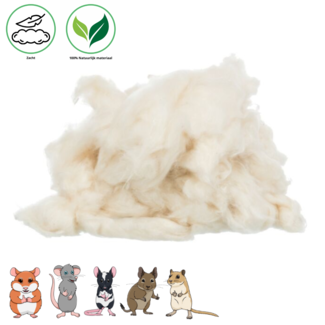
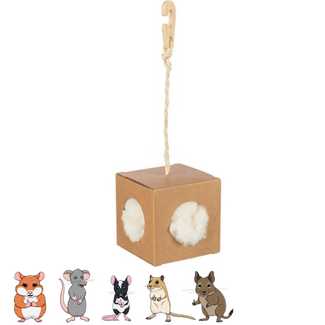
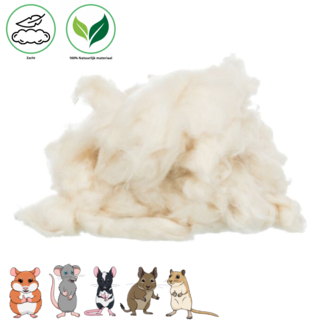
Kapok is a natural fibre from the fruit of the kapok tree. It has a soft, cotton-like texture and is light and springy. Trixie supplies kapok loose in bags of 40 grams and 100 grams and as Kapok in a box of 9 × 9 × 9 cm. You put that box in the enclosure: your hamster pulls the kapok out itself and may then gnaw up the box too. Give kapok in small tufts, so your hamster can easily divide it up.
Why a good nest is so important
A hamster is a prey animal and a nocturnal animal. During the day it sleeps, and then it wants to lie safely and undisturbed. A good nest provides shelter, retains warmth and protects against light and noise. A hamster with a nice nest is usually calmer, startles less easily and dares to explore its enclosure sooner in the evening.
The nest is also where your hamster keeps its food store. Often the store is right next to or even inside the nest. That is normal and how it should be.
Choosing safe nesting material
Not everything that is soft is suitable. Synthetic cotton wool and synthetic nesting wool consist of long, strong threads. A hamster can get a foot tangled in them, and a thread can cut off the circulation to a foot. So only give nesting material made of natural fibres or special rodent nesting material designed with this in mind. Unscented paper, hay and hemp are also safe alternatives.
Also pay attention to scent and dust. Hamsters sleep with their noses in the nest. Scented or dusty material does not belong there. Choose natural, undyed material without added fragrance. Cotton wool from the first-aid box or pieces of fabric are not a good idea either: the fibres are too long or can fray.
How do you give nesting material?
Put a handful of nesting material loose in the enclosure, in or next to the house or at the entrance to a tunnel. You do not need to build the nest yourself. Your hamster knows exactly how it wants it. It plucks the material into smaller pieces, carries it in its cheek pouches and works it into its own spot. Ideally do this in the evening, when your hamster is awake.
Do not give too much at once. A pile of nesting material that is too large becomes messy and can hold moisture. According to the Zooply product information, one to two handfuls is enough for most hamsters. If you notice that everything has disappeared within one night and your hamster is still searching, add a little more.
Nesting material and bedding
A hamster prefers to build its nest underground. For that it needs a thick layer of bedding, at least about 20 centimetres. In a layer like that, it digs a tunnel to a bedroom and stuffs it full of nesting material. Also mix some hay through the bedding: it makes the tunnels sturdier and doubles as extra nesting material. If the layer is too thin, your hamster will build its nest in a house or in a corner, and will be less sheltered.
A house or hide with several chambers is a good addition. Many hamsters use a house as an entrance to their underground nest, or build a second nest in it. Make sure there is at least one hiding place and preferably an extra one, so your hamster can choose.
Keeping the nest clean without disturbing it
The nest is your hamster's most personal place. The less you touch it, the better. Do not keep looking in the house or the tunnels and do not wake your hamster during the day. Do check now and then that the nest is dry. A hamster normally does not pee in its nest, but with a sick or old animal it can happen. Fresh food from the store can also go mouldy.
If you do need to remove something, do it in the evening when your hamster is awake and out of the nest. Only remove wet, dirty or mouldy parts and leave the rest. During a bigger clean of the enclosure, put back part of the old, clean nesting material. That way the familiar smell stays and your hamster will carry on building sooner.
Nesting material in cold periods
In winter, or in a cool room, hamsters often build a thicker nest. Give a little extra nesting material then, so your hamster can decide for itself how warm it lies. Keep the room where the enclosure stands at a normal room temperature and place the enclosure out of draughts, not by an open window or outside door. Hamsters can go into a kind of hibernation in the cold. If your hamster feels cold and hardly responds, calmly move it to a warmer room and contact a vet with experience of rodents.
A good nest also helps in warm weather. Underground and in a thick nest, the temperature stays more even. Never place the enclosure in full sun.
Syrian hamster and dwarf hamster
Both Syrian hamsters and dwarf hamsters build a nest. A Syrian hamster often makes one large nest with a sizeable store. Dwarf hamsters sometimes build several smaller nests spread throughout the enclosure. With dwarf hamsters it is therefore extra handy to put a tuft of nesting material in a few places. Also always keep in mind that hamsters live solitary lives: each hamster has its own enclosure and its own nest.
Useful combinations
A good nest starts with the right foundation. These categories go with it:
- Bedding: Zooply bedding for a thick layer in which your hamster digs an underground nest chamber.
- Houses: a hiding place your hamster can stuff full of nesting material.
- Dried flowers & grasses: natural stalks and flowers that your hamster also works into its nest.
- Tunnels: a sheltered route to the nest.
Frequently asked questions about nesting material for hamsters
Does my hamster really need nesting material?
Yes. A hamster wants to build a nest, even if it has a house. Without suitable material it will get to work with whatever is there, such as bedding or pieces of cardboard. With soft nesting material it can make a warmer and sturdier nest, and that brings calm.
Why not ordinary cotton wool?
Cotton wool and synthetic nesting wool consist of long, strong threads. A hamster can get tangled in them and a thread can cut off the circulation to a foot. So choose nesting material made of natural fibres or material made especially for rodents, such as Zooply Nesting Material.
How often should I give new nesting material?
Only when it is needed. Top up if you see your hamster searching for material or if you have removed wet or dirty parts. According to the product information, you usually replace nesting material at the same time as the rest of the bedding, once it is dirty or damp.
My hamster doesn't use the nesting material. Is that a problem?
Not always. Some hamsters prefer to make a nest of hay, leaves or finely gnawed cardboard. Try putting the nesting material in a different spot, closer to the entrance of its tunnel or house. As long as your hamster has a dry, warm nest, the material matters less.
Can I open the nest to check that everything is all right?
Better not. Every time you open the nest, your hamster gets stressed and has to rebuild. If you want to check whether your hamster is healthy, look in the evening when it is awake: is it eating, moving normally and is its coat clean? If in doubt, contact a vet with experience of rodents.
Can I mix kapok and Zooply Nesting Material?
You can. Your hamster decides for itself what it uses where. Give a little of both and see which it prefers to take. That way you get to know its preferences.
Buying nesting material at Knaagplaza
At Knaagplaza, the webshop of 't Knaagplein, you will find safe nesting material for your hamster, with Zooply Nesting Material leading the way. Zooply is our own premium brand and we use it every day with our own hamsters. Combine it with a thick layer of Zooply bedding and a good house, and your hamster will build the warmest bed in the enclosure all by itself.