


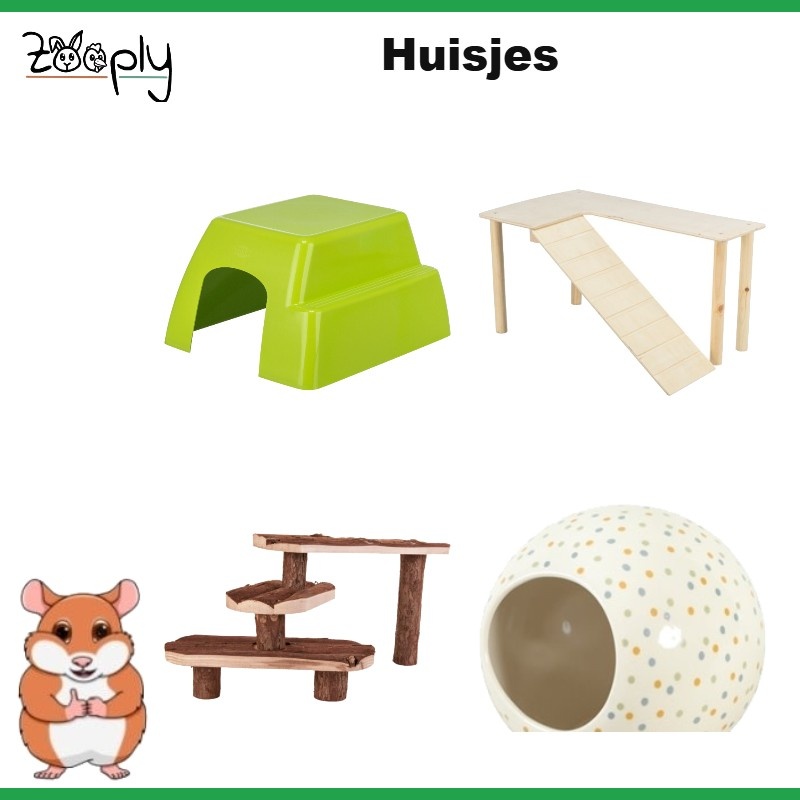
Hamster house: a safe place to sleep and hide
A hamster sleeps during the day and wants to do so in a place where it feels safe. In the wild, that is a burrow underground. In the enclosure, a hamster house takes over that role: a dark, sheltered place to sleep, build a nest and keep a food store. Hamsters are prey animals. Without a hiding place they stay tense, and a tense hamster sleeps worse and startles more easily.
In this category you will find houses in many shapes and sizes: from simple bark hiding places and wooden houses to a multi-chamber house, coconuts, soft sleeping houses and a ceramic house. A house works best in a thick layer of bedding with safe nesting material. For that, we ourselves use the bedding and nesting material from Zooply, our own brand.
In short
- ✓ Provide at least one house per hamster, and preferably an extra hiding place elsewhere in the cage.
- ✓ Choose the size to suit the species: smaller houses for dwarf hamsters, bigger ones for Syrian hamsters.
- ✓ Choose houses without a floor, or place them in a thick layer of bedding, so your hamster can dig underneath.
- ✓ Use untreated, natural materials and replace a house when it has been gnawed to pieces.
- ✓ Leave the nest alone as much as possible; only remove wet patches and perishable food.
What will you find in the Houses category?
Hiding places made of bark, birch and coconut
The simplest houses are often the best: a semicircular bark rodent house in 15 cm for hamsters and mice or in 25 cm for Syrian hamsters, an oval bark house of 17 cm and a round birch house with a diameter of 10 cm. They have no floor, so your hamster can dig straight underneath. The coconut with a hole from Happy Pet (12 × 11 × 11 cm) is also a natural hiding place that you can half bury in the bedding.
Wooden houses and bark houses from Trixie
Trixie makes a large number of houses from wood and bark. For dwarf hamsters there are, among others, the wooden house with pointed roof (15 × 11 × 15 cm), the Hendrik house (14 × 11 × 11 cm), the Jesper corner house in the small size (21 × 10 × 15 cm), the Finn house with a little staircase and the Thordis house with two little staircases. Slightly roomier are the Hendrik house (20 × 12 × 17 cm), the Jerrik log cabin, the Levin train and the Mette house. For Syrian hamsters the larger models are suitable, such as the Jesper corner house in the large size (30 × 13 × 21 cm), the Jule house (25 × 21 × 18 cm) and the Henna house (27 × 21 × 15 cm). The Dolly corner house from Giga Mouse (32 × 13 × 21 cm) is also made for Syrian hamsters. A corner house fits exactly into a corner of the enclosure and takes up little space.
Multi-chamber house
The multi-chamber house from Trixie (25 × 10 × 25 cm) has three interconnected chambers. It imitates an underground burrow. You bury it in the bedding, so your hamster has a nest chamber, a storage chamber and an extra room. Many hamsters find this a nice place to sleep, because it resembles what they would dig underground themselves.
Houses with levels and play houses
The Matti play house (a castle), the Tammo play house with three levels and the Ida house with two levels and a swing combine a hiding place with climbing opportunities. The bark play maze, the coconut houses with rope ladder or hanging bridge, the flexible staircase, the shelters and the platform with stairs from Trixie are also in this category. They make the enclosure more varied, but are mainly climbing and play elements. Always place them above a thick layer of bedding: hamsters are poor at judging heights and sometimes fall off a ledge.
Soft sleeping houses
Flamingo makes soft houses, such as the Clavio igloo and sleeping houses shaped like a pumpkin, pineapple or apple, all about 13 to 15 cm in size. They are cosy and warm. Do check them regularly, though: if your hamster gnaws loose bits of fabric, remove the house, because loose threads can wrap around little feet.
Edible house and ceramic house
The JR Farm hay house with carrot (75 grams) is a house made of hay with a carrot roof, to hide in and nibble on. Because of the carrot, it is less suitable for dwarf hamsters, as they are sensitive to sugar. The ceramic hamster house with dots from Zolux is heavy, doesn't tip over and is easy to clean. Ceramic feels cool, which can be pleasant on hot days.
Which size house suits your hamster?
A house must be big enough to turn around in, curl up and build a nest. The entrance must be roomy enough for your hamster to pass through effortlessly with cheek pouches full of food. A Syrian hamster therefore needs a clearly bigger house than a dwarf hamster. Too small means your hamster won't sleep in it, or that it could get stuck in the opening.
If you are in doubt between two sizes, choose the bigger one. A dwarf hamster usually doesn't mind a roomier house, as long as it is dark and sheltered. A Syrian hamster in a house that is too small will quickly look for another spot. Check the dimensions and the species mentioned for each product.
Where do you put the hamster house?
Place the house along a wall or in a corner, not in the middle of an open space. Hamsters like to walk along edges and feel safer there. Choose a spot in the part of the cage where the bedding is thickest, so your hamster can continue digging from the house. You can also partly bury the house: then it feels even more like a burrow.
Don't put the house directly under the water bottle, so the nest stays dry, and not in the spot where your hamster wees. Many hamsters use the sand bath as a toilet, so place the sand bath at a distance from the house. Your hamster will also use houses with a flat roof as a lookout post. Don't place them so close to the edge or the lid that they become a stepping stone to the outside.
More than one hiding place
One house is the basis, but a second hiding place makes the enclosure calmer. Your hamster can then choose where it sleeps, and always has a place to run to if it gets startled. Connect the spots with tunnels or let them be connected by the tunnels your hamster digs itself. This creates a network of safe routes, just like underground.
It may happen that your hamster doesn't sleep in the house at all, but digs its own nest under the bedding. That is normal and even a good sign: it means the layer is thick enough. The house then serves as an entrance, storage chamber or extra hiding place.
Care and replacement
Hamsters drag food to their nest and build up a store there. That is part of their natural behaviour. Remove perishable fresh food, but leave the dry store and the nest in place. If you keep tidying up the house and the store, your hamster will become stressed.
If your hamster does wee in the house, remove the wet material and let the house dry thoroughly before you put it back. Wood and bark absorb moisture; replace a house that keeps smelling musty. If your hamster gnaws pieces off the house, that is normal: teeth keep growing throughout life. Replace the house when it is so damaged that it no longer stands firmly or has sharp edges, and also provide gnawing wood as a permanent gnawing spot.
Handy combinations
A house only really comes into its own with the right furnishings around it:
- Bedding: Zooply bedding in a thick layer, so your hamster can dig under and around the house.
- Nesting materials: Zooply Nesting Material with which your hamster lines its bedroom.
- Tunnels: connect the hiding places with safe routes.
- Hamster scaping: cork, roots and branches for natural furnishing around the house.
- Gnawing wood: so your hamster gnaws mainly on that and less on its house.
Frequently asked questions about hamster houses
How many houses does a hamster need?
At least one, and preferably an extra hiding place elsewhere in the cage. With two or more hiding places, your hamster can choose where it sleeps and always has a safe place nearby. A tunnel or a piece of cork can serve as a second hiding place. If you keep several hamsters, each hamster has its own cage with its own houses.
My hamster doesn't sleep in its house. Is that a problem?
No. Many hamsters prefer to dig their own nest under the bedding. That is natural behaviour and shows that the layer is thick enough. Your hamster may then use the house as a storage chamber or an extra hiding place. Make sure there is enough nesting material, so it can line its nest properly.
Is a house with a floor bad?
Not bad, but less practical. In a house without a floor, your hamster can dig straight down and continue its nest underground. With a house with a floor, that isn't possible. In that case, place such a house in a thick layer of bedding and also give your hamster a hiding place without a floor.
Are soft sleeping houses allowed in the hamster cage?
Yes, as long as you keep an eye on them. Soft houses are warm and cosy, but some hamsters gnaw bits of fabric out of them. Loose threads can wrap around little feet. If you see your hamster gnawing at the house or threads coming loose, remove it and choose a house made of wood, bark or ceramic.
Can I give the hay house with carrot to any hamster?
For Syrian hamsters it is fine now and then, as a hiding place and to nibble on. Dwarf hamsters, especially the Campbell's and the Russian dwarf hamster, are sensitive to sugar. For them, it is better to choose a house without carrot or other sweet parts. If in doubt, give a bark house or a coconut.
How often do I clean the house?
As little as possible. Remove wet patches and perishable food, but leave the nest and the dry store in place. Only do a thorough clean if the house is really dirty or smells musty. Then let it dry thoroughly and put back some old, clean nesting material, so it smells familiar.
Hamster houses at Knaagplaza
At Knaagplaza, the webshop of 't Knaagplein, you will find hamster houses for Syrian hamsters and dwarf hamsters, from simple hiding places to multi-chamber houses. Combine them with Zooply bedding and Zooply Nesting Material, our own premium brand that we use every day for our own animals in the shop and the breeding facility. That way you give your hamster an enclosure in which it can sleep peacefully during the day.