







Hamster tunnels: safe routes through the enclosure
In nature, a hamster lives in a system of burrows underground. It does not like running across open ground, but moves from hiding place to hiding place. Tunnels give your hamster those safe routes in the enclosure too. It can dive into them when startled, run through them, hide food in them and even sleep in them. An enclosure with a few well-placed tunnels feels safer to a hamster and gets used more.
In this category you will find tunnels made of bark wood, willow, cork, plastic and soft fabric, an underground tunnel and a multi-chamber house to bury, and a few bridges and corner pieces. Tunnels work best in combination with a thick layer of bedding, in which your hamster also digs its own tunnels. For that, we use the bedding from Zooply, our own brand.
In short
- ✓ Choose the diameter to suit the species: narrow tunnels for dwarf hamsters, wider ones for Syrian hamsters.
- ✓ Place tunnels along the walls and connect them to houses, the sand bath and the feeding spot.
- ✓ Bury tunnels halfway into the bedding; that way they feel like a real burrow.
- ✓ Natural materials such as willow, cork and bark may be gnawed; replace them once they are broken.
- ✓ Check soft tunnels regularly for loose threads.
What will you find in the Tunnels category?
Bark wood tunnels
The Trixie bark wood tunnels have a diameter of 7 cm and come in lengths of 20 and 30 cm. They are made of alder wood with the bark still on. With that narrow passage, they are best suited to dwarf hamsters. The short bark wood tunnel with holes (15 × 5 cm) is also made for small rodents such as dwarf hamsters and mice. The bark wood maze toy (35 × 11 × 25 cm) is a labyrinth with several passages and exits for your hamster to search around in.
Willow tunnels and corner pieces
Trixie willow tunnels are woven from willow rods. They come in ø 10 × 25 cm, ø 15 × 33 cm and ø 20 × 38 cm. Willow is a safe gnawing material, and because the tunnels are flexible, you can lay them in a curve or bury them halfway. The smallest size suits dwarf hamsters well, the middle size Syrian hamsters. You place the willow corner pieces (20 × 10 × 13 cm and 30 × 20 × 20 cm) in a corner of the enclosure as a screened-off hiding place.
Cork tunnels
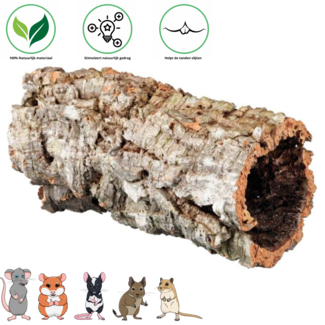
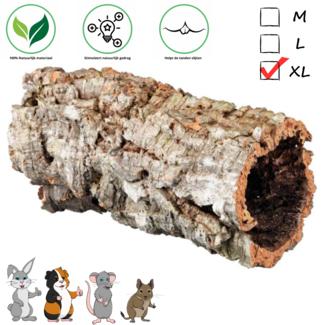
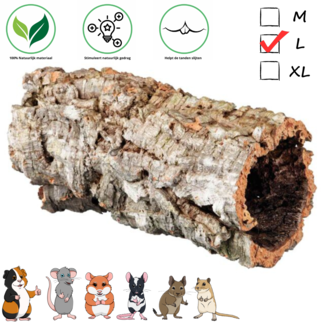
Trixie cork tunnels are made of 100% natural cork. Each tunnel is unique in shape and size. You can choose from tunnels up to ø 14 × 40 cm, up to ø 19 × 55 cm and up to ø 30 × 75 cm. Cork is light, sturdy and lovely to gnaw on. It is also an attractive element for a natural setup. The largest size is mainly intended for guinea pigs; for a hamster it is mainly suitable in a large enclosure, for example buried halfway as a covered digging spot.
Underground tunnel and multi-chamber house
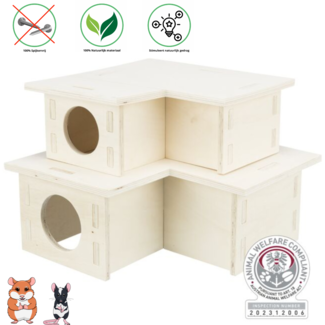
You bury the Trixie underground tunnel (36 × 17 cm) in the bedding. That gives your hamster a sturdy underground passage that does not collapse, with entrances above the surface. The multi-chamber house with three rooms (25 × 10 × 25 cm) works the same way: an underground burrow with a nest chamber and space for a food store.
Plastic and soft tunnels
The Trixie extendable play tunnel is made of plastic, has a diameter of 10 cm and extends from 19 to 75 cm. You can lay it in a curve and rinse it off easily. The soft Clavio play tunnel from Flamingo (25 × 6 × 6 cm) is made of padded fabric and can be hand washed. With a diameter of 6 cm it suits dwarf hamsters. The Trixie Relax tunnel (ø 15 × 35 cm) has a plush lining and is mainly made for guinea pigs. Check fabric tunnels regularly: if your hamster gnaws threads out of it, remove the tunnel.
Bridges
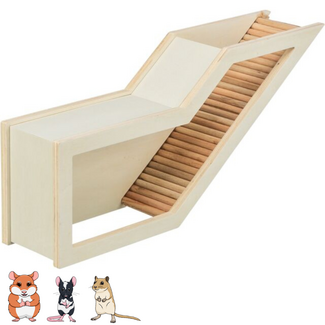
You set up the flexible wooden bridges from Trixie (22 × 10 cm and 28 × 17 cm) as an arch: a small covered hiding place or a bridge over a patch of floor. The rainbow play bridge (14 × 8 × 7 cm) is a small coloured wooden bridge. The Trixie bridge with vegetables and nuts (135 grams) is an edible bridge. For dwarf hamsters, it is better to choose a bridge without pieces of vegetable or fruit, because they are sensitive to sugar.
Which tunnel suits your hamster?
A tunnel must be wide enough to walk through effortlessly, even with full cheek pouches, and to turn around in. Too narrow carries the risk of your hamster getting stuck. Too wide is not dangerous, but feels less sheltered. Narrow tunnels work for dwarf hamsters, such as the ø 7 cm bark wood tunnels and the small willow tunnel. Syrian hamsters are bigger: choose wider tunnels for them, such as the ø 15 cm willow tunnel, the cork tunnels or the ø 10 cm extendable tunnel.
Also pay attention to the material. Willow, cork and bark wood are natural and may be gnawed. That is part of it: a hamster's teeth keep growing throughout its life. Plastic is easy to clean, but if you see your hamster gnawing bits off it, replace it with a tunnel made of natural material.
Placing tunnels cleverly
Hamsters like to walk along edges. So place tunnels along the walls of the enclosure, not in the middle of an open area. Connect the important spots: the house, the feeding spot, the sand bath and the wheel. That way your hamster can get from place to place without having to cross open ground.
Bury tunnels partly in the bedding. A half-buried cork or willow tunnel feels like a real burrow and is a good starting point for your hamster to carry on digging by itself. In a thick layer of bedding of at least about 20 cm, mixed with some hay, the tunnels hold their shape better. Do not place a tunnel where your hamster pees, usually the sand bath or a fixed corner, because it will quickly get dirty and damp.
Tunnels as enrichment
Tunnels are more than a passageway. Hide a few pieces of hamster food or some dried herbs in them, and your hamster will start searching. Move a tunnel to a different spot now and then, or add a new one, and your hamster will have something to discover again. Do not change everything at once: it is better to leave the nest and the fixed routes alone, so the enclosure stays familiar.
A tunnel also helps with taming. Many hamsters will walk into a tunnel of their own accord. If you hold that tunnel, you can move your hamster calmly without having to pick it up. That is handy when cleaning or when you want to put it in a carrier.
Keeping clean and replacing
Hamsters drag food to places where they feel safe, and a tunnel is one of those places. So check now and then whether there is perishable food in it and remove it. Rinse a plastic tunnel with warm water. Shake out natural tunnels made of willow, cork or bark; if they have got wet or smell musty, replace them. Also replace tunnels that have been gnawed so much that they are no longer sturdy or have sharp edges.
Useful combinations
Tunnels work best as part of a complete setup:
- Bedding: Zooply bedding in a thick layer, so your hamster can have tunnels buried and dig its own passages.
- Houses: the hiding places you connect with tunnels.
- Hamster scaping: cork, roots and branches for a natural landscape around the tunnels.
- Dried flowers & grasses: Zooply flowers and grasses to scatter between the tunnels for foraging.
- Gnawing wood: extra gnawing material alongside the natural tunnels.
Frequently asked questions about hamster tunnels
How many tunnels does a hamster need?
There is no fixed number, but two or three tunnels already make an enclosure much safer. Use them to connect houses, the feeding spot and the sand bath. Make sure the enclosure is not so full that there is no room left to dig and run. Tunnels are a supplement to a thick layer of bedding, not a replacement.
Can my hamster gnaw on the tunnel?
Yes, with tunnels made of willow, cork and bark wood that is not a problem. These materials are natural and suitable for gnawing. Replace a tunnel once it is so damaged that it collapses or has sharp edges. With plastic and fabric tunnels, it is better to keep an eye on things: if your hamster gnaws bits off, remove the tunnel.
My hamster sleeps in the tunnel. Is that normal?
Yes. A tunnel is dark and sheltered, and some hamsters choose it as a sleeping place or storeroom. That is not a problem. Do remove perishable food lying in the tunnel, and perhaps add some nesting material so it can line the nest.
Is a plastic tunnel safe?
A plastic tunnel is safe as long as your hamster does not gnaw on it. The advantage is that it is easy to clean and does not get wet or musty. If you see gnaw marks or loose bits, replace it with a tunnel made of willow, cork or bark. With a plastic tunnel, also make sure there is enough ventilation: do not bury it completely under the bedding.
Which tunnel suits a dwarf hamster?
Dwarf hamsters feel comfortable in narrow, sheltered passages. The ø 7 cm bark wood tunnels, the small ø 10 cm willow tunnel and the ø 6 cm Clavio play tunnel are a good fit. These are too narrow for a Syrian hamster; in that case choose one of the larger willow or cork tunnels.
Hamster tunnels at Knaagplaza
At Knaagplaza, the webshop of 't Knaagplein, you will find tunnels in many materials and sizes for Syrian and dwarf hamsters. Combine them with a thick layer of Zooply bedding, our own premium brand that we use every day with our own animals in the shop and the breeding facility. That way you turn the hamster enclosure into a network of safe passages.