




Rabbit run: room to run, jump and dig
A rabbit is built to move. It wants to sprint, zigzag, leap into the air and dig to its heart's content. That just isn't possible in a hutch alone. A run is therefore not a luxury, but the place where your rabbit should spend most of its active hours. Rabbits with enough space are fitter, keep their weight in check better, get bored less and show much more natural behaviour.
In this category you will find outdoor runs made of wood and metal, indoor runs made of panels, extension panels and fleece blankets as a soft floor covering. Place a hay rack with fresh Zooply hay, our own premium brand, in every run: rabbits eat all day long, even while playing.
In short
- ✓ The bigger the run, the better: your rabbit should really be able to make a few hops in a row.
- ✓ An outdoor run must also be closed off from above and prevent digging out.
- ✓ An indoor run must be high enough; a rabbit easily jumps over low panels.
- ✓ Always provide a hideaway, shade, hay and fresh water in the run.
- ✓ Never leave rabbits unattended in an open run without a roof.
What will you find in the Runs & Fencing category?
Wooden outdoor runs
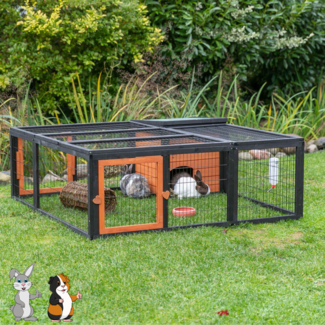
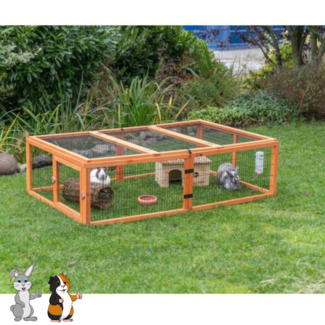
The Trixie Natura run with cover XL (233 × 79 × 116 cm) made of pine is the roomiest wooden run in this category. With the cover, it is closed off from above. The wooden outdoor run (174 × 48 × 109 cm) is made of stained pine. The wooden run with house (150 × 53 × 150 cm, black/brown) has a built-in house, so your rabbit can always take shelter in the run. You can place wooden runs next to or against an outdoor hutch, so your rabbits can choose for themselves between inside and outside.
Metal runs
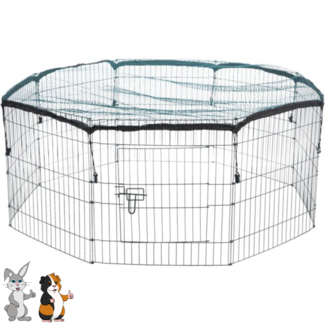
The metal run with protective net (ø 150 × 57 cm, green) is round and has a net over the top. The metal run with roof (114 × 58 × 116 cm, grey) is suitable for the garden or balcony, according to the product information. Metal runs are light, so you can easily move them to a new patch of grass. Do secure them firmly, so they can't slide or be lifted by an enthusiastic rabbit.
Indoor runs
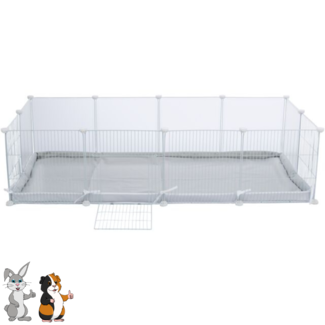
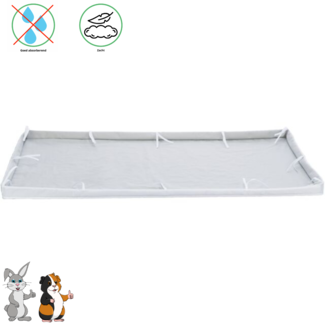
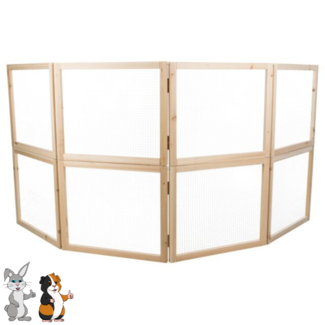
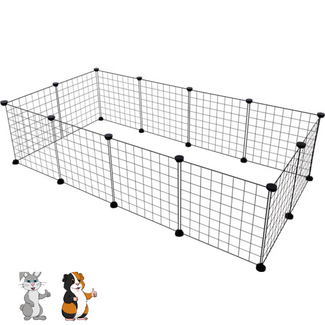
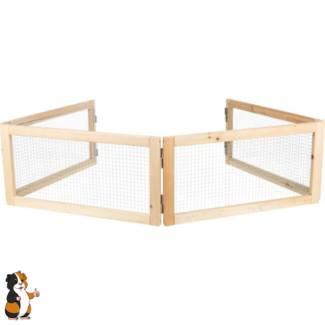
The Trixie wooden indoor run consists of four panels of 50 × 60 cm. At 60 cm high, this is the indoor run that best suits rabbits. This category also includes a wooden indoor run with panels of 60 × 30 cm, the Flamingo rodent run of 140 × 35 × 35 cm and the expandable Trixie guinea pig enclosure (140 × 35 × 70 cm) with separate extension panels of 35 × 35 cm and a matching floor of 140 × 70 cm. These are mainly intended for guinea pigs: an average rabbit jumps over walls of 30 to 35 cm high without any effort.
Fleece blankets for the run
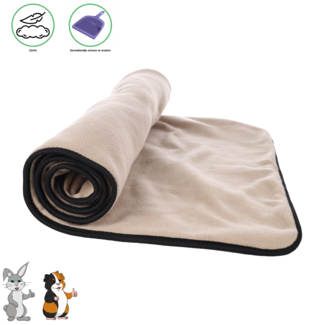
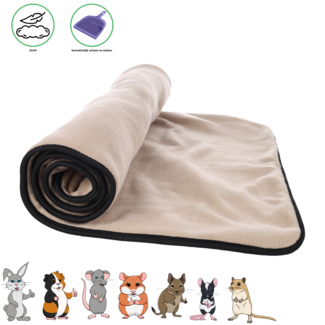
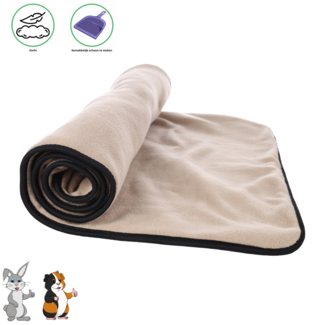
You place the Flamingo fleece blankets (100 × 55, 140 × 70 and 125 × 125 cm, taupe) on the floor of an indoor run or indoor hutch. They provide grip on a slippery floor, are warmer than a bare surface and protect your floor. According to the product information, they are washable. Take care if your rabbit likes to chew fabric: in that case, remove the blanket and choose a mat made of natural material or extra hay.
How big should a rabbit run be?
In a run, a rabbit should at least be able to make a few full hops in a row, stand upright on its hind legs and run without constantly bumping into a wall. With a pair, and rabbits should live in pairs, that need doubles. A run of a few square metres is therefore a good start, and more is always better. Many rabbit owners link several runs together or fence off a part of the garden to make it rabbit-safe.
Height matters too. An outdoor run without a roof must be high enough that your rabbit can't jump over it, and even then a cat or bird of prey can get in from above. That is why an outdoor run preferably has a roof, lid or net.
A safe outdoor run
Rabbits love to dig, and they dig fast. In a run on grass, a rabbit can have a tunnel under the edge within an afternoon. So lay wire mesh on the ground under or around the run, or place the run on tiles with a layer of sand or soil on top to dig in. Check every day that no holes are appearing near the edge.
Place the run in the shade or make sure part of it is always shaded. Rabbits cope poorly with heat. A house or shelter in the run provides protection against sun, rain and moments of fright. Check the water more often on hot days. If your run is not fully closed on all sides, never leave your rabbits in it unattended, not even for a moment.
Setting up an indoor run
An indoor run is ideal if your rabbit needs to be able to move around safely in a room that isn't fully rabbit-proof yet. Lay down a fleece blanket, a rug or another non-slip surface, so your rabbit doesn't slip on laminate or tiles. Put a litter tray with litter pellets in a corner, hang the hay rack beside it, and add a house and a tunnel. Connect the run to the indoor hutch, so your rabbit can walk in and out by itself.
Grass in the run
A run on the grass is the highlight of the day for many rabbits. Do let a rabbit that isn't used to fresh grass get used to it gradually: start with short periods and build that up over a few weeks. That gives the digestive system time to adjust. Don't use grass that has been sprayed or fertilised, and don't place the run where the neighbours' dogs or cats come.
A run with plenty to do
An empty run is roomy, but boring. Rabbits make much better use of the space when there is something to discover. Put down a tunnel as a racetrack, add a digging box or a corner with sand to dig in, and now and then scatter some dried herbs or hide a few pellets in the hay. A flat house or a sturdy crate to jump on provides a lookout post. Do always leave a good stretch of open space free for sprinting.
With two or more rabbits, provide several hideaways and several spots with hay and water, spread across the run. That way a dominant rabbit can't chase the rest away from food or water, and every rabbit can withdraw when it has had enough of its companion for a while.
Useful combinations
A run only really becomes a living space with the right furnishings:
- Outdoor hutches: a dry, predator-proof night shelter next to the run.
- Indoor hutches: connect the indoor run to the hutch.
- Houses: a hideaway in the run.
- Tunnels: to run through and hide in.
- Hay racks: always Zooply hay within reach.
Frequently asked questions about runs for rabbits
How long per day should a rabbit be in the run?
As long as possible, and at least several hours a day. Rabbits are mainly active in the morning and evening; that is exactly when you should give them the space. Best of all is a run that is permanently attached to the hutch, so your rabbits can choose for themselves when to run and when to rest.
Can my rabbit jump over an indoor run?
That depends on your rabbit and the height of the run. Most rabbits jump over walls of 30 to 35 cm without any effort. A run 60 cm high keeps most rabbits in, but some rabbits manage that too. If you notice your rabbit trying to jump, choose higher panels or a run with a roof.
Can I leave the run on the grass?
Yes, but move it regularly, so the grass doesn't become bare and dirty. Prevent your rabbit from digging underneath with wire mesh or tiles along the edge. In wet weather, put it in a dry spot or provide a covered section.
Is a fleece blanket safe for my rabbit?
For most rabbits it is, as a surface to lie and walk on. Do check that your rabbit doesn't chew it or pull bits out. Wash the blanket regularly and don't put it in the toilet corner; place a litter tray there instead.
Can the run stay outside in winter?
Yes. Rabbits that live outdoors are happy to use their run in winter too, as long as they can always go back to a dry, draught-free night shelter with straw and hay. In frosty weather, check more often that the water isn't frozen, and remove fabric blankets and paper toys from an uncovered run.
Can I use a guinea pig run for my rabbit?
Usually not as a permanent run. Guinea pig runs are low, because guinea pigs don't jump. A rabbit easily jumps over them. For a rabbit, choose a run at least 60 cm high or a run with a roof.
Buying rabbit runs at Knaagplaza
At Knaagplaza, the webshop of 't Knaagplein, you will find indoor and outdoor runs to give your rabbits the space they need. Add a hideaway, water and a hay rack with Zooply hay, our own premium brand that we use every day for our own rabbits. That makes the run a place where your rabbits can truly be rabbits.