










Accessories for rabbits: sheltering, playing and resting
A rabbit needs more than food, water and a hutch. It is a prey animal that wants to be able to hide, a clever animal that wants to explore and an active animal that wants to run, dig and gnaw. On top of that, a rabbit rests for a large part of the day and looks for a safe, comfortable spot to do so. With the right accessories you can set up the enclosure so that your rabbit can show all of that natural behaviour.
In this category you will find accessories in four groups: hideouts, tunnels, toys and beds. Together they provide places to shelter, exercise, things to do and comfort. Complete it all with fresh Zooply hay and a pinch of Zooply herbs, our own premium brand: hidden in a tunnel or snuffle mat, food instantly becomes enrichment.
At a glance
- ✓ At least one hiding place per rabbit, preferably one extra; tunnels count too.
- ✓ Choose accessories that suit your rabbit's size: a hideout that is too small or a tunnel that is too narrow won't work.
- ✓ Untreated wood, willow, cork, grass and hay can be gnawed; fabric and plastic cannot.
- ✓ Rotate toys regularly, so the enclosure stays interesting.
- ✓ Check accessories regularly for sharp bits, loose threads and damp.
What will you find in the Accessories category?
Hideouts
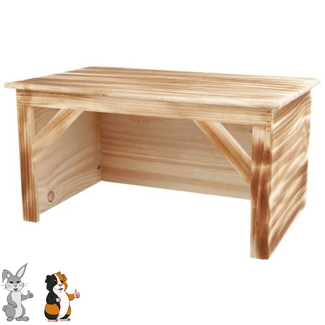
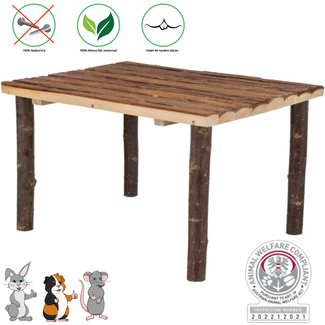
Under Hideouts you will find wooden hideouts made of bark wood and flamed wood in many sizes, hideouts with two entrances, a roof terrace or a built-in hay rack, an outdoor hideout for the run, soft hiding places and edible hay houses. A hideout is the fixed safe place your rabbit runs to when it gets a fright. Choose a size in which your rabbit can lie stretched out, and for a pair a model with two entrances.
Tunnels
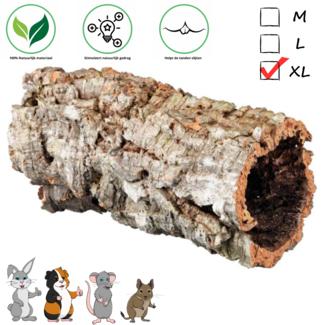
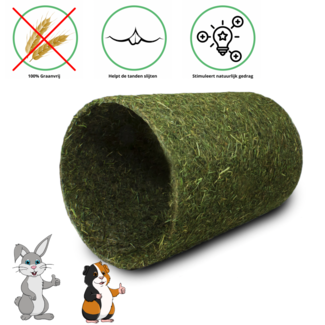
Under Tunnels you will find fabric play tunnels with one or more exits, tunnels and bridges made of willow, cork and wood, edible hay tunnels and the Ferplast Metró tunnel system. A tunnel is a racetrack and a hiding place in one. Pay attention to the diameter: tunnels of 18 to 19 cm suit dwarf rabbits, larger rabbits need 25 to 30 cm.
Toys
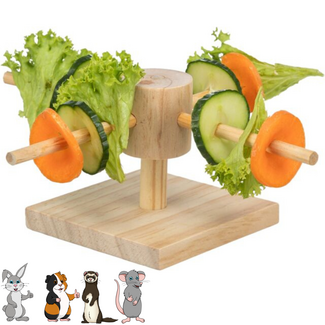
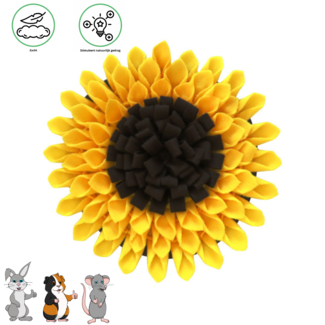
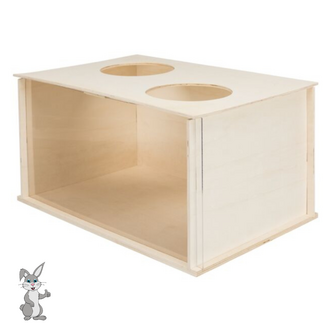
Under Toys you will find chew toys made of willow, grass, straw and wood, snuffle mats, puzzle games in which you hide pellets or herbs, vegetable holders, a feeding tree and a digging box. Toys give your rabbit something to do and stop it from gnawing at bars, furniture or cables out of boredom.
Beds
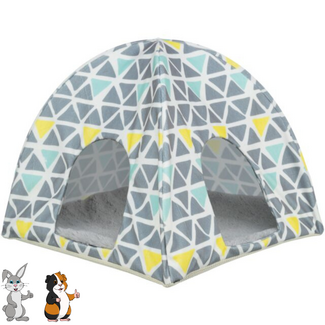
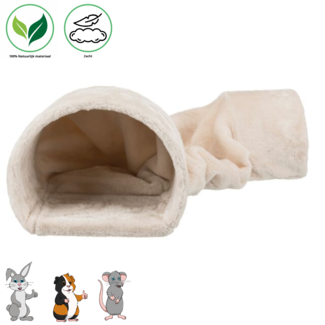
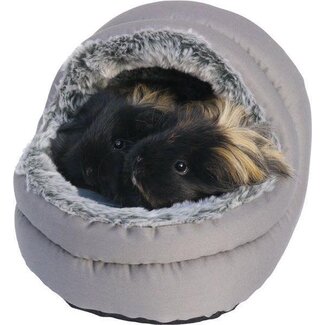
Under Beds you will find soft beds and cushions, and soft hiding places such as a tent, a triangular hideaway and plush houses. A bed is a comfortable place to lie down, especially nice for indoor rabbits on a hard floor and for older rabbits. A bed does not replace a sturdy hideout.
Setting up an enclosure in zones
A rabbit naturally divides up its living space. It has a fixed toilet spot, a place to eat, a place to shelter and sleep, and open space to run. If you follow that layout when setting up the enclosure, your rabbit will feel at home more quickly and the enclosure will stay cleaner.
- Toilet and hay: a litter tray in a corner, with the hay rack above or next to it.
- Food and water: food bowl and water a little further away, in a dry spot.
- Resting: a hideout and possibly a bed in the quietest corner.
- Playing: tunnels, toys and open space in the middle or in the run.
Connect the zones with a tunnel or a clear walking route. That way your rabbit can move from hiding place to hiding place. Prey animals feel safer when there is always somewhere along the way to duck into.
Safe materials
Rabbits gnaw at everything in their enclosure; their teeth keep growing throughout their life. So choose accessories made of materials that can withstand this and are safe. Untreated wood, willow, cork, seagrass, hay and grass may be gnawed and a little of it eaten. Varnished, painted or glued material does not belong in a rabbit enclosure. Fabric beds and tunnels are fine for rabbits that treat them nicely, but take them away if your rabbit pulls bits out of them. Plastic toys are not for gnawing on.
Hay remains the most important source of tooth wear. Chewable toys and wooden hideouts are a welcome addition, but they do not replace hay.
Rotating accessories
A rabbit gets used to its surroundings. That is good for its sense of calm, but an enclosure that never changes becomes boring. Keep the fixed places, such as the toilet, the hideout and the hay rack, in the same spot. Vary things around them: put down a different toy every week, move a tunnel or hide the food in a new place. That way your rabbit stays curious without losing its familiar base.
Indoors and outdoors
For indoor rabbits, soft beds, fabric tunnels, snuffle mats and puzzle games work well. They provide comfort and something to do in an environment without grass and soil. Place accessories on a non-slip surface, so they don't slide around.
Outdoors, choose mainly wood, willow, cork and a spacious outdoor hideout. Fabric and paper get wet and go mouldy; only use them in a covered, dry spot. Always put at least one hiding place in the run that protects against rain and sun.
Young and older rabbits
Young rabbits are curious, jump a lot and gnaw at everything. For them, sturdy wooden hideouts, tunnels and lots of chewable toys are ideal. You are better off holding back on fabric beds and tunnels until you know how your rabbit treats them. A young rabbit that has just arrived in a new home mainly needs hiding places: in the first weeks, put down one hideout too many rather than too few.
Older rabbits rest more and move less easily. A soft bed with a low entrance, a hideout without a high threshold and accessories close to the hay and water make life easier. Foraging games and snuffle mats also keep an older rabbit mentally busy without it having to jump much. If you notice that your rabbit is walking more stiffly or is less active, have it checked by a vet with rabbit experience.
Enrichment without spending much
Not everything has to be bought. A cardboard box with two holes cut in it is a great extra hiding place. A toilet roll tube filled with hay and a few pellets is a foraging game. A tray of untreated soil or sand is a digging spot. Combine simple enrichment like this with sturdy accessories for the fixed places, and rotate regularly.
Accessories for a pair or group
With two or more rabbits you need more than double. Provide several hiding places, preferably with two entrances, so a rabbit never gets trapped by its companion. Tunnels with several exits help with this too. Put toys and foraging games in different places, so there is no squabbling over one snack toy. Many rabbits like to lie together in a spacious hideout or a large bed, but also want to be able to choose a spot of their own.
Useful combinations
Accessories are only complete with the right basics:
- Hay: Zooply hay in and around hideouts and tunnels.
- Dried herbs: Zooply herbs to hide in toys.
- Gnawing wood: extra chew material alongside the toys.
- Runs: enough space to place accessories cleverly.
- Hay racks: a fixed hay spot by the litter tray.
Frequently asked questions about accessories for rabbits
What accessories does a rabbit need at a minimum?
At a minimum, one hideout or hiding place per rabbit, preferably one extra, something to gnaw on and something to explore, such as a tunnel or a foraging game. A bed is a nice extra. Together with a spacious enclosure, a litter tray and a hay rack, you then have an enclosure in which your rabbit feels at home.
My rabbit destroys everything. Which accessories are suitable?
Choose sturdy, untreated wood, willow, cork and hay: materials that are allowed to be gnawed. Avoid fabric and plastic. Also give plenty of hay, gnawing wood and foraging games, so your rabbit can burn off its energy safely. A lot of destructive behaviour comes from boredom or too little space.
How often should I replace accessories?
Replace chewable toys when they are mostly eaten or dirty. Replace hideouts and tunnels when they become unstable, develop sharp edges or keep smelling musty. Replace fabric beds and tunnels when they have holes or the stuffing is coming out.
Can accessories for guinea pigs also be used for rabbits?
Sometimes, but watch the size. Many hideouts, tunnels and beds for guinea pigs are too small for a rabbit. Check the dimensions of each product and compare them with your rabbit: it must be able to get in easily, turn around and lie stretched out.
What is the difference between a hideout and a bed?
A hideout is an enclosed, sturdy hiding place with a roof, where your rabbit can hide completely. A bed is an open, soft place to lie and rest. Every rabbit needs a hiding place; a bed is a nice extra.
How many toys should I put down?
Better a few good toys that you rotate regularly than an enclosure full of stuff. Three or four different types at once, for example something to gnaw, something to forage in and a tunnel, is a good starting point. Always leave enough open space to run.
Buying accessories at Knaagplaza
At Knaagplaza, the webshop of 't Knaagplein, you will find hideouts, tunnels, toys and beds to complete your rabbit's enclosure. Combine them with Zooply hay and Zooply herbs, our own premium brand that we use every day for our own rabbits. That way your rabbit has places to shelter, play and rest every day.