


Nesting material for degus: building a warm nest together
Degus like to sleep snuggled up close to each other, in a sheltered nest they have furnished themselves. In the wild, they make those nests in their underground burrows, lined with grass and other plant material. At home they do exactly the same. They drag hay, shavings and soft material to a house or hiding place and build a sleeping spot there together. This nesting is natural behaviour, brings calm to the group and provides a warm, dry place to sleep.
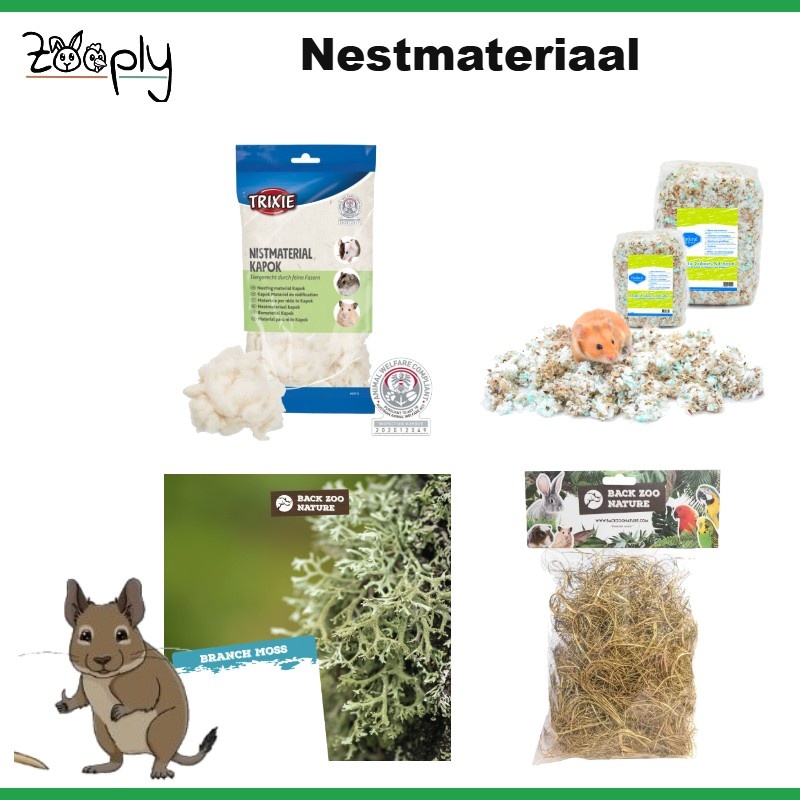
With good nesting material you give your degus the building blocks for that nest. In this category you will find the nesting material from Zooply, our own premium brand, and kapok from Trixie. We use Zooply every day for the animals in our shop and breeding facility.
In short
- ✓ Give degus soft, natural nesting material and always hay as well to build with.
- ✓ Never use synthetic cotton wool or nesting fluff; long threads can constrict little feet.
- ✓ Provide at least one hiding place per degu and preferably one extra, so there is always a choice.
- ✓ Give nesting material in small portions and let your degus build themselves.
- ✓ Replace wet or dirty nesting material, but leave a clean part of the nest in place.
What will you find in the Nesting materials for degus category?
Zooply Nesting Material
Zooply Nesting Material is soft, warm and airy material with which your animals can build their own nest. According to the product information, it is soft enough not to constrict or tangle, free of harmful additives and safe to gnaw on. It is airy enough to drag around easily and fold into a nest. That suits degus well, as they like to pluck their nesting material into pieces themselves and take it to their favourite spot.
You can choose from a bag of 3 litres and a bag of 10 litres. The small bag is enough to try it out or for a pair. The large bag is handy if you have a group or partly replace nesting material at every clean.
Kapok from Trixie
Kapok is a natural, cotton-like fibre from the fruit of the kapok tree. It is light, soft and warm. Trixie supplies kapok as loose nesting material of 40 grams in cream and as kapok in a box of 9 × 9 × 9 cm, from which your animals can pluck it themselves. The box is immediately a small piece of enrichment: your degus have to make an effort to get the material out. Give kapok in small tufts and see how your degus handle it.
Why nesting material is important for degus
For a degu, a nest is a safe base. It is the place where the group rests together, where they retreat when something is exciting and where they stay warm. Degus are prey animals. A good nest in a hiding place gives them the feeling that they are safe, and a degu that feels safe is also calmer and more curious in the rest of the enclosure.
Nesting is also an activity. Searching for, plucking, dragging and piling up material keeps degus active for a large part of the day. For an animal with so much energy, that is valuable enrichment, without any food or snacks being involved.
Choosing safe nesting material
Not every soft material is safe. Synthetic cotton wool or nesting fluff looks cosy, but consists of long, strong threads. A degu can get a foot tangled in it, and those threads can constrict a foot. An animal may also swallow synthetic fibres. So only use nesting material made of natural fibres or material specially made for rodents, plus hay, paper or hemp.
Also don't use old towels, fleece or fabric with loose threads as nesting material. Degus gnaw holes in them and pull out threads. A fabric hammock or sleeping bag is fine, as long as you check it regularly for loose threads and wash it.
Hay as nesting material
Hay is the most natural building material for degus. In the wild they line their nests with grass and plant remains, and at home they also like to drag hay to their sleeping spot. So alongside nesting material, always put an extra portion of loose hay in the enclosure, in addition to the hay in the rack. A mix of hay and soft nesting material gives a nest that is firm yet soft to the touch. Hay that ends up in the nest is often eaten as well.
Where do degus make their nest?
Degus usually choose a dark, sheltered spot: a house, a hollow tree trunk, a cork tube or a tunnel in the bedding. Make sure there are enough such places. A rule of thumb is at least one hiding place per degu, and preferably one extra. That way there is always a choice and no degu has to sleep outside when the group has a disagreement for a while.
Preferably choose houses with two openings or a wide entrance, so a degu never gets trapped in a corner. Ensure ventilation: a nest must be warm, but not stuffy or damp. Houses made of untreated wood or ceramic are suitable; bear in mind that wooden houses will be gnawed.
How much nesting material do you give?
Start with a handful and see what your degus do with it. If it has been worked into the nest within a day and they keep searching, give some more. If there are tufts all over the enclosure, it was too much. Small portions work better for degus than one big pile. They then build more calmly and there is less chance of one degu dragging all the material to its own spot.
Preferably don't put nesting material directly in the house, but next to it or in a few places in the enclosure. That way your degus can choose for themselves where the nest goes, and collecting it is enrichment straight away.
Keeping nesting material clean
A nest must be dry. Degus usually don't wee in their nest, but it can happen, especially if there is little room or the group is large. Check the nest when you remove wet patches each day. If part of it is wet, dirty or musty, remove it and replace it with fresh material.
During a big clean, preferably leave a small part of the clean, dry nesting material in place or put it back in the hiding place. The familiar scent helps your degus feel at home again quickly and prevents unrest in the group. Don't throw everything away at once if that isn't necessary.
Nesting material throughout the year
In colder months, degus often build a thicker nest, and in warm periods a thinner one. Let them choose for themselves by always having some material available. Place the enclosure out of draughts, not in full sun and not next to the radiator, so your degus don't depend on a thick nest to stay warm or, on the contrary, get too hot.
Handy combinations
Nesting material works best together with:
- Bedding: a deep, low-dust digging layer in which degus also make underground nests.
- Hay: Zooply hay to eat and as a natural building material for the nest.
- Houses: sheltered sleeping spots, at least one per degu and preferably one extra.
- Tunnels: extra hiding routes and places to drag material to.
- Hammocks & Hanging bridges: soft resting places up high as a supplement to the nest.
Frequently asked questions about nesting material for degus
Do degus really need nesting material?
Degus naturally build nests and need building material for that. Hay is the basis, but many degus also like to use soft nesting material to line their sleeping spot. It provides comfort, warmth and activity. If you only have hay, most degus will manage; soft nesting material is then a nice addition.
My degus drag everything to one house. Is that normal?
Yes, that is perfectly normal. As a group, degus prefer to sleep together in one nest. Do make sure that spot is big enough for the whole group and well ventilated. Also offer extra hiding places, so a degu can retreat when it wants some peace.
Is kapok safe for degus?
Kapok is a natural plant fibre and is widely used as nesting material for small rodents. Give it in small tufts and check the first few times whether your degus handle it well. If the nest becomes very matted or you see that a degu is bothered by it, use Zooply Nesting Material or hay instead.
How often should I replace nesting material?
Remove wet or dirty nesting material immediately. The dry, clean part can stay, even during a big clean. Partly refresh the nest when it no longer smells fresh. How often that is needed depends on the size of your group and how clean your degus are.
Can I use kitchen paper or tissues?
Unscented, unprinted paper can be used as an emergency solution. It is less warm and falls apart faster than special nesting material. Never use paper with perfume, lotion or ink. For daily use, hay and Zooply Nesting Material are a better choice.
Nesting material for degus at Knaagplaza
A good nest gives a group of degus calm, warmth and a fixed place to sleep together. Zooply is our own premium brand and we use it ourselves every day for our animals. Combine Zooply Nesting Material with hay, enough houses and a deep layer of bedding, and your degus can build the way they would in the wild.