










Bedding for hamsters: a thick layer to dig in
For a hamster, bedding is much more than something to soak up urine. It is its habitat. In the wild, a hamster lives in a tunnel system underground, with separate chambers for sleeping, storing food and going to the toilet. At home it wants the same. With a thick layer of low-dust, firm bedding, your hamster can dig, make tunnels and sleep peacefully deep underground.
In this category you will find the bedding from Zooply, our own premium brand: cotton fibre, cotton with cardboard or sawdust, coconut chips, hemp fibre and wood fibre. You will also find Zooply scatter mixes with herbs, flowers, leaves and seeds to mix through the bedding, and bedding from Plospan, Natural Pet Brand, Back Zoo Nature and Trixie. We use Zooply bedding every day for the hamsters in our shop and breeding facility.
In short
- ✓ Provide at least around 20 centimetres of bedding; according to the Zooply packaging, a Syrian hamster prefers 25 to 30 centimetres.
- ✓ Choose low-dust, absorbent material that is firm enough to keep tunnels standing.
- ✓ Remove wet patches daily, but never replace everything at once.
- ✓ Leave the food store and the nest alone as much as possible.
- ✓ Mix some hay, herbs or leaves through the bedding for firmer tunnels and more foraging.
What will you find in the Bedding category?
Zooply Cotton Fibre and cotton blends
Zooply Cotton Fibre is a low-dust, soft bedding made of 100% cotton fibres, in bags of 40 litres and 100 litres. The airy structure is comfortable for little paws and good for digging. Zooply Cotton & Cardboard (30 and 100 litres) combines cotton fibre with recycled cardboard. According to the product information, hamsters and mice in particular benefit from the firm, diggable structure in which tunnels stay standing. Zooply Cotton & Sawdust (40 litres) mixes cotton with sawdust for extra moisture absorption.
Zooply Hemp Fibre and Wood Fibre
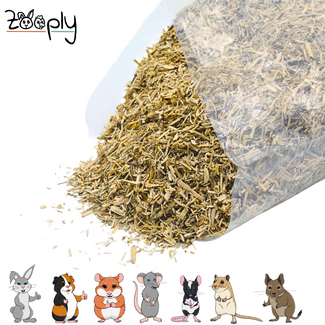
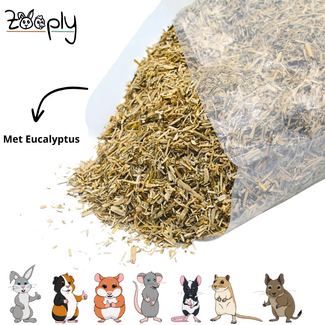
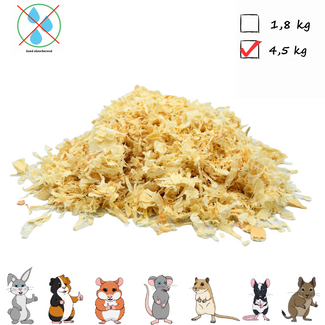
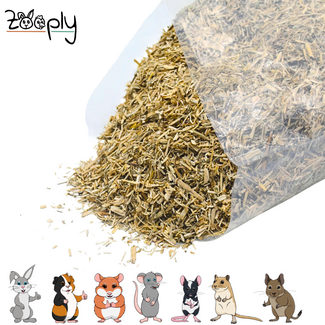
Zooply Hemp Fibre (3.5 kg and 5 kg) is low in dust and absorbs a lot of moisture. Hemp holds odours well and still has a structure your hamster can dig in. Zooply Wood Fibre (1.8 kg and 4.5 kg) is a soft, low-dust bedding made of natural wood. For those who use a lot, there is the large 20 kg bale of Zooply Aubizoo hemp bedding. There is also Zooply Hemp Fibre with Eucalyptus (5 kg). Hamsters live by scent and have sensitive airways. That is why, for a hamster, we ourselves prefer the varieties without added scent.
Zooply Coconut Chips
Zooply Coconut Chips (25 and 100 litres) are made from coconut fibres. They are low in dust, absorbent and have a natural, fresh scent. Coconut gives a dark, natural floor that looks lovely in a furnished enclosure. You can use it as the entire floor or as a layer between other bedding.
Zooply Scatter Herbs, Scatter Flowers and Forest Mix
These are not bedding in themselves, but mixes to scatter through the top layer. The Zooply Scatter Herbs (250 grams) consist of leaves such as apple and birch leaves, flowers and seeds, in varieties with seeds, millet, peas, nuts or fruit. The Zooply Scatter Flowers (200 grams) are colourful flowers with alfalfa, peas, sunflower seeds or various seeds. The Zooply Forest Mix comes with leaves only (100 grams), with leaves and seeds or nuts (250 grams) and with walnuts or hazelnuts (100 grams). Scatter a small handful and mix it lightly through the bedding. The seeds sink between the material and your hamster goes searching. If you have a dwarf hamster, choose the varieties without fruit.
Wood fibre, cotton pellets and natural top layers
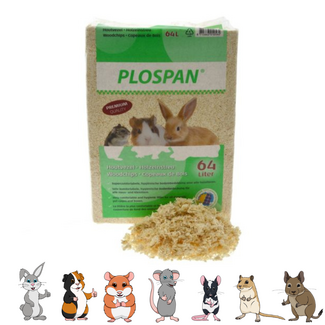
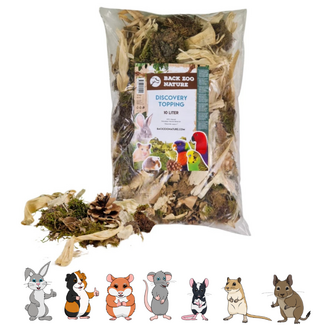
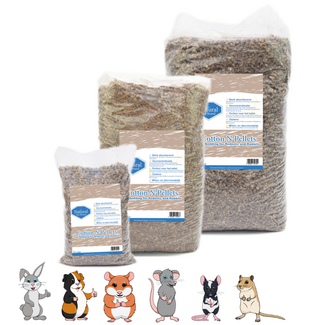
Plospan wood fibre comes in 40, 64 and 160 litres: a soft, absorbent wood fibre made of natural material. The Cotton Pellets from Natural Pet Brand (20 and 40 litres) are pressed cotton fibres that absorb moisture well, handy in the wee corner. From Back Zoo Nature you will find Bark Bedding (20 litres, made from tree bark), Tree leaves (65 grams) and the Discovery topping (10 litres) with corn leaves, moss and pine cones. The dried moss from Trixie (200 grams) is here too. You mainly use these products as a top layer or accent, on top of a thick digging layer.
How thick should the bedding be?
A hamster can only really dig if the layer is thick enough. Keep to at least around 20 centimetres, and more is better. The packaging of the Zooply bedding states 25 to 30 centimetres as the preference for Syrian hamsters. It doesn't have to be equally thick everywhere: many hamster owners make one part of the enclosure extra deep as a digging zone and keep the layer a little lower by the running wheel and the feeding bowl.
Such a thick layer requires an enclosure with a deep base or high sides. Otherwise your hamster will throw half of it out. Make sure there is enough floor space, so your hamster also has room above ground for a running wheel, a sand bath and hiding places.
Tunnels that stay standing
A hamster that keeps seeing its tunnels collapse stops digging and stays above ground. That is why firmness is important. Cotton with cardboard, hemp and wood fibre hold their shape well if you press them down a little. You can improve the firmness further by mixing hay or straw through the bottom layer. The stalks act as reinforcement and keep the tunnels open. Many hamsters then also use that hay as nesting material.
Low-dust for sensitive airways
A hamster sleeps with its nose close to the floor and spends a large part of the day underground. Dusty bedding then goes straight into the airways. So choose low-dust materials, such as the Zooply bedding, which according to the product information is low in dust. Avoid heavily perfumed bedding. You get a fresh enclosure through good absorption and removing wet patches in time, not by covering it with a scent.
Cleaning without stress
Hamsters usually have a fixed wee corner. Remove the wet material there daily or every other day and top up with fresh. That way the rest of the enclosure stays clean for a long time. Only do a bigger clean when the bedding no longer smells fresh. Even then, don't replace everything at once, but leave part of the old, clean material in place. Then the scent stays recognisable and your hamster feels at home again more quickly.
Leave the nest and the food store alone as much as possible. Only remove what is wet, mouldy or perishable. A hamster that loses its entire nest and store becomes stressed and often starts digging restlessly or chewing the bars. Some hamsters also use a sand bath with fine bathing sand as a toilet. That makes cleaning even easier.
Bedding and enrichment
The floor is also where your hamster searches for its food. Scatter part of the hamster food through the top layer, or use the Zooply Scatter Herbs, Scatter Flowers or Forest Mix. Your hamster then sets off every evening, just as in the wild. Leaves, moss and pine cones on top of the bedding add extra structure and hiding spots. That way a flat enclosure becomes a landscape to explore.
Handy combinations
Bedding works best in combination with these categories:
- Nesting materials: Zooply Nesting Material for a soft nest in the deepest chamber.
- Dried flowers and grasses: to dress up the floor naturally.
- Cages: an enclosure with a deep base for a thick digging layer.
- Hamster scaping: cork, roots and hiding places to work into the bedding.
- Sand & Sand baths: a sand bath for coat care, which is often also used as a toilet.
Frequently asked questions about bedding for hamsters
Which bedding is best for a hamster?
A low-dust, absorbent bedding in which tunnels stay standing. Zooply Cotton & Cardboard, Zooply Hemp Fibre and Zooply Wood Fibre all meet that requirement. Many hamster owners mix two types, for example cotton with cardboard as the digging layer and hemp in the wee corner. Mix some hay through it for extra firmness.
How many litres of bedding do I need?
That depends on the size of the enclosure. Calculate the floor area in centimetres, multiply it by the desired layer thickness and divide by 1000. An enclosure of 100 by 50 centimetres with a layer of 20 centimetres therefore needs about 100 litres. Material that you press down takes up less space, so keep some extra in reserve.
How often should I change the bedding?
Remove wet patches daily or every other day. Only replace the whole layer when the bedding no longer smells fresh, and then in sections. Always leave some old, clean material in place. How often that is needed depends on the size of the enclosure and on your hamster.
My hamster doesn't dig. What am I doing wrong?
Often the layer is too thin or the material collapses. Make the layer thicker, press it down a little and mix hay through the bottom layer. Scatter some food or Zooply Scatter Herbs through the bedding to reward digging. Some hamsters also simply need time in a new enclosure.
Is scented bedding good for a hamster?
Hamsters live by scent and have sensitive airways. That is why, for a hamster, we prefer bedding without added scent. You achieve a fresh enclosure with a highly absorbent bedding and by regularly removing wet patches.
When should I go to the vet?
If your hamster sneezes often, has wet eyes or a wet nose or is breathing audibly, contact a vet with knowledge of rodents. In addition, take a critical look at dust and scent in the bedding.
Buying bedding at Knaagplaza
At Knaagplaza, the webshop of 't Knaagplein, you will find low-dust bedding for your hamster, with Zooply leading the way. Zooply is our own premium brand and we use it every day for our own hamsters in the shop and breeding facility. Provide a thick layer, mix some hay and herbs through it and let your hamster build its own tunnel system.