
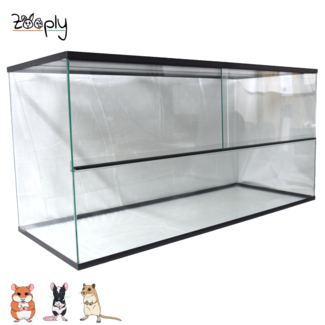

Hamster terrarium: a glass enclosure where your hamster can really dig
A hamster spends a large part of its life underground. In the wild it digs tunnels, sleeping chambers and pantries, and a Syrian or dwarf hamster at home wants to keep doing exactly that. For this it needs two things: plenty of floor space and a thick layer of bedding. A glass terrarium is made for this. The bedding stays inside, you can make the layer as deep as needed, and through the glass you may even see the tunnels your hamster digs along the edge.
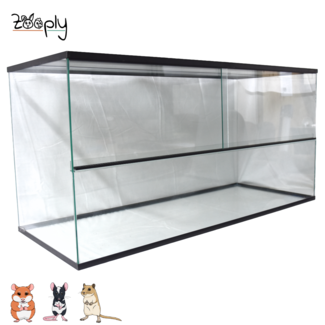
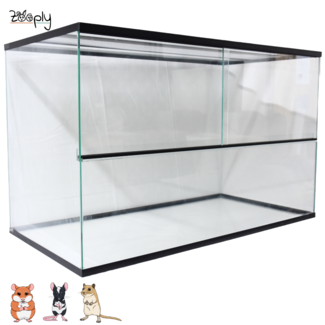
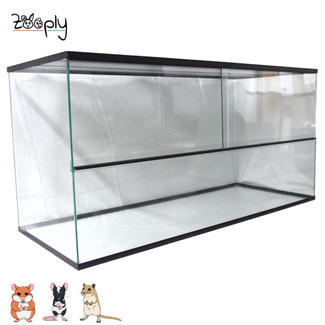
In this category you will mainly find the Zooply Glass Terrariums, our own terrarium in five sizes, with sliding doors, a ventilation grille and a high bottom edge. We ourselves like spacious, low and wide terrariums best, with a large view, a ventilated top and a deep digging layer. That is exactly the type of enclosure you will find here. There is also a Ferplast cage with a glass base.
At a glance
- ✓ Choose by floor space, not by height: a hamster mainly uses the floor.
- ✓ For a Syrian hamster, choose a terrarium that is 100 cm wide or more; according to the product information, the 80 × 40 cm model is suitable for dwarf hamsters.
- ✓ Allow for a layer of bedding of at least about 20 cm, and more is better.
- ✓ Never place a glass terrarium in the sun or next to a radiator, and not in the bedroom.
- ✓ Always keep one hamster per terrarium: Syrian hamsters are solitary and dwarf hamsters also prefer to live alone.
What will you find in the Terrarium category?
Zooply Glass Terrariums
The Zooply Glass Terrarium comes in the sizes 80 × 40 × 50 cm, 100 × 40 × 50 cm, 100 × 50 × 50 cm, 120 × 50 × 50 cm and 150 × 50 × 50 cm, all in black. The first two figures are the floor area, the last figure is the height. So all sizes are equally tall, but they differ considerably in floor space: the largest model has more than twice as much floor as the smallest.
According to the product specifications, all Zooply terrariums have sliding doors, a ventilation grille, an anti-gnaw strip and a high bottom edge. The top is closed and there are no platforms. Thanks to the sliding doors you can reach your hamster and the furnishings without moving the terrarium, and the high bottom edge keeps a thick digging layer in place when you open the doors.
Ferplast cage with glass base
The Ferplast rodent cage (Karat 80) measures 78.5 × 45.5 × 52.5 cm. It combines a glass base with a wire section and several levels above it. This gives you more air circulation than in a fully glass terrarium, plus extra climbing space. With a floor size of about 80 cm, this cage is mainly an enclosure for a dwarf hamster. For a Syrian hamster, you would do better to choose one of the larger Zooply terrariums.
Syrian or dwarf hamster: which size fits?
A Syrian hamster is the largest of the hamsters kept as pets and covers long distances every night. It needs the most floor space. So for a Syrian hamster, choose a terrarium that is 100 cm wide or more. The product information for the 80 × 40 cm Zooply terrarium itself also says that this size is too small for a Syrian hamster. With 100 × 50 cm you have a good base, and with 120 × 50 or 150 × 50 cm you have room for separate zones for digging, running, eating and taking a sand bath.
Dwarf hamsters, such as the Campbell's, the Russian dwarf hamster and the Roborovski, are smaller but at least as active. For a dwarf hamster, the 80 × 40 cm terrarium can be a base. If you have room for more, you will notice that a dwarf hamster also makes full use of a larger terrarium.
If you are in doubt between two sizes, choose the larger one.
How much bedding do you need?
A hamster needs a layer of bedding of at least about 20 cm, and more is better. According to the packaging of the Zooply bedding, Syrian hamsters like 25 to 30 cm best. In such a layer your hamster can make tunnels that do not collapse straight away, and build a nest deep underground where it is quiet and dark.
You calculate how many litres you need like this: length × width × layer depth in centimetres, divided by 1000. For a 20 cm layer, that means about 64 litres in the 80 × 40 cm terrarium, 100 litres in the 100 × 50 cm one and 150 litres in the 150 × 50 cm model. Low-dust bedding such as Zooply Hemp Fibre or wood fibre is kind to the airways and holds tunnels well, especially if you mix in some hay or nesting material.
You do not have to make the layer equally deep everywhere. A deep digging zone on one side and a shallower zone on the other works well in practice. That brings us to setting up the enclosure.
How to set up a hamster terrarium
Start with the digging layer and make it deepest against the back or side wall. Then put the fixed items in place: a house or hiding place, preferably one extra, a sand bath with fine, low-dust bathing sand, a feeding spot and a water bottle or heavy drinking bowl. Scatter some nesting material made of natural fibres in a corner, and your hamster will drag it to its nest itself.
When choosing the running wheel, pay attention to the height of the terrarium. The Zooply terrariums are 50 cm tall. A Syrian hamster needs a wheel with a solid running surface of at least about 28 to 30 cm in diameter, a dwarf hamster at least about 20 cm. So place the wheel in the shallower zone or on a sturdy, low base, and not on top of the deepest digging layer. That way it stands firmly, does not sink in, and there is room left above the wheel.
If you want to make the terrarium more natural, you can build a landscape with cork, roots, branches and dried flowers and herbs. This is called hamster scaping. It gives your hamster more to explore and more places to hide. Only use safe, untreated natural materials and do not put anything tall directly against the ventilation grille, so that the air can flow freely.
The right place in your home
Glass heats up quickly in the sun. So never place a terrarium by a window where the sun shines in, and not next to a radiator either. Hamsters cope poorly with heat. Choose a spot without draughts and without loud noises, so not next to the TV or speakers. A hamster is a crepuscular and nocturnal animal and is active at night. A bedroom is therefore not a good place: it hears you during the day, and you hear it at night.
A filled glass terrarium is heavy. Place it on a sturdy, level surface and put it in its permanent spot before you fill it.
Cleaning without upsetting your hamster
A hamster often has a fixed toilet spot, regularly in the sand bath or in a corner. You clean that spot a few times a week. That keeps the terrarium fresh, even though the bedding layer is deep. Also remove any perishable fresh food your hamster has hidden. Leave its stash of dry food: hoarding is normal behaviour. When cleaning, never throw away the whole nest and the stash at once, because that causes a lot of stress.
Replace the bedding in sections and always leave part of the clean, dry bedding in place, so that the terrarium keeps smelling of your hamster. Clean the glass with warm water and a soft cloth. Do not use strongly scented products; the smell lingers in the terrarium. When cleaning, also check that the ventilation grille is clear and that the sliding doors close properly.
Useful combinations
A terrarium is the base. With these categories you make the enclosure complete:
- Bedding: Zooply bedding for a deep, low-dust digging layer.
- Nesting material: natural fibres your hamster uses to build a warm nest in its tunnels.
- Running wheels: a wheel with a solid running surface in the right diameter for your hamster.
- Sand & Sand baths: a sand box with Zooply Bathing Sand for coat care.
- Hamster scaping: cork, branches and natural materials to furnish the terrarium.
Frequently asked questions about hamster terrariums
Is a terrarium better than a hamster cage?
For many hamsters, yes. In a glass terrarium you can easily fit a layer of 20 cm or more without the bedding falling out, and there are no draughts. A cage with a high base can also work well. What always matters most is the floor space and the depth of the digging layer, not whether the top is made of glass or bars.
Which size Zooply terrarium should I choose for a Syrian hamster?
For a Syrian hamster, choose a terrarium that is 100 cm wide or more. The 100 × 50 cm model is a good base; the 120 × 50 and 150 × 50 cm models give extra room for several digging zones, hiding places and a large sand bath. According to the product information, the 80 × 40 cm terrarium is suitable for dwarf hamsters and mice, and too small for a Syrian hamster.
Does my hamster get enough fresh air in a glass terrarium?
Yes, as long as the ventilation grille stays clear and you put the terrarium in a good spot. Do not place tall furnishings against the grille and do not put the terrarium in a stuffy corner or in the sun. Remove wet patches in good time, so that no moisture or ammonia smell lingers. If it smells musty, clean the toilet spot more often and check where the terrarium is placed.
Can my hamster escape from a terrarium?
Hamsters are strong and curious. A closed top, as on the Zooply terrariums, prevents your hamster from climbing up via a house or the running wheel and getting out. Do make sure you always slide the doors fully shut after caring for your hamster, and check regularly that they still close properly.
Can I keep two dwarf hamsters together in a large terrarium?
We do not recommend it. A Syrian hamster naturally lives alone and must always be kept alone. Dwarf hamsters are also best kept alone, because keeping them together often leads to fights and injuries, sometimes only after months. A large terrarium does not solve that. Rather use the extra space for one hamster, which then has all the floor and enrichment to itself.
Buying a hamster terrarium at Knaagplaza
At Knaagplaza, the webshop of 't Knaagplein, you will find terrariums in which a Syrian or dwarf hamster can do what it likes best: digging, running and sleeping in peace. Combine the Zooply Glass Terrarium with Zooply bedding, Zooply Nesting Material and Zooply Bathing Sand. Zooply is our own premium brand, which we use every day for our own animals in the shop and the breeding facility.