


Hamster food: the right basis for Syrian and dwarf hamsters
Hamster food is your hamster's daily main food. In the wild, a hamster eats seeds, grains, plant parts and the occasional insect. A good seed and pellet mix matches that best. Your hamster can forage through it, sort it and build up a store. That is not fussiness, but normal hamster behaviour.
In this category you will only find food from Zooply, our own premium brand. Zooply came about because the products that worked best for our own animals were not always available from other brands. We feed it every day to the hamsters in our shop in Bodegraven and in our breeding facility. You can choose from a separate mix for Syrian hamsters, a separate mix for dwarf hamsters and two complete rodent mixes.
At a glance
- ✓ Choose food that suits the species: Zooply Syrian Hamster Food for Syrian hamsters, Zooply Dwarf Hamster Food for dwarf hamsters.
- ✓ According to the label, give about 15 grams of the species-specific mixes per hamster per day, preferably in the evening.
- ✓ Only top up once the bowl has been eaten properly empty, otherwise only the favourites will get eaten.
- ✓ A store in the nest is normal; only remove perishable or damp food.
- ✓ Always switch to a new food gradually, spread over 1 to 2 weeks.
What will you find in the Food for Hamsters category?
Zooply Syrian Hamster Food
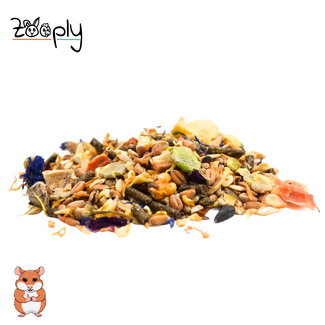
Zooply Syrian Hamster Food is a complete food, tailored to the daily needs of Syrian hamsters. Among other things, the mix contains wheat, corn, milo, barley, peas, carrot, parsnip, pumpkin and apple cubes, supplemented with a flower mix of marigold, chamomile, rose and cornflower. The pieces are larger than in dwarf hamster food and suit the size of a Syrian hamster well. According to the label, you give about 15 grams per animal per day. The food comes in a small pack of 550 grams, so you use it up within a reasonable time and it stays fresh.
Zooply Dwarf Hamster Food
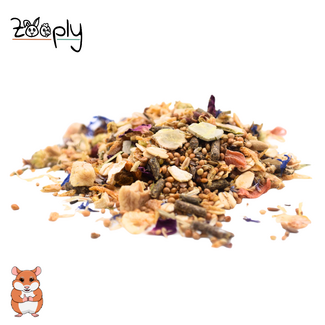
Zooply Dwarf Hamster Food is a complete food for dwarf hamsters. The mix contains smaller seeds such as millet and panicum, supplemented with barley, peas, carrot, parsnip and pumpkin, among other things, and a flower mix of marigold, chamomile, rose and cornflower. Small seeds suit a dwarf hamster's small mouth and call for real foraging and shelling. Here too, the label states about 15 grams per animal per day, preferably in the evening. You buy it in a pack of 600 grams.
Zooply Rodent Food Excellent
Zooply Rodent Food Excellent is a complete mix for hamsters, gerbils, mice and rats. It contains wheat, barley, corn, corn flakes, sunflower seeds, pumpkin seeds, vegetable chips, carrot chips, pea flakes, carob and mealworms, among other things. Those mealworms provide animal protein in the mix. The label states about 10 to 15 grams per 100 grams of body weight per day, adjusted to species, age and activity. This mix is especially handy if you keep several species of rodent and want to use one food. If you have a dwarf hamster, the species-specific Zooply Dwarf Hamster Food is the first choice.
Zooply Rodent Food
Zooply Rodent Food is a varied daily mix of grains, pulses and pellets, containing wheat, grass and alfalfa pellets, oats, barley, milo, linseed, peas, sunflower seeds, peanuts, carrot pieces and mealworms, among other things. Thanks to the pellets and grains alongside the seeds, it is a solid base mix for hamsters and other small rodents. You will find it here in the 1750 gram pack, handy if you feed several animals.
Syrian or dwarf hamster: which food should you choose?
A Syrian hamster is a good deal bigger than a dwarf hamster and eats larger pieces. Zooply Syrian Hamster Food is put together with that in mind. Dwarf hamsters, such as the Campbell's, the Russian (winter white) dwarf hamster, the Chinese hamster and the Roborovski, have a small mouth and love to search for small seeds. Zooply Dwarf Hamster Food is intended for them.
Dwarf hamsters, especially the Campbell's and the Russian dwarf hamster, are sensitive to sugar. So don't give them sweet snacks, fruit or dried fruit as a treat. The main food is the basis; for a dwarf hamster, keep the extras sugar-free, for example with dried insects or herbs without fruit.
How much hamster food should you give per day?
For Zooply Syrian Hamster Food and Zooply Dwarf Hamster Food, the label states about 15 grams per hamster per day. With Zooply Rodent Food Excellent and Zooply Rodent Food, you calculate 10 to 15 grams per 100 grams of body weight. A Syrian hamster of 150 grams therefore gets about 15 to 22 grams. Weigh the food for the first few weeks with kitchen scales. By eye you will quickly give too much, because a bowl of hamster food doesn't look like much.
After that, look at your own hamster. If the bowl is completely empty in the morning and the store stays small, the portion is usually right. If the store in the nest grows week after week, or the same seeds keep being left, you are giving too much. In that case, only top up once the bowl has really been eaten empty. That way your hamster also eats the less popular pieces, and those often contain exactly the nutrients it needs.
Feeding to the rhythm of a nocturnal animal
Hamsters are crepuscular and nocturnal animals. They wake up in the evening and then go looking for food. So give the food in the evening and don't wake your hamster during the day to feed it. Place the enclosure in a quiet room, not in the bedroom: a hamster is active at night and you will hear it.
A hamster fills its cheek pouches and carries the food to its nest or a fixed storage spot. That store gives it calm and security. So leave it alone when cleaning and only remove what is damp, mouldy or perishable, such as a forgotten piece of fresh food. If you keep throwing away the whole store, your hamster will hoard even harder and become stressed.
Letting your hamster forage in the bedding
In the wild, a hamster covers large distances every night to gather food. You can mimic that foraging behaviour at home. Give part of the daily portion in a heavy food bowl and scatter the rest through the bedding. Your hamster will then start sniffing, digging and searching, and will spend longer on its food. That helps against boredom and suits an animal that is naturally on the move a lot.
For that foraging, you need a thick layer of bedding, at least about 20 centimetres and preferably more. Then your hamster can also dig tunnels and build its own nest. The more your hamster can forage and dig, the more natural its behaviour.
Animal protein on the menu
Hamsters are not pure herbivores. In the wild, they also eat insects. That is why Zooply Rodent Food Excellent and Zooply Rodent Food contain mealworms. If you give Zooply Syrian Hamster Food or Zooply Dwarf Hamster Food, you can occasionally give a dried insect as a snack, such as Zooply Mealworms, Crickets or the Zooply Insect Mix. A few at a time is enough; it remains a treat alongside the main food.
Switching to a different hamster food
A hamster also benefits from a calm switch. First mix small amounts of the new food into the old food and increase the proportion every few days. After 1 to 2 weeks, you give only the new food. During that period, keep an eye on the droppings and the appetite. If you have just bought a young hamster, first give the same food it was used to for a while. A new environment is exciting enough.
Storing hamster food properly
Store hamster food in a dry, cool and dark place, in a well-sealed bag or storage box. That way the smell and quality stay good. Don't give food that smells musty or feels damp. Don't pour new food on top of a bit of old food, but empty the box first.
Useful combinations
Good hamster food works best in an enclosure where your hamster can forage, gnaw and drink. These categories complete the picture:
- Food bowls: a heavy bowl that doesn't tip over when your hamster sits in it.
- Water bottles: anyone eating dry food must always have access to fresh water.
- Snacks: Zooply Crickets, Grasshoppers and Silkworms as a protein-rich treat and for taming your hamster.
- Dried herbs: Zooply herbs to mix through the food or hide in the bedding.
- Bedding: a thick layer for hiding food in and digging tunnels.
Frequently asked questions about hamster food
Why doesn't my hamster eat everything in the bowl?
A hamster first picks out its favourite seeds and carries a lot to its store. That is normal. If the same pieces are left every day, the portion is often too large. Only top up once the bowl is really empty, and scatter part of it through the bedding. Then your hamster eats a more varied diet and the store stays manageable.
Can I give Syrian hamster food to a dwarf hamster?
Preferably not as a regular basis. Syrian hamster food has larger pieces and contains apple cubes, and dwarf hamsters are sensitive to sugar. Zooply Dwarf Hamster Food is tailored to a dwarf hamster's small mouth and needs. The other way round, a Syrian hamster can eat dwarf hamster food, but Zooply Syrian Hamster Food suits its size better.
How often should I feed my hamster?
Give a measured portion once a day, preferably in the evening when your hamster wakes up. You don't need to wake your hamster. When feeding, also check the water and see whether the previous day's bowl is empty.
Does a hamster need hay?
For a hamster, hay is not a main food as it is for a rabbit. Many hamsters do like to use hay as nesting material and nibble on it now and then. The main food remains a good seed and pellet mix. A little hay in the bedding also makes the tunnels sturdier.
My hamster has a huge store. Should I remove it?
No, leave most of the store where it is. Only remove what is damp, mouldy or perishable. If the store is very large, you are probably giving too much food. In that case, reduce the daily portion a little. That way the store shrinks by itself without you having to dig into the nest.
When should I go to the vet?
If your hamster suddenly eats much less, loses weight, is lethargic or has diarrhoea, wet eyes or a wet nose, don't wait. Hamsters are small and can go downhill quickly. Contact a vet with knowledge of rodents. A different food is not the solution in that case.
Buying hamster food at Knaagplaza
At Knaagplaza, the webshop of 't Knaagplein, you choose hamster food that we stand behind ourselves. Zooply is our own premium brand and we feed it every day to our own hamsters in the shop and the breeding facility. Choose the food that suits your hamster, give a fixed portion in the evening and let your hamster forage to its heart's content. That way it gets a good, natural basis every day.