








Houses for degus: a safe sleeping spot for the whole group
Degus are diurnal. They are busy during the day, but in between and at night they withdraw to sleep. They prefer to do that snuggled up close together, in a dark, sheltered spot. A degu is a prey animal: when startled, it wants to be out of sight within a few leaps. A good house provides that security, and with it a calmer group.
In this category you will find houses made of bark wood, flamed wood and willow in various sizes, corner houses, houses with two entrances and levels, and shelters you can use as an extra platform. A house is not food, but degus will certainly gnaw on it. So also provide enough chewing material and hay, such as Zooply hay from the Hay category, so the house lasts longer.
At a glance
- ✓ Provide at least one hiding place per degu, and preferably one extra, spread around the enclosure.
- ✓ Choose a sleeping house that fits the whole group; degus like to sleep huddled together.
- ✓ A house with two entrances prevents a degu from getting trapped within the group.
- ✓ Degus gnaw wood and plastic to pieces: check houses regularly and replace them in good time.
- ✓ Put houses in a dry, stable spot, away from the water bottle and the regular pee spot.
What will you find in the Houses category for degus?
Roomy bark wood houses
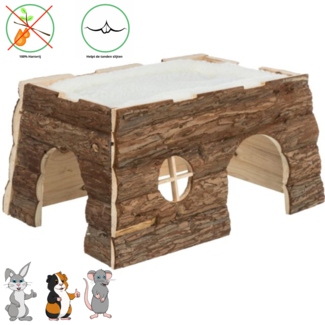
Bark wood has a rough, natural look and is lovely to gnaw on. The Trixie Hanna house comes in 26 × 16 × 15 cm, 31 × 19 × 19 cm and 43 × 22 × 28 cm. For a pair, the middle size is a good start; for a small group, choose the largest model. The Jerrik log cabin comes in 28 × 16 × 18 cm, 40 × 20 × 23 cm and 50 × 25 × 33 cm. The semicircular small animal house made of bark wood comes in 25 cm and 36 cm and lies on the floor like a vault. The semicircular shape also works well in a deep layer of bedding: your degus dig tunnels under and around it.
Houses with two entrances
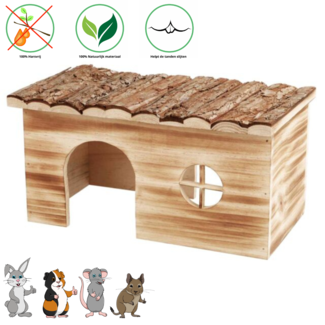
The Grete house made of flamed wood has two entrances and comes in 35 × 18 × 20 cm and 45 × 24 × 28 cm. The bark wood Ineke house (38 × 25 × 50 cm) has two entrances and a roof terrace, so it is a sleeping spot and a lookout post in one. For degus, two entrances are no luxury. If a dominant animal is sitting at one opening, another can leave through the other.
Corner houses and houses with a level
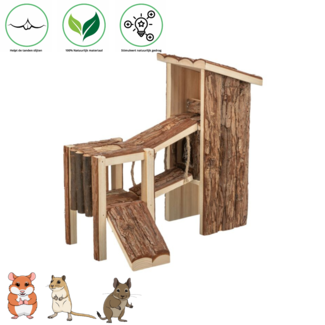
A corner house makes use of the space in a corner of the enclosure. The Jesper corner house comes in 30 × 13 × 21 cm and 42 × 15 × 30 cm, and Giga Mouse has the Dolly corner house of 32 × 13 × 21 cm. With these models, your degus can also climb onto the roof. The Giga Mouse Onyx house (20 × 19 × 21 cm) has two levels with a little staircase and adds extra living space on a small patch of floor. The compact Giga Mouse Bella house (28.5 × 19.5 × 16.5 cm) and the Hanne house made of flamed wood (29 × 18 × 18 cm) are suitable as a second or third hiding place.
Shelters, bridges and a maze house
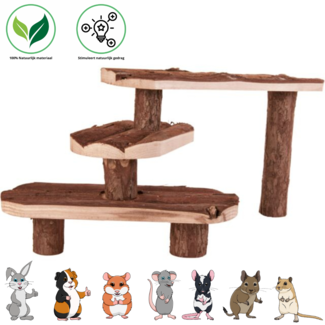
A bark wood shelter (30 × 22 × 25 cm) or a shelter with step (37 × 17 × 28 cm) is a hiding place underneath and a platform on top. The wooden house with flat roof (28 × 16 × 18 cm) works in the same way. The willow bridge (30 × 16 × 30 cm) is an open willow arch to shelter under and gnaw on. The bark wood toy maze (35 × 11 × 25 cm) is a labyrinth house with little passages: a hiding place that also invites exploration.
How do you choose the right house for degus?
Start with your group. Degus live at least in pairs, preferably in a small group of the same sex. They like to sleep together, so the main house must be roomy enough for everyone. An adult degu is bigger than a hamster and has a long tail. So it is better to choose one size too big than too small. Houses mainly intended for hamsters and mice are usually too cramped as a sleeping spot for a group of degus.
Then look at the entrances. For a group, a house with two entrances is ideal. There is then always a way out, even if two degus briefly disagree. If you have a house with one entrance, position it so the opening does not face into a narrow corner.
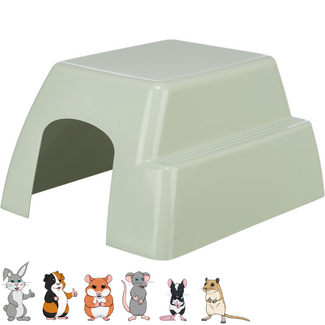
Finally, think about the material. Wood, bark wood and willow are safe to gnaw and feel natural. They do slowly get gnawed to pieces; that is part of it. Plastic houses are less suitable for degus, because they quickly gnaw plastic to pieces and can then end up with fragments and sharp edges.
How many houses does a group of degus need?
The rule of thumb is at least one hiding place per degu, and preferably one extra. They do not all have to be large houses. A large sleeping house for the group, supplemented with a few smaller houses, shelters, a willow bridge or tunnels, gives enough choice. Spread the hiding places over different levels: one house low on the floor, one on a platform and a shelter halfway up. That way a degu that wants some peace can always go somewhere without having to pass through the whole group.
Where do you put a house?
Put the sleeping house in a quiet, dry spot, not under the water bottle and not where your degus prefer to pee. A house on a higher platform must stand stably. Degus leap on and off at speed, and a wobbly house can topple over. Provide a safe route up, such as a bridge, ramp or branch, so they do not have to jump from a great height.
In an enclosure with a deep layer of bedding, you can also bury a house halfway. Degus will then dig tunnels to the entrance themselves. That fits in nicely with their natural behaviour, because in the wild degus live in underground tunnel systems. Make sure the house is firmly in place and cannot collapse.
Nesting material in the house
Degus like to finish off their sleeping spot themselves. Put some hay or safe nesting material made of natural fibres near the house and let them drag and arrange it themselves. Do not use cotton wool or synthetic nesting fluff: the threads can wrap around little legs or toes. Zooply Nesting Material from the Nesting material category and ordinary hay are safe choices.
Cleaning and replacing
Check the sleeping house at every clean. Remove wet or dirty bedding and refresh the nesting material if needed. You can brush off wooden houses and, if necessary, wipe them with a slightly damp cloth. Then let them dry thoroughly before they go back into the enclosure. Do not use strongly scented cleaning products. Replace a house if it keeps smelling musty, is so damaged that it becomes unstable, or if sharp splinters appear.
Useful combinations
A house works best as part of a well-furnished enclosure:
- Bedding: a deep, low-dust layer of Zooply Hemp Fibre or Wood Fibre to dig in.
- Nesting material: Zooply Nesting Material to furnish the sleeping spot.
- Tunnels: safe connections between houses, feeding spot and sand bath.
- Hammocks & Hanging bridges: extra resting places and routes up high.
- Chew wood: gives the urge to gnaw an outlet, so the house lasts longer.
Frequently asked questions about houses for degus
How big should a degu house be?
Big enough for all your degus to lie in together. For two degus, a medium-sized house such as the 31 × 19 × 19 cm Hanna house is a good starting point. For a group of three or more, choose a larger model, such as the 43 × 22 × 28 cm Hanna house, the 40 × 20 × 23 cm Jerrik log cabin or the 45 × 24 × 28 cm Grete house. Use smaller houses as extra hiding places.
My degus are gnawing the house to pieces. Should I choose a different material?
No, gnawing on a wooden house is normal and even useful. Degus gnaw both wood and plastic to pieces, but wood is safe if they swallow a bit. Give extra chewing material, such as Zooply Apple Branches or Zooply Dandelion Roots, and the urge to gnaw will be spread out. Replace the house when it becomes unstable or develops sharp edges.
Why don't my degus sleep in the house?
Sometimes the house is too small for the whole group, it stands in a draughty or busy spot, or they simply prefer another place. Try moving the house to a quiet corner or a platform, and put some hay and nesting material inside. If they sleep contentedly in a tunnel or hammock, that is fine too, as long as there is enough choice.
Is a house with one entrance bad?
Not bad, but for a group two entrances are better. A degu sitting in a house with one opening can be blocked in by another animal. If you use houses with one entrance, provide several hiding places, so nobody depends on a single spot.
My degus pee in the house. What can I do?
Move the house to a different spot and see where your degus prefer to pee. Clean that spot more often. Clean the house and let it dry thoroughly before putting it back. A house that is too close to the water bottle or the feeding spot is more likely to be used as a toilet.
Can I use an edible hay house for degus?
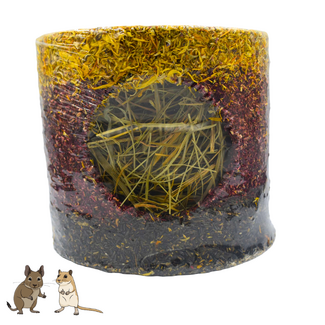
A house made of hay is natural in itself, but always read the ingredients. Degus must not have sugar, so no houses with carrot, fruit or honey. An ordinary wooden or willow house with loose hay alongside it is the safest choice for degus.
Buying houses for degus at Knaagplaza
At Knaagplaza, the webshop of 't Knaagplein, you will find houses for degus in every size, from a compact hiding place to a roomy group house. Complete it with Zooply hay, Zooply bedding and Zooply Degu Food. Zooply is our own premium brand and we use it every day for our own animals. That way you give your degus an enclosure where they can be active and truly relax.