


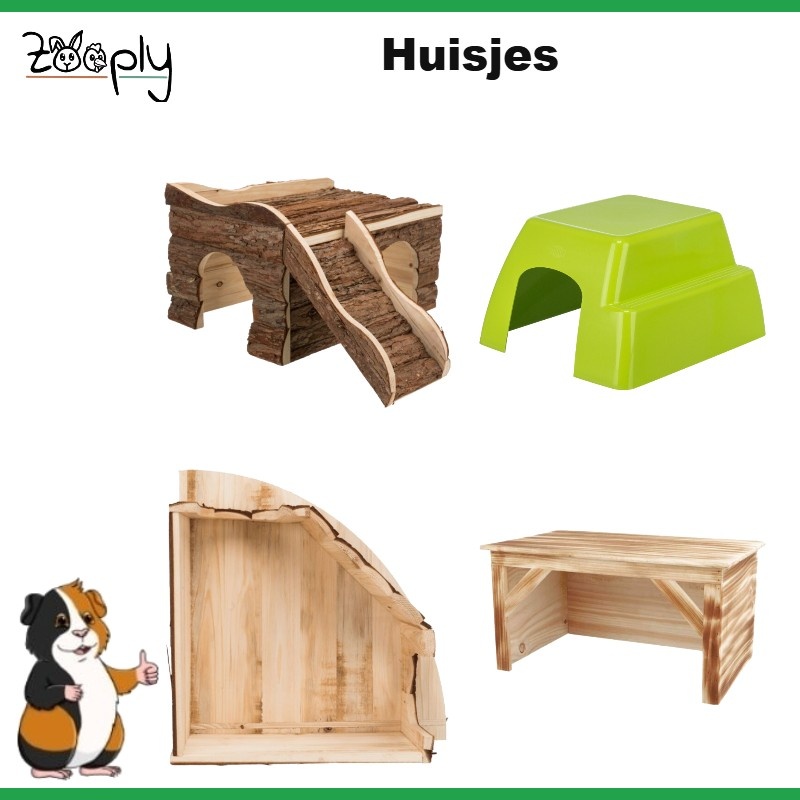
Houses for guinea pigs: a safe place to hide
A guinea pig is a prey animal. In the wild, guinea pigs live in groups in dense vegetation, and at every unexpected sound they dash off to a sheltered spot. That behaviour is still fully present in a pet guinea pig. A guinea pig without a hideaway feels unsafe, becomes jumpy and eats and moves less. With enough houses in the enclosure, guinea pigs actually dare to do more: they explore, eat calmly and get used to you more quickly.
In this category you will find wooden hideaways in many sizes, edible hay houses, soft sleeping houses, plastic igloos and shelters for the run. Place the houses on a floor with a generous layer of bedding and add some Zooply hay, our own premium brand. Guinea pigs like to eat close to their hideaway, and they feel safest in a house with hay in front of it.
In short
- ✓ Provide at least one hideaway per guinea pig, and ideally one extra.
- ✓ Houses with two entrances are ideal: a guinea pig never gets trapped.
- ✓ Choose a house in which your guinea pig can sit upright and turn around.
- ✓ Wood and hay may be gnawed on; replace them when they are broken.
- ✓ Soft houses are cosy, but you need to wash them regularly.
What will you find in the Houses category?
Wooden houses with two entrances
For guinea pigs, houses with two openings are the best choice. Trixie House Grete (flamed wood) has two entrances and comes in 35 × 18 × 20 cm and 45 × 24 × 28 cm. House Ineke made of bark wood (38 × 25 × 50 cm) has two entrances and a roof terrace. Log cabin Jerrik, House Hanna and the Trixie wooden houses with a flat roof also come in sizes for guinea pigs. Pay attention to the dimensions: for a guinea pig, choose the models from about 30 cm in length.
Corner houses and large wooden houses
Corner house Jesper made of bark wood fits neatly into a corner of the enclosure and comes in 42 × 15 × 30 cm and 52 × 18 × 37 cm. Larger wooden houses, such as House Hanna (43 × 22 × 28 cm), House Ragna (35 × 18 × 20 and 43 × 22 × 25 cm), House Kirby (43 × 22 × 28 cm) and House Bella (37 × 28 × 21 cm) by Giga Mouse and the semicircular bark wood rodent house (36 cm), offer room for one or two guinea pigs at a time. House Tilde (39 × 22 × 29 cm) has a soft bed on the roof.
Houses with hay rack
Trixie House Hilke (40 × 23 × 32 cm) and the house with hay rack (40 × 25 × 29 cm) combine a hideaway with a built-in hay rack. Guinea pigs like to eat under cover, so this is a clever combination. Do make sure there are enough other hideaways, so not everyone fights over this one house.
Edible hay houses
The JR Farm hay houses are made of dried hay and are completely edible. There is a hay house with flowers in 37 × 24 × 21 cm and 27 × 18 × 17 cm, and a 350-gram hay house with carrot. Your guinea pig hides in it and slowly nibbles it away. See it as enrichment: after a while the house has been eaten and needs to be replaced. Carrot contains sugar; the hay house with carrot is therefore a treat, not for every day.
Soft sleeping houses
For guinea pigs that like to lie snugly, there are soft houses: the Flamingo sleeping houses shaped like a pumpkin, apple or pineapple (around 23 cm), the Flamingo Clavio sleeping place, the Beeztees plush houses (40 × 40 × 40 cm, in anthracite, beige or pink), and from Trixie a triangular hideaway (44 × 33 × 40 cm), a tent (37 × 35 × 37 cm) and a soft relax tunnel (27 × 21 × 80 cm). Soft houses are warm, but guinea pigs also wee in them. Choose them as an extra, alongside wooden houses, and wash them often.
Plastic houses
The Trixie plastic house (26 × 23 × 15 cm) and the Zolux igloo (30 × 26.5 × 17 cm, grey or beige) are light and easy to rinse off. Guinea pigs sometimes gnaw on plastic; check the edges and replace a house with rough gnawed areas.
Shelters, bridge and Metró Station
The Trixie shelter (50 × 26 × 31 cm) is made for the run and provides protection against sun and rain. Shelter Sunny (28 × 24 × 28 and 37 × 29 × 27 cm) combines a wooden shelter with a hammock. The willow bridge (30 × 16 × 30 cm) is an open hideaway to lie under and gnaw on. The Natura rodent house (60 × 47 × 50 cm) is a large outdoor house for the run. The Ferplast Metró Station (43 × 48 × 44 cm) is a house that you can connect to the Metró tunnels.
How many houses do you need?
Guinea pigs should live at least in pairs. Even in a good group, a guinea pig sometimes wants to be alone for a while. That is why the rule is: at least one hideaway per guinea pig, and ideally one extra. With two guinea pigs, that means three hideaways. Spread them across the enclosure, so a dominant guinea pig can't guard all the houses from one spot.
Not every hideaway has to be a closed house. A tunnel, a shelter, a hay house or a basket counts too. It is exactly that variety that makes the enclosure interesting: one guinea pig likes to sleep in a closed house, another prefers to lie under an open shelter.
Why two entrances are so important
A house with one entrance can become a trap. If a dominant guinea pig sits down in front of the opening, the guinea pig inside has nowhere to go. That causes stress and sometimes fights. With a house with two entrances, a guinea pig can always get out on the other side. That is why houses such as Grete and Ineke are the best foundation for a group. If you also have houses with one entrance, position them so that the opening isn't in a corner or against a wall.
The right size
A guinea pig must be able to sit upright in the house, turn around and lie stretched out. Adult guinea pigs vary quite a bit in size, so look at your own animals. The smallest models, such as House Hanna of 26 cm and the small Log cabin Jerrik of 28 cm, are made for hamsters and gerbils and are too small for an adult guinea pig. Ideally choose models from about 30 cm; houses just below that only suit small or young guinea pigs. A slightly larger house is never a problem; two guinea pigs will then sometimes lie in it together.
Maintenance
Take the houses out of the enclosure once a week, shake them out and wipe them clean. Don't get wooden houses too wet; let them dry thoroughly after cleaning. Wash soft houses regularly according to the label. Check wooden and plastic houses for sharp edges, splinters and gnawing damage, and replace a house that is broken. Replace a hay house when it has been eaten or has become dirty.
Useful combinations
A house is the start of a well-furnished enclosure. Combine it with:
- Tunnels: safe walking routes between the houses.
- Baskets: an open sleeping place to lie in and gnaw on.
- Hay: Zooply hay at the entrance of the house, so your guinea pigs can eat under cover.
- Bedding: a dry, absorbent layer under and around the houses.
- Runs: a run needs hideaways too.
Frequently asked questions about guinea pig houses
My guinea pig sits in its house all day. Is that normal?
A new guinea pig often hides a lot during the first few days. That is normal. Give it peace and quiet, put hay and vegetables close to the house and let it come out by itself. If a guinea pig is still almost always inside after a few weeks, or is eating less, check whether there are enough hideaways and whether it is being chased away. If it isn't eating or is losing weight, contact a vet with guinea pig expertise.
Why does my guinea pig gnaw on its wooden house?
Gnawing is natural behaviour. Guinea pigs' teeth keep growing throughout their lives, and gnawing on untreated wood keeps them busy. Hay remains the most important thing for the wear of teeth and molars, though. A gnawed house is therefore not a problem, as long as no sharp points or loose pieces appear.
Is a soft house suitable for guinea pigs?
Yes, as an extra. Many guinea pigs love lying in a soft house, especially in the colder months. Guinea pigs do wee in them, though, and some nibble on the fabric. So wash soft houses often, check them for loose threads and make sure there are always wooden houses or tunnels as well.
Can guinea pigs eat a hay house?
Yes, that is what it is meant for. The JR Farm hay house is made of hay with flowers or carrot. With the carrot hay house, it is wise to see it as a treat, because carrot contains sugar. Remove a hay house when it has become wet or dirty.
How many houses do I need for three guinea pigs?
At least three, and ideally four hideaways. These can be houses, tunnels, shelters or baskets. Spread them across the enclosure and choose at least a few with two entrances.
Guinea pig houses at Knaagplaza
At Knaagplaza, the webshop of 't Knaagplein, you will find houses of all types and sizes, so every guinea pig in your group has its own hideaway. Place them on a thick layer of bedding and add fresh Zooply hay, our own premium brand that we use every day for our own guinea pigs. That way your guinea pigs feel safe and dare to show themselves.