




Buying a hamster enclosure: cages, runs and terrariums
The enclosure is the most important thing you buy for your hamster. A hamster spends practically its entire life in it: it sleeps there during the day, runs for miles in its wheel at night, digs tunnels and builds up a food stash. The more space and digging depth the enclosure offers, the more natural behaviour your hamster can show and the calmer it is. An enclosure that is too small or too shallow is more likely to lead to stress, bar chewing and restless pacing back and forth.
In this category you will find everything to house your hamster: cages with a glass or acrylic base and wooden enclosures, runs for temporary extra space, and terrariums. Whichever type you choose, the basics are always the same: plenty of floor space and a thick layer of bedding. In our own shop and at our breeding facility, we use bedding from Zooply, our own brand, for this.
In short
- ✓ The permanent enclosure (cage or terrarium) is the foundation; choose it as large as you can fit.
- ✓ Floor space and a deep base matter more than extra levels.
- ✓ Allow for at least about 20 cm of bedding to dig in.
- ✓ A run is temporary extra space under supervision, not a replacement for the enclosure.
- ✓ One hamster per enclosure; place it in a quiet, draught-free spot, not in the bedroom.
What will you find in the Cages category?
Cages
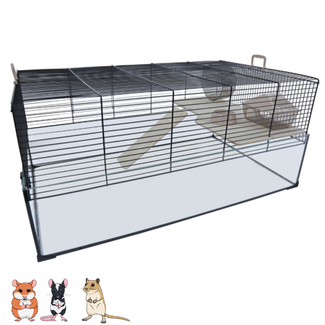
In the Cages subcategory you will find enclosures with a deep base. There are models with a glass base, such as the rodent enclosure of 80 × 50 × 40 cm and the Ferplast cage of 78.5 × 45.5 × 52.5 cm, and the Zolux enclosures on legs of 78 × 48 × 36 cm. For Syrian hamsters, the larger models are most suitable: the Trixie wooden enclosures with acrylic (100 and 115 cm wide) and the Ferplast cages with an acrylic base of 100 and 120 cm. Matching stands on wheels are available for the Ferplast enclosures.
Runs
In Runs you will find a Trixie metal playpen, a wooden indoor run with separate panels and a fleece blanket for the floor. A run is handy when you are cleaning the enclosure or want to work calmly on taming. Always use a run under supervision and with a hideaway in it; hamsters climb and escape faster than you would expect.
Terrariums
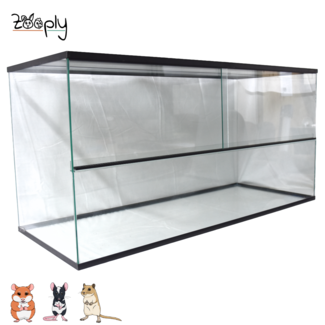
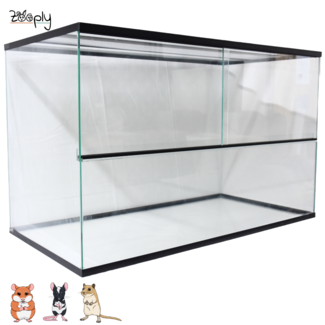
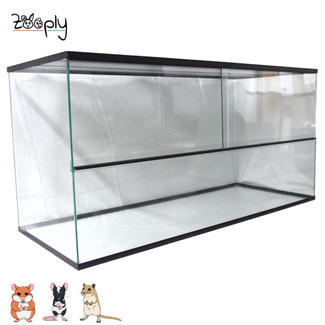
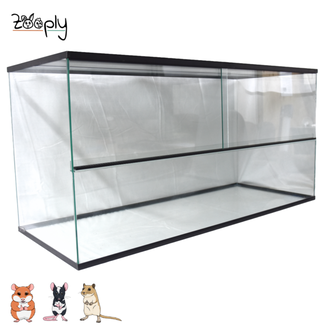
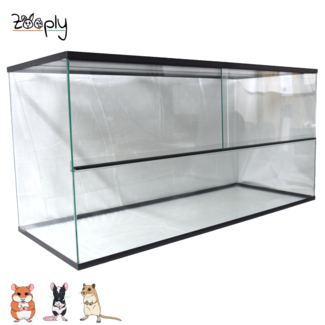
In the Terrariums subcategory you will find glass enclosures. Glass allows for a thick layer of bedding and makes it easy to set up the enclosure as a natural landscape. With a glass enclosure, always make sure there is enough ventilation and never place it in the sun, because glass warms up quickly.
Cage, run or terrarium: which do you choose for what?
Each of these three types of enclosure has its own role. A cage or a terrarium is your hamster's permanent home: that is where it lives, where it digs its tunnels and where its stash is. A run is something else. You use it now and then, briefly and under supervision, as extra space or as a safe place during cleaning. So always buy a good permanent enclosure first; a run is an addition you can add later.
You choose between a cage and a terrarium based on your situation. An enclosure with a glass or acrylic base and bars or mesh on top combines a deep digging layer with plenty of fresh air. A fully glass enclosure keeps the bedding inside and lets you see the tunnels along the glass, but needs extra attention for ventilation and heat. Wood gives a natural look, but absorbs moisture; you need to take that into account when cleaning.
Three questions before you choose an enclosure
How much space do I have at home?
Measure the spot where the enclosure will stand, and choose the largest model that fits there. With hamsters, it is the floor space that counts, not the height. A wide, deep enclosure gives more room to run and dig than a tall enclosure with levels. The enclosures in this category range from about 80 cm to 120 cm wide.
Do I have a Syrian hamster or a dwarf hamster?
A Syrian hamster is the largest and needs the most space, plus a running wheel of at least about 28 to 30 cm. The enclosures of 100 cm and wider are most suitable for it. Dwarf hamsters are smaller and manage with a wheel of at least about 20 cm, but they are just as active. A roomy enclosure pays off for them too. Whichever species you have: keep one hamster per enclosure. Syrian hamsters are solitary, and keeping dwarf hamsters together often ends in fights.
Will a thick digging layer fit in it?
A hamster needs at least about 20 cm of bedding, and preferably more. So look at the height of the base. A low plastic base is too shallow; the bedding will then disappear through the bars. With a high glass or acrylic base, you can add a generous layer.
Escape risks
Hamsters are surprisingly strong and resourceful. They push against doors, climb up mesh and squeeze through gaps that seem smaller than their body. So check on arrival that all doors and the lid close properly, that the bars are close enough together for your hamster and that there is no gap anywhere between the base and the top. In a glass enclosure, don't place a house or branch so high against the wall that your hamster can reach the edge with it. What's more, an escaped hamster often hides under furniture or behind cupboards, where it is hard to find again.
Where will the enclosure stand?
A hamster sleeps during the day and wakes up at dusk. So choose a room that is quiet during the day and where its digging and running in its wheel won't disturb anyone at night. That makes the bedroom unsuitable. A good spot is draught-free, out of sunlight and away from radiators, the television and speakers. At table height or on a stand, you can also watch your hamster calmly without approaching it from above, which is less threatening for a prey animal.
Setting up the enclosure
Once the enclosure is there, it's time to set it up. Fill the base with Zooply bedding, for example hemp fibre, wood fibre, cotton fibre or coconut shreds, and mix in some hay for sturdy tunnels. Provide nesting material, at least one house and an extra hideaway, tunnels, a running wheel with a solid running surface, a sand bath, a food bowl and a water bottle. Gnawing wood, dried herbs and natural materials complete the set-up.
Maintenance
A hamster wants its enclosure to keep smelling of itself. Maintenance is therefore mainly targeted: refreshing wet patches and the sand bath, removing perishable food, and leaving the nest with the stash in place. A full clean is only needed now and then. During such a big clean, put your hamster in a small carrier or a run, and afterwards mix some old, clean bedding through the fresh layer.
Useful combinations
- Bedding: Zooply bedding for a thick digging layer.
- Nesting material: Zooply nesting material for a warm nest.
- Accessories: houses, tunnels, running wheels and hamster scaping to furnish the enclosure.
- Care & Grooming: food bowls, water bottles, sand baths and small carriers.
- Hamster food: Zooply Syrian Hamster Food and Dwarf Hamster Food.
Frequently asked questions about hamster enclosures
What is the difference between a cage and a terrarium?
A cage usually has a base with bars or mesh above it, which provides plenty of fresh air. A terrarium is mostly made of glass, keeps a deep layer of bedding inside well and lets you see the tunnels. With a terrarium, you pay extra attention to ventilation and you never place it in the sun. For both, floor space and digging depth are the most important things.
What do I use a run for?
For short moments outside the enclosure, for example while cleaning or to practise taming calmly. Always stay with your hamster and put a hideaway in the run. A run is not suitable as a permanent home, because it can't hold a deep digging layer and your hamster doesn't really feel safe in it.
Which enclosure size suits a Syrian hamster?
For a Syrian hamster, preferably choose an enclosure 100 cm wide or more, with a deep base. Such an enclosure also has room for a running wheel of at least about 28 to 30 cm, a few large houses and a sand bath, without losing digging space.
Can I keep two dwarf hamsters together in one enclosure?
We advise against it. Dwarf hamsters can seem to get along for a while and then suddenly start fighting, resulting in injuries. So keep each hamster in its own enclosure. For Syrian hamsters this always applies: they are solitary.
What do I need besides the enclosure?
A thick layer of bedding, nesting material, at least one house and ideally an extra hideaway, a running wheel of the right size, a sand bath with bathing sand, a heavy food bowl, a water bottle and good hamster food. With tunnels, gnawing wood and natural materials, you complete the enclosure further. Start with the basics and then expand step by step.
Buying a hamster enclosure at Knaagplaza
At Knaagplaza, the webshop of 't Knaagplein, you will find cages, runs and terrariums for Syrian hamsters and dwarf hamsters. Start with a roomy permanent enclosure, fill it with Zooply bedding and set it up step by step. Zooply is our own premium brand; we use it every day for the animals in our shop and at our breeding facility.