











Rabbit house: a safe hideaway in the hutch, run or home
Rabbits are prey animals. In the wild, they dash into their burrow at the slightest sign of danger. Pet rabbits still have that behaviour. A rabbit that can hide somewhere feels safer, gets startled less easily and, as a result, actually dares to explore more. A house is therefore not a luxury but a basic need. Every rabbit needs at least one hideaway, and with two or more rabbits you ideally provide one extra.
In this category you will find wooden houses in many sizes and shapes, soft fabric hideaways, an outdoor house and shelter for the run, and edible hay houses. Put some fresh Zooply hay, our own premium brand, in and around the house: the hideaway then immediately becomes a place to nibble in peace.
In short
- ✓ A rabbit must be able to lie stretched out and turn around in the house.
- ✓ A house with two entrances prevents a rabbit from getting trapped by a companion.
- ✓ Provide at least one hideaway per rabbit, ideally one extra.
- ✓ Choose untreated wood without varnish or paint; gnawing is part of the deal.
- ✓ Place the house in a dry, quiet spot, not in the wet toilet corner and not in full sun.
What will you find in the Houses category?
Wooden houses for rabbits
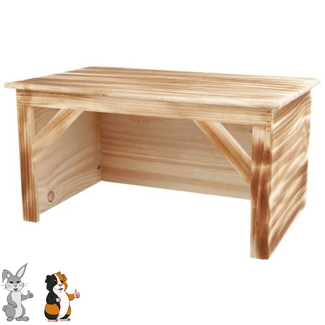
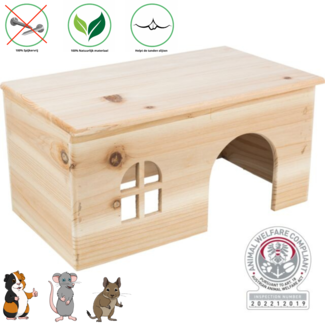
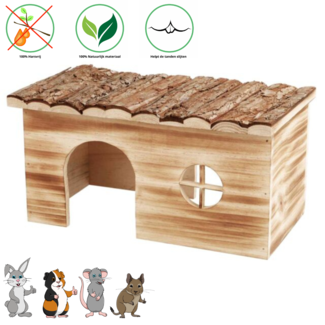
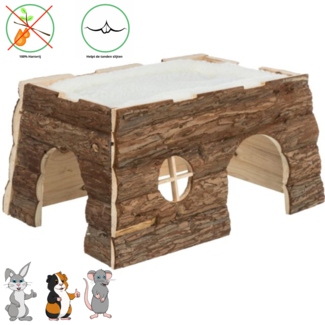
Most of the category consists of wooden houses by Trixie and Giga Mouse, made of bark wood or flamed wood. For a rabbit, the roomier models are particularly suitable. Log cabin Jerrik of 50 × 25 × 33 cm is made for rabbits and also comes in 40 × 20 × 23 cm. House Grete of 45 × 24 × 28 cm has two entrances. House Hanna and House Kirby come in 43 × 22 × 28 cm; Kirby has two openings. There is also House Bella (37 × 28 × 21 cm), House Ragna (43 × 22 × 25 and 35 × 18 × 20 cm), the wooden house with a flat roof (40 × 20 × 23 cm) and the large Corner house Jesper of 52 × 18 × 37 cm, which fits neatly into a corner of the enclosure.
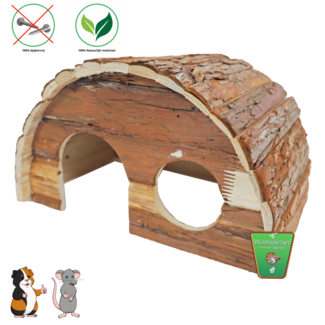
Some houses have something extra. House Ineke (38 × 25 × 50 cm) has two entrances and a roof terrace. Rabbits love to sit on the flat roof of many houses to look around. House Tilde (39 × 22 × 29 cm) has a soft bed on the roof. House Hilke (40 × 23 × 32 cm) and the house with hay rack (40 × 25 × 29 cm) have a built-in hay rack, so your rabbit can eat in a sheltered spot. The semicircular bark wood rodent house (36 cm) is an open arch to shelter under.
Pay close attention to the sizes: houses of around 20 cm high suit a dwarf rabbit, not a medium-sized or large breed. The category also includes smaller models that, according to the product information, are intended for guinea pigs, rats or hamsters, such as House Hanna of 26 and 31 cm, House Hanne and the small Log cabin Jerrik. These are too small for a rabbit.
Outdoor house and shelter for the run
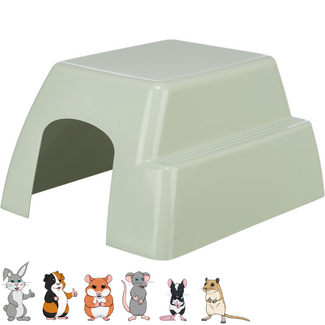
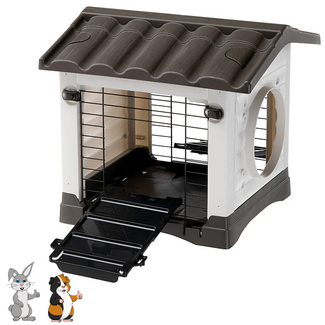
The Trixie Natura rodent house (60 × 47 × 50 cm, grey-green) is a roomy house for the outdoor run. Two rabbits can also lie in it together. The Trixie shelter (50 × 26 × 31 cm) provides a protected spot in the run against rain and sun. A run should always have at least one place where your rabbit can get out of the sun and rain.
Soft hideaways
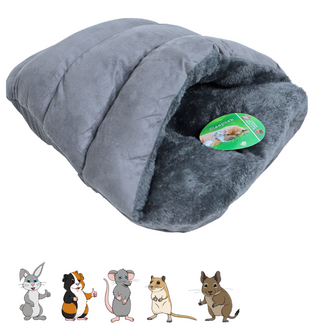
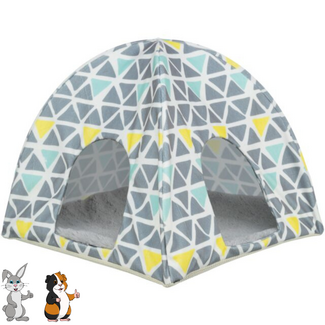
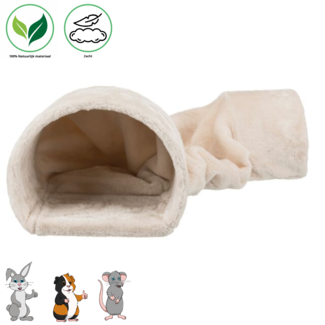
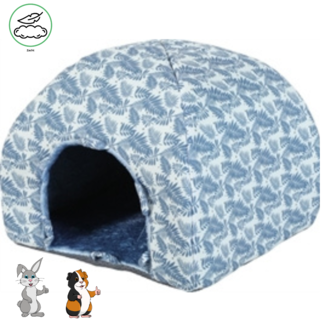
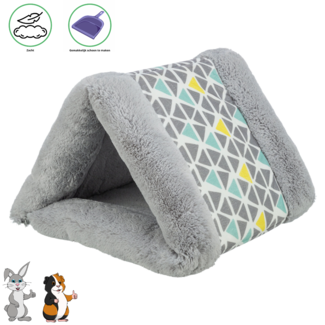
For indoor rabbits there are fabric hideaways: the triangular Trixie hideaway (44 × 33 × 40 cm), a tent (37 × 35 × 37 cm), the Beeztees plush house (40 × 40 × 40 cm) in anthracite, beige and pink, and the soft relax tunnel (27 × 21 × 80 cm). They are cosy and lightweight. Fabric is less suitable for a rabbit that chews it a lot or wees in it. Check soft houses regularly for loose threads and holes, and wash them according to the product information.
Edible hay houses
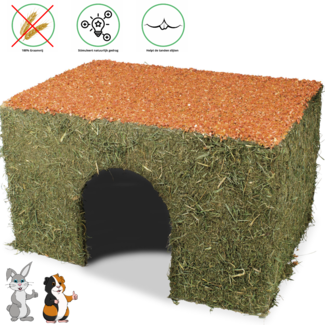
The JR Farm hay houses are a hideaway and a nibble product in one. There is a hay house with a carrot roof (650 grams) and a hay house with flowers made of mountain meadow hay in 37 × 24 × 21 cm and a smaller size. Your rabbit slowly eats the house. See it as enrichment and a treat: it does not replace the daily hay, and the carrot on the roof is sweet. Replace the house when it has mostly been eaten or is dirty.
Other hideaways
The willow bridge (30 × 16 × 30 cm) is an arch of willow branches to hide under and gnaw on. The Ferplast Metró Station (43 × 48 × 44 cm) is an enclosure section that you can connect to the Metró tunnels.
How big should a rabbit house be?
A rabbit must be able to lie stretched out in its house, turn around and sit without crouching. Measure your rabbit when it is lying stretched out and add some room to that. A dwarf rabbit manages with a house of about 40 cm long and 20 cm high. A medium-sized rabbit needs a house of 45 to 50 cm long and at least 25 to 30 cm high. For a large breed, choose the roomiest model, such as the Natura outdoor house.
If you want two rabbits to lie together in one house, it must be roomy enough for both. Many rabbits like to snuggle up against each other, but a rabbit also wants to be able to be alone. A second house or a tunnel as an extra hideaway prevents squabbles.
Why two entrances?
A house with one entrance can become a trap. If one rabbit is inside and the other blocks the entrance, it can't get away. With a pair that gets along well, this is usually not a problem. With new pairs, during bonding or with a dominant rabbit, however, it can lead to stress or a fight. Houses with two entrances, such as Grete, Ineke and Kirby, always leave a way out.
The right spot for the house
Place the house in a dry, quiet spot. Not in the corner where your rabbit wees: the wood will get wet and start to smell. Not in full sun, because it can quickly get warm inside a house. Indoors, not in the middle of a walkway and not next to a radiator or television. Outdoors, place the house on a raised base or on tiles, so it doesn't get wet from below.
A house with a flat roof is also a lookout post. In that case, make sure your rabbit can jump off it safely and that the roof isn't too close to the top of the hutch. Give the house a fixed spot: rabbits like a fixed layout, and a house that has been moved can cause some unrest for a while.
Gnawing, cleaning and replacing
Rabbits gnaw on their house. With untreated wood that is not a problem, as long as no sharp splinters or loose pieces appear. Also give plenty of hay and gnawing wood, so the house isn't the only thing to gnaw on. Regularly remove old hay and droppings from the house. Clean it now and then with warm water and a brush, without strongly scented products, and let it dry thoroughly before putting it back. Replace a house when it has been gnawed so much that it becomes unstable, or when it keeps smelling damp and musty.
Useful combinations
A house works best as part of a complete set-up with several places to hide, eat and play:
- Tunnels: a second hideaway and an escape route between the house and the hay spot.
- Baskets: to lie in and gnaw on.
- Hay: Zooply hay in and around the house for a quiet nibbling spot.
- Gnawing wood: a safe alternative to gnawing on the house.
- Runs: plenty of room to move, with a house as a safe base.
Frequently asked questions about rabbit houses
How many houses does a rabbit need?
At least one hideaway per rabbit, and ideally one extra. For a pair, that means three hideaways, for example two houses and a tunnel. That way each rabbit can always choose its own spot and nobody has to wait for the other to come out.
My rabbit wees in its house. What can I do?
A rabbit often wees in a place where it feels safe. Place a litter tray with litter pellets and hay above it next to the house, clean the house thoroughly without strong scents and let it dry. It often also helps to move the house slightly, away from the corner your rabbit has chosen as its toilet. With young rabbits, it usually sorts itself out once they are litter trained.
Is a fabric house suitable for a rabbit?
For a calm indoor rabbit that doesn't gnaw much, a soft hideaway is fine and often much loved. For a rabbit that likes to destroy things or isn't litter trained yet, wood is more practical. Check fabric houses for loose threads: threads can get wrapped around a little paw. Wash them regularly.
Can my rabbit eat the edible hay house completely?
Yes, that's the idea. The hay house is made to be nibbled on. It is a treat, though: your rabbit still gets unlimited loose hay in a rack as well. With the carrot hay house, the roof is sweet; so it isn't a daily snack.
Does a rabbit that roams free in the house also need a house?
Yes. Even a rabbit with lots of space wants a safe place of its own, ideally in a quiet corner. Without a house, it often crawls under the sofa or behind a cupboard, where you can hardly see it and where it can gnaw on cables. A house near its hay and toilet spot gives peace of mind.
Which house suits two rabbits?
Choose a roomy house with two entrances, such as House Grete of 45 cm or the Natura outdoor house, and add a second hideaway alongside it. That way your rabbits can lie together when they want to, and go their separate ways when they prefer.
Buying rabbit houses at Knaagplaza
At Knaagplaza, the webshop of 't Knaagplein, you will find houses and hideaways in many sizes for indoors and outdoors. Choose a size that really suits your rabbit and add some Zooply hay, our own premium brand that we use every day for our own rabbits. That way your rabbit has a safe place to rest and nibble.