


Toys for degus: gnawing, climbing and foraging
Degus are awake during the day and busy all day long. They run, climb, dig, gnaw and investigate everything that is new in their enclosure. A degu that has nothing to do will find something itself: chewing the bars, running endless circles or becoming restless in the group. Good toys give that energy an outlet. They make the enclosure more interesting and let your degus do what they are naturally good at.
In this category you will find toys made of natural materials such as willow, bark wood, grapevine wood, straw and bamboo, climbing material such as bridges and steps, and enrichment games in which you hide food. For degus, one thing is extra important: they are sensitive to sugar. That is why you preferably fill foraging games with their own Zooply Degu Food or with sugar-free Zooply herbs, and not with fruit or sweet snacks.
In short
- ✓ Mainly choose toys made of untreated natural material: degus gnaw everything they come across.
- ✓ Degus quickly chew plastic and fabric to pieces; use such toys only briefly and under supervision at most.
- ✓ Fill foraging games with part of the daily degu food or sugar-free herbs, never with fruit or sweets.
- ✓ Spread toys across the enclosure, so every degu in a group has something to do.
- ✓ Check toys weekly and replace them if sharp edges, loose parts or threads appear.
What will you find in the Toys category for degus?
Chew toys made of willow, straw and bamboo
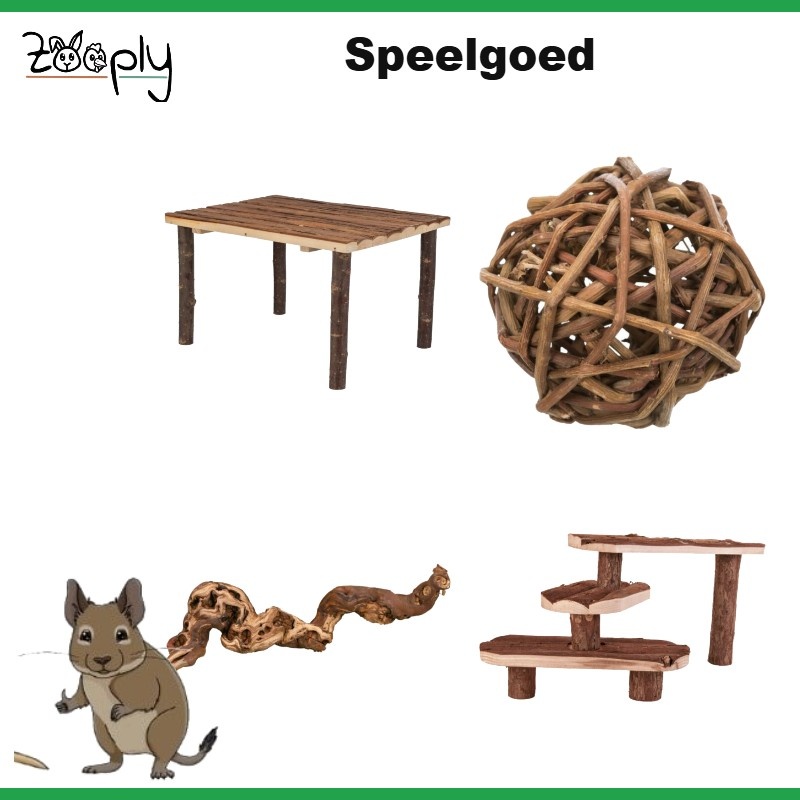
For a degu, gnawing is not a pastime but a basic need: the teeth keep growing throughout life. The Trixie Willow Ball in ø 6 cm and ø 10 cm is made of 100% willow wood. Degus roll it around the enclosure, pull twigs out of it and slowly gnaw it to pieces. You can also put a few dried herbs inside. The Trixie Set of Dumbbells (ø 4.5 × 9 cm, two pieces) are wooden chew dumbbells that you put down loose. Trixie also has straw toys: a set of corn cob and carrot of 15 cm and a set of radishes of 8 cm. They only have the shape of vegetables and are made of straw. The bamboo ball of ø 5 cm is made of natural material with hay.
Chew hangers
You hang the Flamingo hangers on the mesh or on a platform with a wooden hook. The Flamingo Hanger Jao (22 cm) is made of loofah, sisal and wood. The Flamingo Hanger Mareb (14 cm) consists of grass, loofah, corn leaves, leather and wood. A hanger makes your degu stretch and pull, which brings out slightly different behaviour from gnawing on the floor. Remove rope and sisal parts as soon as they start to fray.
Climbing branches, bridges and steps
Degus love to climb and are good at it. A 100% natural grapevine branch comes in 30–40 cm, 40–60 cm and 55–80 cm. Thanks to its irregular shape, you can use it to create a route between two platforms or a lookout post in a corner. You hang the flexible bark wood hanging bridge (61 × 8 cm) and the wooden hanging bridge with rope ladder (35 × 15 × 15 cm) between two levels. You can set up the flexible bark wood steps (38 × 24 cm) as stairs, as a bridge or curved as a hideaway.
Levels and corner elements
The Trixie Shelter and lying platform made of bark wood (45 × 27 × 35 cm) provides a sheltered spot under the roof and a lookout spot on top. You place the willow corner elements in 30 × 20 × 20 cm and 20 × 10 × 13 cm in a corner as a partition and hiding corner. Elements like these make an open enclosure calmer, because degus can get out of sight.
Foraging and brain games
With enrichment games, you make your degu think for its food. The Trixie Snack board (ø 20 cm) has seven little lids under which you hide something. With the Flip board and the Slide & Fun board (both ø 23 cm), your degu has to lift and slide lids. The wooden Snack cups (15 × 6 × 4.5 cm) and the Snack Bowl (28 × 3.8 × 18 cm) work in the same way. In the JR Farm Sniffing Box, you work food into the box, so your degu has to sniff and search. Fill all these games with degu food or sugar-free herbs. The Sniffing Box comes with snacks; read the ingredients and only use them if they contain no fruit, carrot or other sugars.
What should you look for in toys for degus?
Degus gnaw harder and more than many other rodents of their size. They chew wood and plastic to pieces in a short time. That is why untreated natural material works best: willow, bark wood, grapevine wood, cork, straw and bamboo. If a degu swallows a small piece of that, it isn't a problem. With plastic or soft fabric, it is a different story. A plastic toy lying on the floor gets damaged quickly, and then sharp edges and bits can appear. Don't leave such toys in the enclosure unattended.
Also watch out for varnish and paint. For degus, ideally choose toys in the natural colour of the material. With painted or coloured toys, you know less well what your degu is taking in when it chews through them.
Finally, look at the size. An adult degu is bigger than a hamster or mouse and has a long tail. A ball or hanger that is fine for a mouse will be gone in an afternoon with a degu. It is better to choose a larger model, such as the ø 10 cm willow ball.
Toys and sugar: watch what you put in them
Degus are prone to diabetes. That is why they don't get fruit, dried fruit, carrot, honey, molasses or sweet snacks. That also applies to what you hide in a foraging game or sniffing box. Use a small part of the daily portion of degu food, so your degu doesn't get anything extra. If you want variety, use sugar-free dried herbs such as dandelion leaf, nettle leaf or ribwort plantain from the Dried herbs category. Always read the ingredients of ready-made snacks. If they contain fruit, carrot, beetroot, sugar or honey, they are not for your degus.
Toys in a degu group
Degus should live at least in pairs, ideally in a small same-sex group. In a group, the pecking order is important. If you put one new toy in the middle, the dominant degu often claims it. So spread toys over several spots and levels. Put foraging games in two places and hang hangers at different heights. Then every degu can be busy without any pushing and shoving.
New toys also bring some tension. Degus are curious, but also cautious. Let them get used to it calmly.
How to use toys cleverly
Vary things, but not everything at once. Degus like fixed routes and a familiar layout. It is better to replace one item a week than the whole enclosure in one go. That keeps it interesting without making your group restless.
Combine toys with the furnishings. A grapevine branch between two platforms is a toy and a walking route. A corner element is a hideaway and something to gnaw. The more functions an item has, the more your degus get out of it, and the more floor space is left for running and digging.
Toys don't replace space. A degu needs a large, tall enclosure with levels, a quietly turning running wheel with a solid running surface of at least about 30 cm in diameter, a sand bath and enough hideaways. Toys make that enclosure richer, but they are no solution for a cage that is too small.
Cleaning and replacing
Toys made of willow, straw and bark wood can't really be cleaned with water. Knock or brush them off and replace them when they are dirty or smell musty. Wipe wooden boards and bowls with a dry or slightly damp cloth and let them dry thoroughly. Keep a regular wee spot in the enclosure free of toys, so they stay clean for longer. Check every week for loose strings, splinters or sharp edges. Toys that have been gnawed to pieces are a good sign: they were used. Replace them in good time.
Useful combinations
Toys work best in an enclosure where everything else is in order too. These categories go well with them:
- Gnawing wood: extra chewing material, such as Zooply Apple Branches and Zooply Dandelion Roots.
- Hay: unlimited Zooply hay, also handy for filling toys.
- Degu scaping: furnish the enclosure naturally, so toys get a logical place.
- Tunnels: safe routes and hideaways between the play areas.
- Hammocks & Hanging bridges: more climbing routes and resting spots up high.
Frequently asked questions about toys for degus
Do degus really need toys?
Above all, degus need space, company, hay, chewing material and a sand bath. On top of that, toys are an important addition. They give their daytime activity a purpose, prevent boredom and help reduce bar chewing. Chew toys made of natural material and foraging games in particular suit the behaviour of degus well.
Can I put snacks in the treat ball or snack board?
Only sugar-free ones. Degus are prone to diabetes, so fruit, carrot, honey and sweet snacks are not suitable. Use part of the regular degu food or a few sugar-free dried herbs. That keeps foraging fun without your degu unknowingly taking in sugar. If you are in doubt about a product, check the ingredients on the packaging.
My degus destroy toys within a day. Is that normal?
Yes, degus are enthusiastic gnawers. That is natural behaviour and actually exactly what chew toys are for. In that case, give more chewing material at once and choose sturdier items, such as a grapevine branch or wooden dumbbells. Only remove toys that become dangerous, for example due to sharp edges or loose strings.
Are plastic toys suitable for degus?
Degus quickly chew plastic to pieces. That is why plastic toys are not suitable to leave in the enclosure permanently. At most, you can offer a plastic foraging game briefly while you are there, and then take it away again. For toys that always stay in the enclosure, choose natural material such as willow, bark wood, grapevine wood or straw.
My degu doesn't play with new toys. What can I do?
Give it time. Degus are cautious with new things. Put a few sugar-free herbs in or next to it, or hide part of the daily portion of degu food in the toy. Place it in a spot your degus already visit often, such as along a walking route. After a few days, most degus will start investigating of their own accord.
Buying toys for degus at Knaagplaza
At Knaagplaza, the webshop of 't Knaagplein, you can choose toys that suit the active, gnaw-happy nature of degus. Combine them with unlimited hay, sugar-free herbs and Zooply Degu Food. Zooply is our own premium brand, which we use every day for our own animals in the shop and at our breeding facility. That way you give your degus a challenge and a healthy foundation every day.