



Degu cage: an enclosure for digging, climbing and running
The enclosure is the foundation of everything you do for your degus. Degus are active during the day and on the move all day long. They dig tunnels, climb to the highest point, run laps and gnaw on everything they come across. They live in at least pairs, preferably in a small same-sex group. A degu cage therefore needs to be spacious, sturdy and able to withstand strong gnawing teeth. The bigger, the better: an enclosure that the shop offers as a minimum is often truly the lower limit for degus.
In the Cages category you will find the subcategories Cages and Terrariums. At the moment the range mainly consists of the Zooply Glass Terrarium in 100 × 50 × 50 cm and 120 × 50 × 50 cm, our own enclosure with sliding doors, a ventilation grille, an anti-gnaw strip and a high bottom edge for a thick digging layer. Below you can read what to look for in any degu enclosure, which material is suitable and how to furnish it.
In short
- ✓ Choose the largest possible enclosure with plenty of floor space as well as height for levels.
- ✓ Degus gnaw wood and plastic to pieces: choose an enclosure made of metal or glass.
- ✓ Provide a thick digging layer, levels with safe routes, hiding places, a sand bath and a wheel of at least about 30 cm.
- ✓ Place the enclosure out of draughts, out of full sun and not next to a radiator, TV or speakers.
- ✓ A glass enclosure needs good ventilation and must never stand in the sun.
What will you find in the Cages for degus category?
Cages
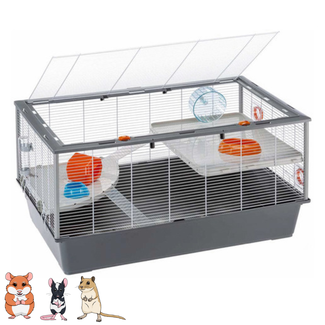
The subcategory Cages is for wire cages for degus. A good degu cage has a metal frame and bars, a deep base for bedding and several levels. With bars, look for a small bar spacing, so young degus cannot squeeze through, and sturdy doors with a catch that a clever degu cannot open.
Terrariums
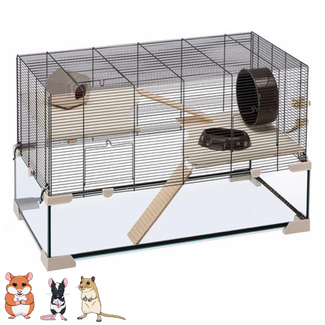
In the subcategory Terrariums you will find the Zooply Glass Terrariums. For degus, glass has one big advantage: it cannot be gnawed to pieces. The Zooply terrarium has sliding doors for easy cleaning, a ventilation grille and, according to the product details, an anti-gnaw strip and a high bottom edge. That high edge allows a thick layer of bedding, so your degus can dig real tunnels. The product information explicitly describes the terrarium as suitable for animals that love to dig, such as degus. With a height of 50 cm, it is an enclosure that offers space in width rather than height; you create climbing space with platforms, branches and cork. For degus, choose the roomiest size of 120 × 50 cm.
What to look for in a degu enclosure
Space in width and height
Degus run a lot and need floor space to build up speed. They also love to climb, so height is just as important. The ideal degu enclosure combines a large floor with a thick digging layer and, above it, levels connected by bridges, ladders and branches. The more space, the more easily you can fit in several routes, resting places and a large wheel, and the more calmly a group gets along.
Gnaw-proof material
Degus gnaw wood and plastic to pieces. A wooden cage or a cage with plastic levels, ramps or base is therefore not a good choice. Choose an enclosure made of metal or glass. Wooden items inside the enclosure, such as houses and bridges, are fine: they are allowed to gnaw on those. But the outside of the enclosure must be able to withstand their teeth, otherwise your degus will escape in no time.
Ventilation and temperature
A good enclosure is fresh and dry. With wire cages, ventilation is rarely a problem. With a glass enclosure, pay extra attention: the air must be able to circulate, and glass heats up quickly in the sun. So place every degu enclosure out of full sun, out of draughts, and not next to the radiator. A spot in a quiet living room where you are also around during the day suits these day-active animals well.
How to furnish a degu enclosure
The floor. Start with a thick layer of low-dust bedding, such as Zooply Hemp Fibre or Wood Fibre. Mix some hay through it, and dug tunnels will hold their shape better.
Levels and routes. Connect the levels with hanging bridges and ladders, cork tunnels or grapevine branches. Create several routes, so a dominant degu cannot block a single passage.
Hiding places. At least one hiding place per degu, preferably one extra, with a roomy sleeping house that the whole group fits in. Take a look in Houses.
Exercise. A wheel with a diameter of at least about 30 cm and a solid running surface.
Care. A fixed sand bath spot with Zooply Bathing Sand, a hay rack with Zooply hay, a heavy food bowl and a water bottle hung out of gnawing reach.
An enclosure for a group
Degus live in at least pairs, preferably in a small same-sex group. The more degus, the more space you need, but also the more choice. In an enclosure that is too cramped, degus keep getting in each other's way and squabbles over the best sleeping spot, the wheel or the sand bath arise more quickly. So for a group, plan extra hiding places, at least two routes to every level, two eating and drinking spots and possibly a second sand bath. Avoid dead-end corners and narrow passages where one degu can corner another.
Free-roaming time outside the enclosure
Even in a spacious enclosure, degus enjoy going on an expedition now and then. The roaming area must then be completely degu-proof, though: no cables, no gaps behind cupboards, no poisonous plants and nothing they can gnaw to pieces. Degus are fast and climb well, so a closed run or a small, fully screened-off room works better than an open living room. Always stay with them. Never pick a degu up by its tail: the skin of the tail can come off. Instead, let it walk into a tunnel or house by itself to bring it back.
Cleaning
Remove wet patches, droppings and food leftovers daily and replace the regular pee spot more often than the rest. Scoop the sand bath clean and refresh the water. Do a big clean in sections, so there is always part of the enclosure with a familiar smell. Wash hammocks regularly and check wooden items for sharp edges. Clean a glass enclosure with warm water and a mild cleaner; rinse well and let everything dry before the bedding goes back in.
Useful combinations
An enclosure becomes a home with the right furnishings:
- Bedding: Zooply Hemp Fibre, Wood Fibre or Cotton Fibre for a thick digging layer.
- Degu scaping: cork, branches, Zooply Forest Mix and Stone Moss for a natural landscape.
- Houses: a roomy sleeping house and extra hiding places.
- Sand & Sand baths: Zooply Bathing Sand and a sturdy sand bath.
- Degu food: Zooply Degu Food, sugar-free, as the daily foundation alongside hay.
Frequently asked questions about cages for degus
How big should a degu cage be?
As big as your space and budget allow. Degus run, dig and climb all day, and live in a small group. An enclosure must offer space for a thick digging layer, several levels with routes, a wheel of at least about 30 cm, a sand bath and at least one hiding place per degu. If that does not fit, the enclosure is too small.
Is a glass terrarium suitable for degus?
A degu cannot gnaw glass to pieces, and a terrarium with a high bottom edge is ideal for a thick digging layer. Do watch the ventilation and never put it in the sun. The Zooply Glass Terrarium has a ventilation grille and, according to the product information, is also intended for animals that love to dig, such as degus. Because the height is 50 cm, you create climbing space with platforms and branches.
Why is a wooden cage not suitable for degus?
Degus gnaw wood and plastic to pieces. A wooden cage or a cage with plastic parts gets gnawed from the inside, and eventually your degus can escape. So choose an enclosure made of metal or glass, and only use wood for the furnishings.
Where should I put the degu cage?
In a quiet room where people are around during the day, because degus are day-active animals. Out of draughts, out of full sun, not next to the radiator and not next to a TV or speakers. Preferably not on the floor in a hallway where people keep walking past.
Can I keep degus in a cage for rats or chinchillas?
A tall metal cage with levels can be suitable, as long as the bar spacing is small enough, the base is deep enough for a digging layer and there are no plastic parts your degus can reach. Look mainly at space, material and safe routes between the levels.
How often should I clean the enclosure?
Remove wet patches and leftovers daily. Do a big clean about once a week or every other week, depending on the size of the enclosure and the number of degus. Do it in sections, so the familiar smell partly remains.
Do I need to pay extra attention to anything when furnishing a terrarium?
Yes, mainly to ventilation and height. Keep the ventilation grille clear, place the terrarium out of the sun and build climbing space with platforms, cork and branches, so your degus can seek out height in a terrarium too.
Buying a degu enclosure at Knaagplaza
At Knaagplaza, the webshop of 't Knaagplein, you will find the Zooply Glass Terrarium and everything to furnish a degu enclosure completely. Zooply is our own premium brand: we use it every day with our own animals in the shop and breeding facility. With a spacious, gnaw-proof enclosure, a thick digging layer and safe routes, you give your degus a home where they can be active all day.