




Feeding bowl for your hamster: a fixed, clean feeding spot
A hamster eats differently from most pets. It doesn't eat everything straight away, but stuffs its cheek pouches full and carries the food to its nest or another safe spot. There it builds up a store. Still, a feeding bowl is handy. It provides a fixed place where you put down the fresh food, it keeps the food dry and clean, and it shows you how much your hamster actually eats. That last point is important: a reduced appetite is often one of the first signs that something isn't right.
In this category you will mainly find feeding bowls made of ceramic and stone, in various shapes and sizes, and a few decorative glass bowls on a wooden base. Put a good hamster food in the bowl, such as Zooply Syrian Hamster Food or Zooply Dwarf Hamster Food from our own brand, and also hide part of the food in the bedding for foraging.
In short
- ✓ Choose a heavy feeding bowl made of ceramic or stone, so your hamster can't push it over.
- ✓ A small, low bowl suits a hamster; it must be able to look into it easily and reach the food.
- ✓ Place the bowl on a level, firm spot, not next to the sand bath or under the water bottle.
- ✓ Don't top up before the bowl has been eaten properly empty, or your hamster will only eat its favourites.
- ✓ Alongside the bowl, give part of the food scattered through the bedding.
What will you find in the Feeding bowls category?
Small ceramic feeding bowls
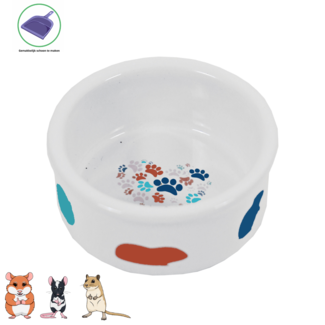
For hamsters, small, low bowls are the most practical. Trixie makes a ceramic feeding bowl of ø 7 cm. There is also a ceramic bowl of ø 7 cm with pastel print, made for hamsters, mice and gerbils, and the Two-tone feeding bowl of ø 9 cm in various colours with rounded edges. There is also a stone feeding bowl with hamster print for small rodents. These sizes are handy for dwarf hamsters and also suit a Syrian hamster.
Feeding bowls with a rainforest look
The ceramic feeding bowls from Trixie with a rainforest look come in 10 × 2.5 × 7.5 cm and 13 × 3.5 × 11 cm. They are low and wide, with a natural look that fits nicely into an enclosure furnished as a natural landscape. The small size is suitable for dwarf hamsters, the larger one for Syrian hamsters.
Vegetable-shaped feeding bowls
If you like, you can choose a bowl shaped like a vegetable. Happy Pet has a feeding bowl shaped like a lettuce leaf and a sturdy feeding bowl shaped like a carrot (13.5 × 6.5 × 3 cm). Trixie makes a ceramic carrot feeding bowl of 12 × 11 cm. They are made of ceramic, stand firmly and are easy to clean.
Round and square feeding bowls from Flamingo
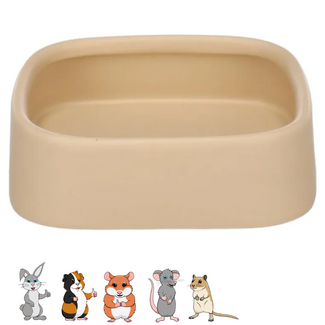
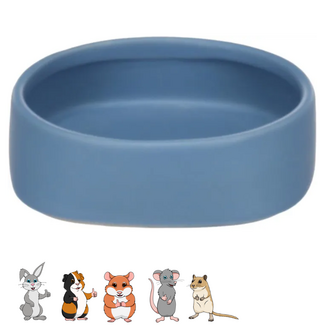
Flamingo makes ceramic feeding bowls in round and square shapes, in blue, green and beige. The round bowls come in 100 ml and 200 ml, the square one in 200 ml. They are mainly intended for guinea pigs and rabbits. For a hamster, the 100 ml size is the most suitable; the 200 ml bowls are usable for a Syrian hamster, but on the large side for a dwarf hamster.
Glass bowls on a wooden base
The glass bowls from Gigan Garden & Deco stand on a base of Gamal root and come in various sizes, including 25 cm. You can use them as a feeding bowl or as a sand bath. They are decorative and go well with hamster scaping. Make sure the bowl stands firmly and that your hamster can easily get in and out of it.
What should you look for in a feeding bowl for a hamster?
Heavy and stable
Hamsters dig, push and climb on everything in their enclosure. A light plastic bowl is easily knocked over or disappears under the bedding. So choose a bowl made of ceramic or stone. That is heavy enough to stay put, and a hamster can't gnaw on it.
Low and not too big
A hamster must be able to reach the food without effort. A low rim is therefore handy, especially for dwarf hamsters. A very large bowl isn't necessary: a hamster only eats a small amount per day. A bowl that is too big also tempts you to give too much food. A bowl into which the daily portion just fits works best.
Easy to clean
Smooth, glazed ceramic doesn't absorb moisture or odours and is quick to wash. Rinse the bowl regularly with warm water and let it dry thoroughly before putting new food in it. Moisture in the feeding bowl can make the food go off.
Where do you put the feeding bowl?
Place the bowl on a level spot in the enclosure, preferably on a firm surface such as a small board, a flat piece of cork or a platform close to the floor. Otherwise, in a thick layer of bedding, a bowl slowly sinks away or your hamster buries it. Choose a spot away from the sand bath and the wee spot, so no sand or urine gets into the food, and not directly under the water bottle, where drips can fall into the food.
Also don't put the bowl in the middle of an open space. Hamsters prefer to eat in a place where they feel safe, for example along a wall or close to a tunnel or house.
The feeding bowl and hoarding
It is normal for your hamster to empty the bowl and carry the food to its nest. It does that because in the wild it builds up a store for leaner times. You don't need to keep removing that store; only remove perishable fresh food, such as vegetables or protein snacks, daily. If you throw away the whole store, your hamster will become stressed.
It is important not to top up as soon as the bowl looks empty. A hamster with a full store that still gets a full bowl every day becomes a picky eater. It picks out the tastiest bits, such as sunflower seeds, and leaves the rest. So give a fixed daily portion and look in the store now and then. If there is a lot of untouched food there, you can make the portion a little smaller.
Not everything in the bowl: let your hamster forage
Hamsters are made to search for food. So scatter part of the daily food through the bedding or hide it in a tunnel or piece of cork. That keeps your hamster busy for longer and lets it eat in a more natural way. The feeding bowl remains the fixed place where you can see how much disappears. A good split is, for example, half in the bowl and half scattered around the enclosure.
Handy combinations
- Hamster food: Zooply Syrian Hamster Food and Zooply Dwarf Hamster Food for the bowl and for hiding.
- Snacks: small extras such as insects, to give by hand or to hide.
- Dried herbs: Zooply herbs for variety through the food or the bedding.
- Water bottles: fresh drinking water always belongs next to food.
- Hamster scaping: cork and natural materials to fit the feeding spot nicely into the enclosure.
Frequently asked questions about feeding bowls for hamsters
Does a hamster really need a feeding bowl?
It isn't compulsory, but it is handy. With a feeding bowl you have a fixed place for fresh food and you can see how much your hamster eats. Food that is only scattered through the bedding can become damp or dirty more quickly, and you lose track. The best approach is a combination: part in the bowl, part scattered for foraging.
My hamster keeps knocking over its feeding bowl. What now?
Choose a heavier bowl made of ceramic or stone with a wide, flat base. Place it on a firm surface instead of on loose bedding. If your hamster keeps burying it, move it to a spot where the layer is less thick or place it on a platform close to the floor.
How big should a feeding bowl for a dwarf hamster be?
Small and low. A bowl of about 7 to 9 cm in diameter, such as the ceramic feeding bowls of ø 7 cm or the Two-tone of ø 9 cm, is roomy enough for a dwarf hamster. A dwarf hamster only eats a few grams a day; a big bowl isn't necessary and only tempts you to give too much food.
My hamster empties the bowl and doesn't eat. Should I be worried?
Usually not: it is carrying the food to its store. Check whether the store in the nest is getting bigger and whether your hamster is active in the evening. If you are worried, carefully check whether the store also gets smaller again. If your hamster is losing weight, is sluggish or really isn't eating, contact a vet with knowledge of rodents.
How often do I clean the feeding bowl?
Rinse the bowl with warm water a few times a week, and more often if fresh food has been in it or if moisture has got into it. Let it dry thoroughly before putting new food in it. Don't use strong-smelling cleaning products; a hamster can smell them for a long time afterwards.
Feeding bowls at Knaagplaza
At Knaagplaza, the webshop of 't Knaagplein, you will find sturdy feeding bowls for Syrian hamsters and dwarf hamsters, from simple ceramic bowls to decorative glass bowls. Fill them with Zooply Syrian Hamster Food or Zooply Dwarf Hamster Food, our own premium brand that we use every day for our own animals in the shop and the breeding facility, and hide part of it in the bedding. That way your hamster eats calmly and has something to search for.