



Running wheels for mice: running for miles every night, safely and with a straight back
Mice are little runners. As soon as it gets dark, they spring into action and cover a considerable distance in one night. In an enclosure at home there is never enough room for that. A good running wheel gives your mice the chance to burn off their energy, at the moment they want to. Mice that can move enough are often calmer in the group and gnaw less on bars.
A running wheel does have to be a good one, though. A wheel that is too small forces your mouse to run with a curved back, and a wheel with rungs or holes can injure little feet and tails. In this category you will find running wheels made of plastic and bark in sizes that suit mice and larger rodents. Combine the wheel with a thick layer of Zooply bedding and good Zooply Mouse Food, both from our own brand, and your mice have the basis for an active life.
In short
- ✓ For fancy mice, choose a running wheel of at least around 20 cm in diameter; smaller is too curved for the back.
- ✓ The running surface must be solid: no rungs or holes where little feet or the tail can get caught.
- ✓ The wheel must stand firmly and turn easily, so even a small mouse can get it moving easily.
- ✓ In a small group, avoid squabbles with more than one wheel or an extra running spot.
- ✓ Clean the wheel regularly; mice mark it with urine.
What will you find in the Running wheels category?
Plastic running wheel ø 20 cm
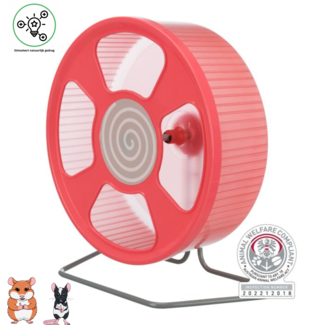
The plastic running wheel from Trixie with a diameter of 20 cm is made for dwarf hamsters and mice. According to the product information, it runs quietly. Plastic is light, easy to wash and doesn't quickly hold odours. The wheel is supplied in various colours. For most fancy mice, this is a suitable size.
Bark running wheel ø 23 cm
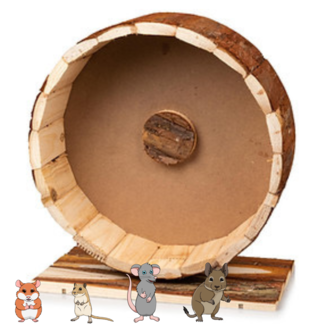
The bark running wheel from Trixie has a diameter of 23 cm and is intended for dwarf hamsters and mice. The slightly larger size gives a flatter running line, which is nice for somewhat larger mice. Bark has a natural look and gives good grip underfoot. It fits nicely into an enclosure that you furnish naturally.
Larger running wheels of 28, 29 and 33 cm
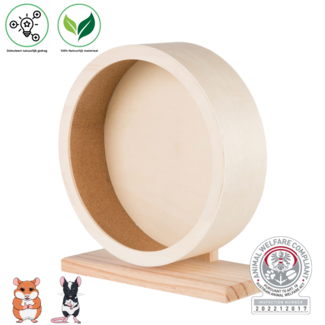
The 28 cm plastic running wheel (for Syrian hamsters, rats and gerbils), the 33 cm plastic running wheel (for Syrian hamsters and rats) and the 29 cm bark running wheel from Giga Mouse are made for larger rodents. A bigger wheel is never a problem for a mouse's back. It is, however, heavier to get moving and takes up more space. These sizes are mainly interesting if you have a spacious enclosure and mice that already use the wheel well. For most mice, 20 or 23 cm is the logical choice.
The right size: why the back must stay straight
Take a look from the side at a mouse running in her wheel. In a good wheel, the back stays roughly straight or bends only slightly. In a wheel that is too small, you see the back arch upwards and the head tilt backwards. A mouse runs for hours every night. If she always does that in a curved wheel, it puts a strain on her back and neck.
For fancy mice, we therefore stick to a diameter of at least around 20 cm. If you have large mice, or if you are in doubt, choose the 23 cm. Little wheels of 12 to 16 cm that you sometimes find in a ready-made cage are too small for an adult mouse. Replace them with a wheel of the right size.
What should you look for in a safe running wheel?
Solid running surface
The running surface must be solid, without rungs or holes. With old wire wheels, little feet can slip between the rungs. A mouse runs fast and can then injure herself badly. A mouse's long tail can also end up between the rungs or between the wheel and the stand with an open wheel.
No trapping points
Check the space between the turning wheel and the base or the attachment. A narrow gap that a little tail or foot can get into is dangerous. With a firmly mounted wheel of the right size this isn't an issue, but it is good to check this briefly after assembly.
Turning easily
A mouse only weighs a few tens of grams. A wheel that turns heavily gets used less. A wheel that runs lightly and smoothly, on the other hand, invites running. If bedding or nesting material gets into the pivot, the wheel turns more stiffly and often starts squeaking.
Standing firmly
A wheel that wobbles or falls over scares mice off. Put the wheel on a level, firm surface, for example on a small board or tile placed in the bedding, so it doesn't sink. Don't bury the wheel: bedding against the running surface slows it down and gets into the pivot.
Plastic or bark?
A plastic wheel is light, smooth and easy to wash. It hardly holds any odour. That makes it practical for those who want to clean the wheel often. Mice can gnaw on the edges, though; so check the wheel now and then for sharp edges.
A bark wheel looks natural and gives good grip. Wood does absorb odour and urine more quickly. Remove dirt regularly, clean the wheel dry or with a slightly damp cloth and let it dry thoroughly. Both materials are a good choice; it mainly depends on your set-up and how you want to maintain the enclosure.
One wheel or more for a small group of mice?
Female mice live in a small group, and often everyone wants to run at the same time. Sometimes two mice run together in one wheel, but there is also regular pushing, or a mouse jumps in halfway. A dominant mouse can even occupy the wheel. In a group of more than two or three mice, a second wheel is therefore a good idea, in a different spot in the enclosure. That way everyone can run without fighting.
A male that lives alone has enough with one good wheel. Also provide other forms of exercise: climbing, digging and exploring are just as important.
Placement, noise and a good night's sleep
Mice run mainly in the evening and at night. Even a quiet wheel makes some noise: the tapping of little feet, the turning and the occasional clack. So preferably don't put the enclosure in the bedroom, but in a quiet room where your mice are free to be active at night. During the day they sleep; don't wake them up to play then.
Don't put the wheel directly next to the nest or the feeding spot. A mouse that runs wants room to jump in and out. A spot along the wall, with a tunnel or house nearby, works well.
Cleaning
While running, mice leave small drops of urine and sometimes droppings behind. That is part of it. So wipe or rinse the wheel regularly. Wash plastic with warm water and a mild cleaner, rinse well and dry it. Clean bark with a brush and a little warm water, and let it dry completely. While cleaning, check the pivot for dirt and the edges for gnawing damage straight away.
Handy combinations
A running wheel is one part of an active mouse enclosure. These categories complete it:
- Bedding: Zooply bedding for digging, alongside running in the wheel.
- Tunnels: safe routes from the nest to the wheel.
- Toys: climbing and gnawing toys for variety alongside running.
- Mouse food: Zooply Mouse Food, a seed and pellet mix for active mice.
- Cages: an enclosure with enough room for a wheel of the right size.
Frequently asked questions about running wheels for mice
My mouse doesn't use the new running wheel. What can I do?
Give her a few days. Mice are cautious with new things. Check whether the wheel stands firmly and turns easily. A wheel that wobbles or runs heavily is often avoided. If necessary, put a few pellets of food in the wheel or place it in a spot your mouse already passes often. If a mouse that always ran suddenly stops running, and is also less active or eating poorly, contact a vet with knowledge of rodents.
Is a 20 cm wheel big enough?
For most fancy mice, yes; 20 cm is the minimum size we stick to. Look at your mouse's back while she is running. If it stays straight or slightly curved, it is fine. If the back clearly arches, or if you have large mice, choose the 23 cm bark wheel.
Can a mouse run too much?
A healthy mouse decides for herself how much she runs, and lots of running is normal for mice. Do look at the whole picture, though: a mouse that does nothing but run and little else may be bored. Then give more variety with digging opportunities, climbing routes, hidden food and nesting material.
My running wheel squeaks. How do I fix that?
Usually there is dirt or bedding in the pivot, or the wheel is standing crooked. Take the wheel off, clean the pivot and put it back straight and firmly. Don't use oil or lubricant: your mice could ingest it. If it keeps squeaking, the pivot is probably worn.
Can young mice use a running wheel?
Yes, young mice often discover the wheel quickly. Make sure it stands firmly and turns easily, so they can get in and out easily. Choose the size for adult mice straight away, then you won't have to switch later.
Buying running wheels for mice at Knaagplaza
At Knaagplaza, the webshop of 't Knaagplein, you will find running wheels in sizes that suit mice. Combine the wheel with Zooply bedding and Zooply Mouse Food, our own premium brand that we use every day for our own animals in the shop and the breeding facility. That way your mice can run safely every night.