




Toys for mice: gnawing, climbing and searching for food
Mice are clever, curious and constantly on the move. In the wild, they spend a large part of the night searching for food, climbing, gnawing and exploring. An enclosure without challenges quickly becomes boring. You can see it in mice that endlessly run the same laps, gnaw at the bars or become restless in the group. Toys give their day some substance and let your mice show the behaviour they are made for.
In this category you will find chew toys made of willow, straw and natural materials, climbing toys made of bark wood and grapevine wood, and puzzle games in which you hide snacks. The best toy for a mouse is often one with something tasty to find inside. For that, use Zooply Mouse Food or Zooply snacks such as crickets and millet spray, from our own brand that we use every day for our own mice.
At a glance
- ✓ Choose toys that suit natural mouse behaviour: gnawing, climbing, digging and searching.
- ✓ Natural materials such as willow, straw, bark and untreated wood may be gnawed.
- ✓ Swap one or two toys now and then, but leave the fixed routes and hiding places in place.
- ✓ In puzzle games, mainly use ordinary mouse food; snacks remain a small treat.
- ✓ Check toys regularly for sharp edges, loose threads and small loose parts.
What will you find in the Toys category?
Chew toys made of willow, straw and bamboo
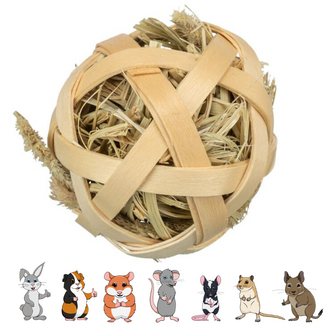
The willow balls from Trixie are made of 100% willow wood, in ø 6 cm and ø 10 cm. For mice, the small ball is the handiest size: they roll it around, gnaw on it and you can put a few pieces of food or a tuft of hay inside. The bamboo ball (ø 5 cm) is filled with hay. The straw toys from Trixie, a corn cob and a carrot of 15 cm and two radishes of 8 cm, are made for nibbling on.
Nibble hangers
You hang the hangers from Flamingo on the mesh with a wooden hook. Jao (22 cm) is made of loofah, sisal and wood with rope and beads. Mareb (14 cm) consists of grass, loofah, corn leaves, leather and wood. Oda (20 cm) combines nuts, wood, corn, loofah and grass. Hangers like these give your mice something to climb towards and pull on.
Climbing toys
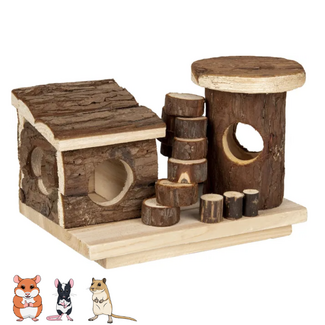
Mice love to climb and are good at it. The natural grapevine branches from Trixie (30–40, 40–60 and 55–80 cm) are made of 100% grapevine wood and have lots of branches and grip. You place the bark wood climbing wall (16 × 20 cm) at an angle or upright against a platform. You will also find the bark wood seesaw (22 × 7 × 8 cm), made for small rodents such as hamsters, gerbils and mice, the flexible ladder (38 × 24 cm), the platform with ladder, the hanging bridge with rope ladder, the rainbow play bridge and the willow corner pieces here.
Puzzle games and snack balls
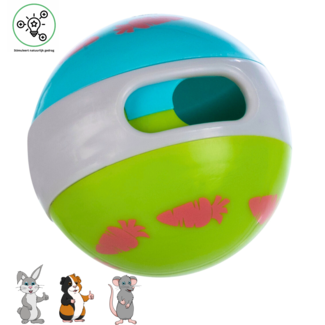
With the snack ball from Trixie (ø 6 cm, plastic) you hide small snacks in a ball that your mice have to roll. The Snack board (ø 20 cm) has seven lids under which you put something tasty. The Flip board and the Slide & Fun board (both ø 23 cm) have flaps and sliders. These boards are made for rabbits and rodents in general; for mice they are quite large, but clever mice quickly learn how to get to the reward.
Grass growing kit
With the growing kit from Trixie (100 grams), you grow fresh rodent grass yourself. Mice love nibbling on the fresh blades. Give it in moderation, as a small treat alongside the normal food.
Why toys are important for mice
Mice's teeth keep growing throughout their life. By gnawing on untreated wood, willow and straw, they keep their teeth busy and help wear them down. Gnawing is also simply a need: a mouse with nothing to gnaw on will start gnawing at the bars or the wall of the tank.
Toys are also a form of enrichment. A mouse that has to search, puzzle and climb to get somewhere uses her nose, her balance and her brain. That keeps her fit and content. In a group of females, plenty to do also means the mice are less focused on each other and bother each other less.
For a male mouse, toys are even more important. Males are usually kept on their own, because they often fight with each other. So they miss out on the distraction of their own kind. A male living alone therefore benefits all the more from a varied enclosure with climbing routes, gnawing material and food he has to search for, and from daily attention from you.
What should you look out for with mouse toys?
Material
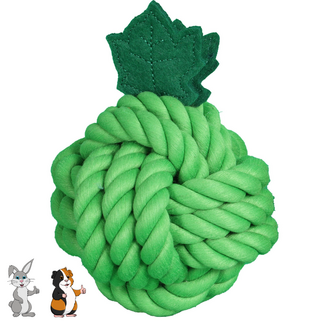
Everything in a mouse enclosure gets gnawed. So preferably choose natural, untreated materials. Plastic toys such as the snack ball and the boards are sturdy, but remove them if your mice gnaw bits off. With hangers that have rope, sisal or leather, watch out for loose threads and pieces; snip off loose fibres and replace the toy if it frays.
Size
Mice are small and light. A seesaw, ball or hanger made for a rabbit is often too heavy for a mouse to move. Preferably choose toys intended for small rodents. Large climbing branches and platforms are fine, as long as your enclosure is roomy enough for them.
No places to get trapped
Check toys for gaps and holes where a foot or the tail could get stuck. Beads and wooden blocks must be firmly attached.
How to play with your mice
Searching for food
The easiest and most natural game is hiding food. Scatter part of the daily portion of mouse food through the bedding, hide some pieces in a willow ball or put them under the lids of the Snack board. Your mice will then search for their food just as they would in the wild. Mainly use ordinary food for this and keep snacks small. That way the game stays healthy.
Climbing course
Use grapevine branches, the climbing wall, ladders and bridges to build a course up to a platform or hammock. Change one element now and then, for example by placing a branch differently. Your mice usually discover the new route quickly.
Swapping calmly
Mice love variety, but also familiarity. So never change the whole enclosure in one go. Swap one or two toys every week or two, and leave hideouts, tunnels and fixed walking routes in place. Preferably put a new toy in a spot your mice often pass.
Cleaning and replacing
Chew toys made of willow, straw and bamboo are meant to be used up; replace them when they have mostly been gnawed away or have become wet and dirty. Brush wooden and bark wood climbing toys clean and let them dry thoroughly after a wet clean. Wash plastic toys with warm water and a mild cleaner. Rinse well, because mice have a sensitive nose.
Useful combinations
Toys work best in an enclosure where the basics are right. These categories go well with them:
- Snacks: Zooply crickets, silkworms and millet spray to hide in puzzle games.
- Mouse food: Zooply Mouse Food, part of which you scatter through the enclosure or hide in toys.
- Gnawing wood: Zooply Apple Branches and Dandelion Roots as extra gnawing material.
- Running wheels: for the running that no toy can replace.
- Mouse scaping: natural materials to turn the whole enclosure into a playground.
Frequently asked questions about toys for mice
How many toys does a mouse need?
There is no fixed number, but provide variety: something to gnaw, something to climb on and a way to search for food. Also leave open areas where your mice can walk and dig. An enclosure that is completely full is cluttered and hard to keep clean.
My mice ignore the new toy. What now?
New things smell strange. Put the toy on a regular route for a few days and, if you like, rub it with a little used bedding. Hide a few pieces of food in or near it. The toy is usually discovered within a few days.
Can I use cardboard and toilet roll tubes as toys?
Yes. Unprinted cardboard without tape or staples is safe, and mice love tearing it up. Put some hay or food inside and fold the ends shut. Replace it when it gets wet or dirty.
Is the snack ball safe for mice?
The snack ball is made of sturdy plastic and is safe as long as it stays intact. Mice do gnaw on plastic, though. So check the ball regularly. If you see bits coming off or sharp edges forming, remove it. In that case, choose a willow ball instead, which your mice are allowed to gnaw on.
How many snacks can I put in the toys?
Very few. Snacks are a treat and should only be a small part of the menu. With too many fatty or sweet snacks, mice quickly become overweight. For foraging games, preferably use part of the normal portion of mouse food, and a single insect or bit of millet spray as a reward.
My mice destroy their toys. Is that a problem?
No, that is exactly the idea. Chew toys made of willow, straw and wood get used up. Just make sure no sharp pieces, loose threads or small hard parts are left behind. If your mice destroy things noticeably often and are also restless, check whether there are enough hiding places, bedding and space.
Buying mouse toys at Knaagplaza
At Knaagplaza, the webshop of 't Knaagplein, you will find gnawing, climbing and puzzle toys that suit mice. Combine them with Zooply Mouse Food and Zooply snacks, our own premium brand that we use every day for our own animals in the shop and the breeding facility. That way your mice have something to do every night.