


Mouse terrarium: a glass enclosure for a group of fancy mice
Mice are small, quick and curious. They dig, climb, build nests and love to hide. Because they can squeeze through very small openings, a fully glass terrarium is a good choice for many mouse keepers: no bars for a mouse to slip between, no bedding flying around the room and a clear view of everything your group gets up to.
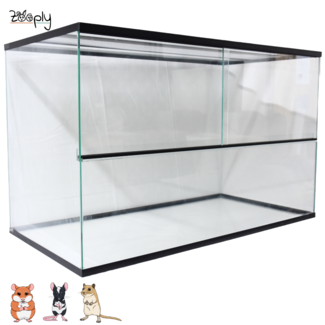
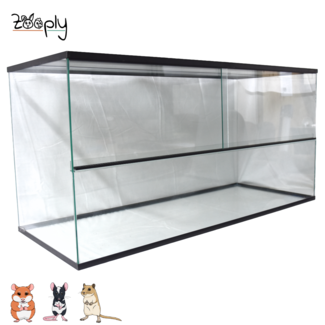
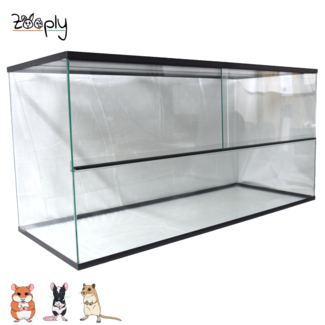
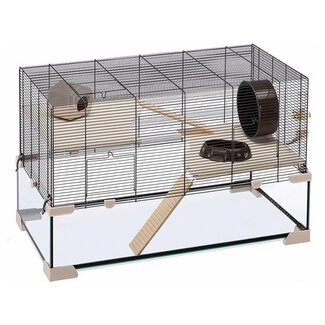
In this category you will find the Zooply Glass Terrariums in five sizes, with sliding doors, a ventilation grille and a high bottom edge. We like spacious, low and wide terrariums with a large view, good ventilation at the top and a deep layer of bedding. For mice this kind of enclosure works well, especially if you furnish it upwards with cork and branches. There is also a Ferplast cage with a glass base.
At a glance
- ✓ Choose by floor space: with 80 cm you have a base for a small group, with 100 cm or more you have room for separate zones.
- ✓ Mice are true escape artists: always keep the sliding doors properly closed.
- ✓ Provide a layer of bedding to dig in; the Zooply product information gives 10 to 15 cm for mice.
- ✓ Make use of the height with cork, branches and hanging bridges, but do not let it replace floor space.
- ✓ Clean the terrarium in sections, so your mice can still find their own scent.
What will you find in the Terrarium category?
Zooply Glass Terrariums
The Zooply Glass Terrarium is available in 80 × 40 × 50 cm, 100 × 40 × 50 cm, 100 × 50 × 50 cm, 120 × 50 × 50 cm and 150 × 50 × 50 cm, in black. According to the product information, all five sizes are suitable for mice. The height is always 50 cm; the floor area goes up from 80 × 40 to 150 × 50 cm.
According to the product specifications, the terrariums have sliding doors, a ventilation grille, an anti-gnaw strip and a high bottom edge, and the top is closed. For mice, that closed top with a grille is a big advantage: mice climb up anything in the enclosure, and with an open tank that is the fastest way out. They cannot gnaw through the glass walls, and the glass gives them no grip for climbing. Through the sliding doors you clean and top up food without having to move the terrarium.
Ferplast cage with glass base
The Ferplast rodent cage with glass base (Karat 80) measures 78.5 × 45.5 × 52.5 cm and has a wire section with several levels above the glass base. With mice, check the bar spacing of any cage with bars, because they squeeze through surprisingly small openings, especially when they are young. If you do not want to take any risk at all, a fully glass Zooply terrarium is the most reassuring choice for mice.
Which size for your group?
Female mice like to live in a small group. Males are often territorial and can fight fiercely; they are usually kept alone, or neutered together with females. That largely determines which size you need.
With the 80 × 40 cm terrarium you have a base for a small group of females or a single male. At 100 × 50 cm or larger you can create separate zones: a quiet nesting area, a digging corner, a feeding spot and a play area with a running wheel. In a group, that matters. The more routes and hiding places there are, the easier it is for mice to avoid each other, and the calmer the group. If you keep a larger group, choose 120 × 50 or 150 × 50 cm.
Bedding and nest: the basis of the terrarium
Mice love to dig little tunnels and prefer to build their nest under or between the bedding. The Zooply product information gives 10 to 15 cm as a comfortable layer depth for mice. Feel free to make the layer a bit deeper in one corner; that is often where the main nest appears. In a 100 × 50 cm terrarium you need about 75 litres of bedding for a 15 cm layer (length × width × layer depth in cm, divided by 1000).
Choose low-dust bedding without added fragrance, such as Zooply Hemp Fibre or wood fibre, and also provide nesting material made of natural fibres, paper or hay. Do not use cotton wool or synthetic nesting fluff: the thin threads can wrap around little feet. Mice drag the nesting material to the spot they like best themselves, often moving it several times a day.
Furnishing across the width and the height
Mice use the floor the most, but they also love to climb. You can make use of the inside height of 50 cm with cork, branches, ropes and hanging bridges. This gives you routes at different heights. Keep height differences limited and make sure there is soft bedding underneath climbing routes, so that a fall does no harm.
Place several houses throughout the terrarium, preferably with more than one exit, and connect them with tunnels. A running wheel with a solid running surface of at least about 20 cm in diameter belongs in an enclosure for fancy mice; smaller is too curved for the back. In a group you sometimes see one mouse hogging the wheel. A second wheel in a larger terrarium prevents this. Place wheels in a firm spot, so they do not sink in or get stuck in the bedding.
If you want to furnish the terrarium more naturally, you can build a landscape with cork, moss, dried flowers and herbs, and roots. This is called mouse scaping. Also scatter part of the food through the bedding, so your mice go searching and foraging.
Location, fresh air and cleaning
Mice have sensitive airways and are small, so they warm up quickly. Keep the terrarium out of the sun, away from radiators and out of stuffy corners. Leave the ventilation grille clear: do not put tall furnishings or branches against it.
Mice mark their enclosure with urine. That is how they know where home is. So do not make the terrarium completely odourless at every clean: that only makes them mark even more and causes stress. Do regularly replace the dirty and wet spots, often in a fixed corner, and refresh the rest of the bedding in sections. After a big clean, always put some clean nesting material back. Wipe the glass with warm water and a soft cloth, without strongly scented products.
Useful combinations
With these categories you make the mouse terrarium complete:
- Bedding: low-dust Zooply bedding to dig in.
- Nesting material: safe nesting material made of natural fibres for the shared nest.
- Running wheels: wheels with a solid running surface of at least about 20 cm.
- Mouse scaping: cork, branches and natural materials to furnish upwards.
- Mouse food: Zooply Mouse Food, partly scattered through the bedding for a foraging hunt.
Frequently asked questions about mouse terrariums
Can mice escape from a glass terrarium?
From a closed terrarium, only if there is an opening. Mice squeeze through gaps you would not expect. Slide the doors fully shut after every care session, keep the runners free of bedding and check regularly that everything still fits snugly. According to the product specifications, the Zooply terrarium has an anti-gnaw strip, but even so it is wise to check briefly every day.
How many mice fit in an 80 cm terrarium?
The 80 × 40 cm terrarium is a base for a small group of females or a single male. Exactly how many animals also depends on how well you furnish the space with hiding places and routes. If you notice unrest in the group, or want to keep a larger group, choose 100 × 50 cm or larger.
Won't a glass terrarium get too stuffy for mice?
Not if the ventilation grille stays clear, the location is right and you refresh wet spots in good time. If you smell a sharp ammonia odour, it is time to refresh the toilet spots more often. Never place the terrarium in full sun: glass heats up quickly and mice cope poorly with heat.
Can I keep males together in a large terrarium?
That usually goes wrong. Male mice are territorial and often fight, even in a large enclosure. A bigger terrarium at most shifts the problem. Keep a male alone, or have him neutered and put him with a small group of females. Females generally live well together.
Why does my mouse terrarium smell stronger just after cleaning?
If everything is made odourless in one go, mice start marking their enclosure again. That can actually make it smell stronger. Rather refresh small sections more often, especially the fixed toilet spots, and leave part of the clean material in place.
How deep should the bedding be for mice?
The Zooply product information gives 10 to 15 cm as a comfortable layer depth for mice. Feel free to make one corner deeper, so they can make little tunnels and a nest underground there. Mix in some hay or nesting material, so the tunnels hold their shape better.
How do I provide food and water in a terrarium?
Put a heavy food bowl in a fixed, dry spot and hang a water bottle or place a drinking dish that will not disappear under the bedding. Follow the label for the amount: for Zooply Mouse Food that is about 15 grams per animal per day. Scatter part of it through the bedding, so your mice have to search. Only top up when the bowl is properly empty, otherwise only the favourite seeds are eaten and the rest is left. Check the water every day.
Buying a mouse terrarium at Knaagplaza
At Knaagplaza, the webshop of 't Knaagplein, you will find terrariums in which your mice can safely dig, climb and nest together. Combine the Zooply Glass Terrarium with Zooply bedding, Zooply Nesting Material and Zooply Mouse Food. Zooply is our own premium brand, which we use every day for our own animals in the shop and the breeding facility.