


Toys for rabbits: keeping busy the way a rabbit does
Rabbits are clever, curious and by nature spend hours searching for food, digging, gnawing and exploring their surroundings. A bored rabbit will find something to do by itself: gnawing the bars, digging the bedding out of the enclosure or nibbling skirting boards and cables. Good toys give that natural behaviour a safe outlet. That is good for your rabbit's wellbeing, fitness and mood.
In this category you will find chew toys made of natural materials, play balls, snuffle mats, puzzle games for hiding treats, vegetable holders, a digging box and more. Fill the foraging games with a few pellets of Zooply Rabbit Food, a pinch of Zooply herbs or a small Zooply treat: then playing immediately becomes a reward too.
In short
- ✓ Offer different kinds of toys: for gnawing, searching, pushing and digging.
- ✓ Rotate them regularly so the toys stay interesting.
- ✓ For foraging games, preferably use part of the daily pellet portion or dried herbs, not extra treats.
- ✓ Check toys regularly and remove broken pieces, loose threads and sharp edges.
- ✓ Hay remains the most important thing for the teeth; chew toys are a supplement.
What will you find in the Toys category?
Chew toys made of natural materials
Trixie has lots of toys made of untreated wood, willow, grass, straw and paper yarn. Think of willow balls of ø 6, 10 and 13 cm, grass balls with a bell (ø 6 and 10 cm) and an apple-shaped grass ball (ø 7 cm), wooden play rolls and a slatted ball with a bell, wooden chew dumbbells, play blocks on a cotton rope, wooden sticks with straw and the bamboo ball with hay. In straw and paper yarn there are figures shaped like a carrot, a corn cob and a radish. Flamingo has two carrots made of paper and maize leaves. A rabbit may gnaw on and eat these toys; that is what they are made for. For a rabbit, choose the larger sizes, which it can pick up, toss and push away.
Hanging toys to nibble on
The Flamingo hanging toys (Jao, Mareb and Oda) are hung from the side or roof of the enclosure. They are made of materials such as loofah, sisal, grass, maize leaves and wood. A rabbit has to stand up on its hind legs to reach them, which makes them fun and challenging. Do check the composition: Oda also contains nuts and maize, which are high in fat and starch. So give that hanging toy to a rabbit only now and then.
Snuffle mats
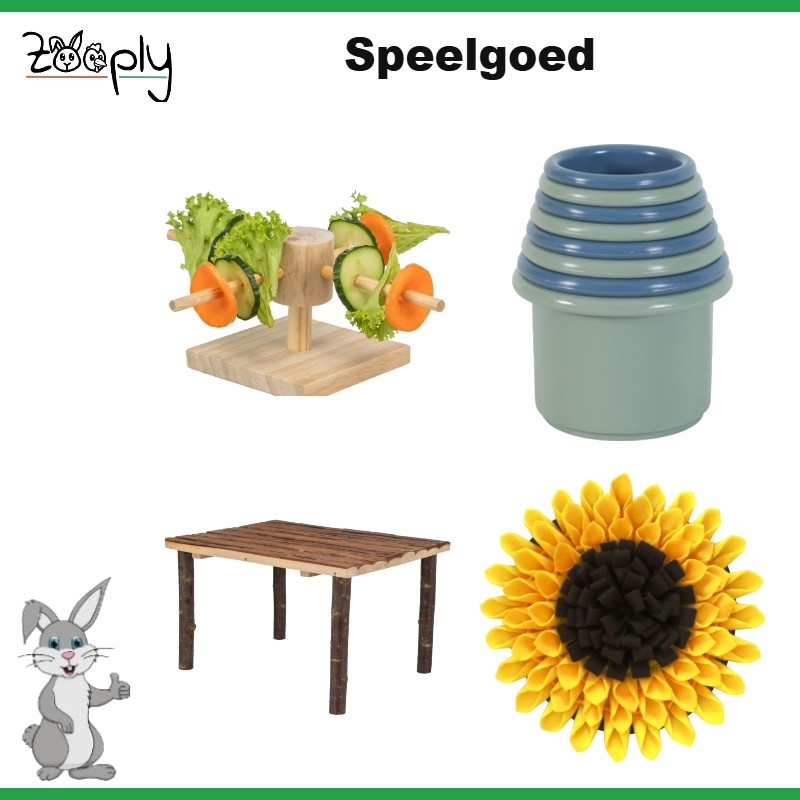
A snuffle mat consists of strips of fabric between which you hide pellets or dried herbs. Your rabbit finds them with its nose and front paws, just as it would search for food in the grass. There is a snuffle mat from Zolux Neolife (45 × 29 cm), a strawberry-shaped snuffle mat from Trixie (33 × 40 cm) and snuffle mats in the shape of a carrot (35 × 22 cm) and a sunflower (ø 30 cm). Wash the mat regularly and do not let your rabbit chew pieces of fabric off it unsupervised.
Puzzle games and treat toys
With a puzzle game, your rabbit has to slide, lift or push something over to get to the food. Trixie has a Snack Board (ø 20 cm, with seven lids), a Flip Board and a Slide & Fun Board (ø 23 cm), wooden snack cups, a snack cube, a snack box with lid and a snack tray (28 × 3.8 × 18 cm). From Zolux there are treat-hiding cups (8 pieces), a treat ball (ø 7 cm) and a treat roller (ø 6 × 12 cm). The Trixie treat ball (ø 6 cm) and the JR Farm snuffle box work in the same way. Start on an easy setting and only make it harder once your rabbit understands the idea.
Vegetable holders and feeding tree
With the Trixie vegetable holder (17 × 12 × 17 cm) and the rotating vegetable holder (22 × 8 × 22 cm) you can hang up fresh greens or hay. Your rabbit has to pull and turn to get at it, so it spends longer on its food. The feeding tree (ø 25 × 36 cm) has branches on which you hang vegetables, herbs or hay.
Digging, exercise and more
The Trixie digging box (58 × 30 × 38 cm) is made especially for rabbits to dig in. Fill it with a digging material that suits your rabbit, such as low-dust bedding, hay or paper shreds. With the agility set (28 × 26 × 11 cm) with a ring and a hurdle, you can practise with your rabbit. This category also contains tunnels, a soft relax tunnel, a wooden picnic table and a bark wood shelter with a lying platform (45 × 27 × 35 cm). Smaller plastic toys, such as the Jimmy rattle and the knot balls, are not meant for gnawing; remove them if your rabbit bites pieces off.
Which toys suit your rabbit?
Every rabbit has its own play style. Look at what your rabbit already does by itself. Does it gnaw a lot on the hutch or on furniture? Then chew toys made of willow, wood or grass are a good choice. Does it dig in the bedding or in the sofa? Then a digging box or snuffle mat gives it a place where digging is allowed. Does it tip over its food bowl or push everything aside? Then it often enjoys balls and rollers to push away. A clever, food-motivated rabbit will get a lot of fun out of puzzle games.
Young rabbits are usually the most active and will play with almost anything. Older rabbits play more calmly, but foraging games and snuffle mats remain a good way to keep the day interesting for them as well.
Toys for indoor and outdoor rabbits
Indoor rabbits often have fewer natural stimuli than rabbits in a garden run. No grass to pluck, no soil to dig in. For them, snuffle mats, a digging box and puzzle games are extra valuable. They replace a little of what a rabbit would find for itself outdoors.
Outdoor rabbits in a run have more to discover, but toys help there too. Outdoors, choose mainly natural materials such as willow, wood and grass, and bring fabric snuffle mats and cardboard or paper toys inside when it rains. Wet toys soon go mouldy. A vegetable holder or feeding tree with hay in the run keeps your rabbit busy under a shelter even in bad weather.
Rotating toys
If the same toys lie around for weeks, they become boring. Put out three or four toys instead and swap a few every week. Put them in a different spot, or hide something in a tunnel or under a tuft of hay now and then. That way your rabbit stays curious and keeps discovering something new.
Treats in toys: in moderation
Foraging games are the most fun with something tasty, but treats are an extra: a small part of the menu, never in place of hay or pellets. So preferably use part of the measured daily portion of pellets for the puzzle games. Dried herbs and flowers are also a good filling. Give sweet treats and fruit only in very small amounts at most.
Playing safely
Check toys regularly. Remove pieces that splinter, loose threads, fraying strings and plastic that your rabbit bites pieces off. Hang toys in such a way that your rabbit cannot get tangled in them. A rabbit that stops playing altogether, sits still and eats less may be in pain; in that case contact a vet with rabbit experience.
Useful combinations
Toys really complete the enclosure in combination with:
- Dried herbs: Zooply herbs to hide in snuffle mats and puzzle games.
- Snacks: a small Zooply treat as a reward.
- Gnawing wood: for gnawing alongside the toys.
- Tunnels: for running, hiding and play routes.
- Hay: Zooply hay in the vegetable holder or feeding tree as an extra challenge.
Frequently asked questions about toys for rabbits
Does a rabbit really need toys?
Yes. A rabbit needs something every day to express its natural behaviour: gnawing, digging, searching and exploring. Plenty of space and a companion are the basis, but toys and enrichment make the difference between a bored rabbit and one that is active and content. A cardboard box with a hole in it or a tuft of hay in a toilet roll already counts as enrichment.
My rabbit does not play with its toys. What now?
Not every rabbit starts playing straight away. Put the toy in a spot your rabbit visits often and make it interesting with a few pellets or herbs. Try different kinds: a rabbit that ignores a ball may love a snuffle mat. Give it time and sit with it calmly.
Is my rabbit allowed to eat the toys?
Toys made of willow, grass, straw, hay, untreated wood and paper yarn are made to be gnawed. It is not a problem if your rabbit eats small pieces of them. Toys made of plastic and fabric are not for eating; remove them if your rabbit bites pieces off.
How often should I replace the toys?
Replace chew toys when they are mostly gnawed away, dirty or wet. Puzzle games and snuffle mats last a long time if you clean them regularly. Also rotate toys, so you do not have to keep buying something new.
Can two rabbits play together?
Yes, and they often do. Do make sure there are enough toys for both, so that no squabbles arise over a single treat game. Place foraging games in two spots, so the calmer rabbit also finds its share.
Buying rabbit toys at Knaagplaza
At Knaagplaza, the webshop of 't Knaagplein, you will find toys that let your rabbit gnaw, search, dig and explore. Fill the foraging games with Zooply herbs or a few pellets of Zooply Rabbit Food, our own premium brand that we use every day for our own rabbits. That way every day becomes a little adventure.