


Gnawing wood for rabbits: safe chewing and keeping busy
Gnawing is as much a part of being a rabbit as running and digging. A rabbit's front teeth and cheek teeth keep growing throughout its life, and gnawing and chewing keep them at the right length. Gnawing is also a way to explore the surroundings and to burn off energy. If you don't give a rabbit anything suitable to gnaw on, it will find something itself: skirting boards, cables, furniture or the bars of the hutch.
In this category you will find natural chew material, including Zooply Apple Branches and Zooply Dandelion Roots from our own premium brand. You will also find dried willow twigs, chew rolls, edible bridges and tunnels, and small wooden chew blocks from Trixie, JR Farm and Flamingo. Hay remains the most important thing for the teeth; gnawing wood is the extra that gives your rabbit something more to do.
At a glance
- ✓ Unlimited hay provides most of the wear on the front and cheek teeth; gnawing wood is a supplement.
- ✓ Choose untreated wood without varnish, paint or glue.
- ✓ Offer different types and shapes and rotate them regularly.
- ✓ Place gnawing wood in a dry spot and replace it if it gets wet, dirty or mouldy.
- ✓ If your rabbit gnaws noticeably more than usual, or stops gnawing altogether, have its teeth checked.
What will you find in the Gnawing wood category?
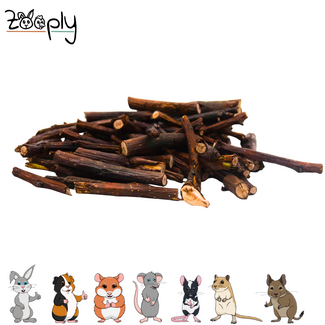
Zooply Apple Branches
Zooply Apple Branches are dried branches from the apple tree, in a pack of 275 grams. Apple wood is one of the best-known gnawing woods for rabbits: it has a firm structure and a scent that many rabbits find attractive. According to the product information, the branches are sugar-free and you can offer them daily. Put a few branches loose in the enclosure, push them in between the hay or stand them upright in a hideout or tunnel. Your rabbit will gnaw off the bark, chew on the wood and drag it around. So a simple product gives you a lot of enrichment.
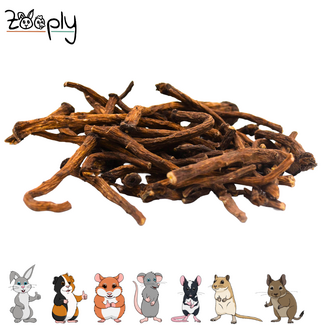
Zooply Dandelion Roots
Zooply Dandelion Roots (250 grams) are dried roots of the dandelion. They have a firm bite and a natural, slightly herbal scent. According to the product information, they are sugar-free and you can give them daily as a treat alongside hay and pellets. They are not wood, but their hard structure does give your rabbit something to chew on properly. Give a few pieces at a time, loose or hidden in the enclosure.
Dried willow twigs
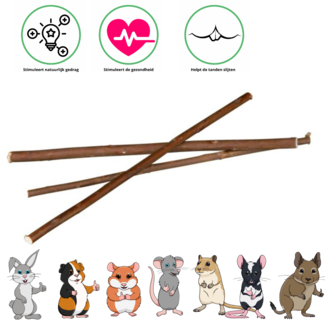
The dried willow twigs from Trixie are about 18 cm long and come 20 to a pack. Willow is soft enough to gnaw on easily and most rabbits are happy to use it. Put a few twigs in the hay or weave them through the bars, so your rabbit has to pull on them.
Chew rolls, bridges and edible tunnels
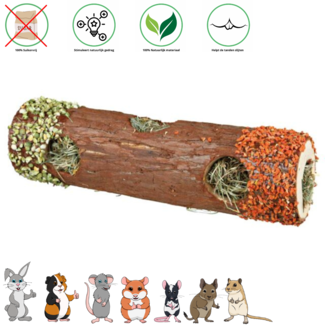
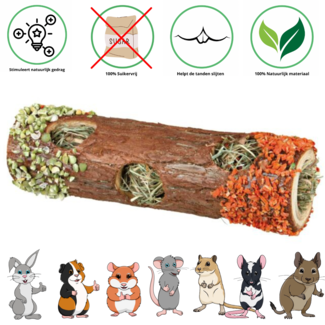
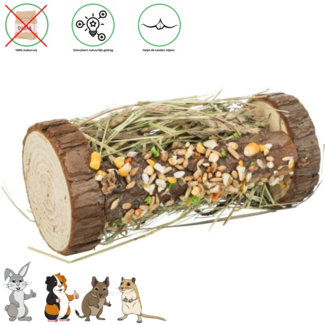
The JR Farm Wooden chew roll with carrot (150 grams) is a roll of untreated wood with carrot and millet. The Trixie Bridge with vegetables and nuts (16 × 8 × 20 cm) is a bridge made of bark wood to walk over and gnaw on. The Trixie Tower with mountain hay and seeds is a wooden tower filled with hay. The Trixie Tunnels with hay and vegetables are also in this category, in ø 6.5 × 20 cm and ø 9 × 30 cm. Please note: those tunnels are small, so for a rabbit they are more of a chew object than a tunnel to crawl through. Products with carrot, millet, seeds or nuts are also a snack, so don't give them all at the same time.
Wooden chew blocks and a small platform
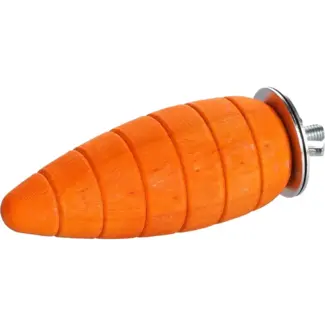
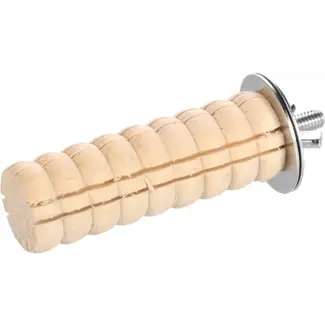
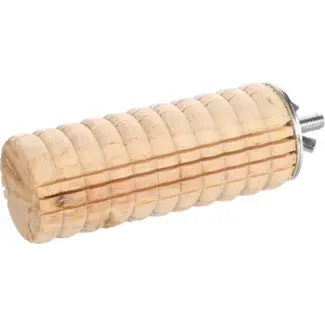
The Flamingo Knabbelhout Majs (7.5 × 2.5 cm and 10 × 3.5 cm) and the Flamingo Knaaghout Wortel Caro (7.5 × 2 cm) are wooden chew blocks that you attach to the bars with a wing nut. For a rabbit they are fairly small; the largest size fits best. You hang the wooden platform from Trixie (10 × 15 cm, bark wood) on the bars; it is intended as a place to sit and climb for smaller rodents and is too small for most rabbits to sit on.
Why is gnawing wood important?
In rabbits, it is not only the front teeth that keep growing, but also the cheek teeth. The cheek teeth wear down mainly through the long grinding of hay. That is why unlimited hay is the most important basis for healthy teeth. Gnawing wood mainly helps to keep the front teeth busy and satisfies the need to gnaw and to take things apart.
The effect on behaviour is at least as important. A bored rabbit will often start gnawing at the bars, scratching at the floor or pacing restlessly. Gnawing wood gives it an outlet. Indoor rabbits and rabbits that spend part of the day in a hutch especially benefit from this.
Which wood is safe for a rabbit?
Only use untreated wood without varnish, stain, paint or glue. Gnawing wood for rodents and rabbits bought in a shop is made with this in mind. If you also want to give branches from your own garden, choose wood that is commonly used for rabbits, such as apple, pear, willow, hazel and birch. Only take branches from trees that have not been sprayed and do not stand along a busy road. Wash them and let them dry.
Avoid poisonous or doubtful plants, such as yew, thuja, laurel, box and oleander. If you are unsure about a tree or shrub, don't give it. With the gnawing wood in this category, you are always on the safe side.
How do you offer gnawing wood?
Every rabbit has its own preference. One rabbit prefers to gnaw on a loose branch, another on a block on the bars or on a bridge. So offer different shapes and see what your rabbit uses. Place gnawing wood where your rabbit spends a lot of time: by the hay rack, by the hideout or in a corner where it currently gnaws at the bars or the skirting board.
Rotate regularly. A branch that has been lying in the enclosure for a week is often no longer interesting. Put down a new one, or take it away for a few days and give it again later. Combine gnawing wood with enrichment: push an apple branch into a hay ball, hide a dandelion root under some hay or put willow twigs in a tunnel.
Hygiene and replacing
Gnawing wood that ends up in the toilet area or gets wet becomes dirty and can go mouldy. Place it in a dry spot in the enclosure and check it regularly. If it smells musty, is soft and damp or you see mould, throw it away. Also remove gnawing wood that has been gnawed down completely to small, sharp pieces. Store unused gnawing wood in a dry, airy place.
Recognising dental problems
Gnawing wood will not prevent dental problems if something else is going on, such as misaligned teeth or sharp points on the cheek teeth. Watch for signs: your rabbit eats less hay, leaves hard bits, drools, has a wet chin, eats slowly or drops food from its mouth. Fewer droppings is also a warning sign. In that case, contact a vet with rabbit experience straight away. With many rabbits it helps to look at the front teeth yourself now and then: they should close neatly over each other.
Useful combinations
Gnawing wood works best as part of a richly furnished enclosure:
- Hay: unlimited Zooply hay is the basis for healthy front and cheek teeth.
- Dried herbs: Zooply leaves and herbs to hide together with the gnawing wood.
- Toys: balls and sniffing toys for extra variety.
- Tunnels: for hiding branches and roots in.
- Snacks: edible hay rolls and chew snacks as a reward.
Frequently asked questions about gnawing wood for rabbits
Does my rabbit need gnawing wood if it eats enough hay?
Hay does most of the work for the teeth, especially the cheek teeth. Even so, almost every rabbit has a need to gnaw and to take things apart. Gnawing wood gives it a safe place to do that and stops your rabbit from gnawing at the hutch or your furniture. So it is mainly a question of wellbeing and keeping busy.
My rabbit ignores the gnawing wood. What can I do?
Try a different type or shape. Many rabbits find loose branches with bark, such as Zooply Apple Branches or willow twigs, more interesting than a smooth block. Try rubbing a branch through the hay or putting a few Zooply herbs next to it, so it smells appealing. Some rabbits also gnaw mainly in the evening and at night, so you may simply not see it happening.
Is my rabbit allowed to eat the gnawing wood?
Swallowing a little wood and bark is normal and not a problem with untreated gnawing wood. Rabbits gnaw most of it off and leave the splinters. If your rabbit eats large amounts of wood while eating little hay, check that there is always enough fresh hay and, if in doubt, consult a vet.
How often should I replace gnawing wood?
Replace it as soon as it is wet, dirty or mouldy, or when it has been gnawed down so far that only small pieces are left. For variety it is also good to put down something new every week or two, even if the old piece is still usable.
Why does my rabbit gnaw at the bars?
Bar gnawing is often a sign of boredom, too little space or too little time out, or your rabbit wants attention. Make sure your rabbit gets daily exercise outside the hutch, has a spacious enclosure and has enough chew material in the spot where it gnaws at the bars. Keeping a rabbit on its own can also play a part: rabbits are social animals and should live at least in pairs.
Buying gnawing wood at Knaagplaza
At Knaagplaza, the webshop of 't Knaagplein, you will find chew material that your rabbit can gnaw on safely. With Zooply Apple Branches and Dandelion Roots from our own premium brand, which we use every day for our rabbits in the shop and breeding facility, and unlimited Zooply hay, you look after healthy teeth and a rabbit that is happily kept busy.