


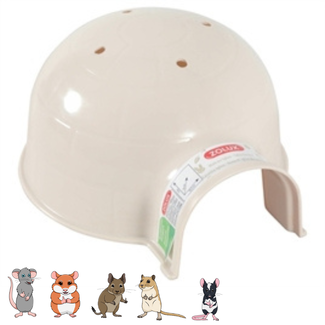

Rat house: a hiding place where the group can sleep together
Rats prefer to sleep snuggled up close together, in a place that is sheltered and a little dark. A rat house provides that place. It is a hideaway when the house is busy, a sleeping spot on cooler days and often a pantry too: rats love to drag a few pellets or a piece of nesting material in there. That is normal behaviour and part of being a contented rat.
In this category you will find wooden houses, corner houses, soft fabric sleeping houses, plastic houses and hanging tunnels to lie in. With Zooply Nesting Material and low-dust Zooply bedding, you turn any house into a soft, dry sleeping spot.
At a glance
- ✓ Choose a house in which several rats can lie at once; rats like to sleep in a heap.
- ✓ Provide more hiding places than just the house: hammocks, tunnels and a second house bring calm to the group.
- ✓ A house with two openings prevents a rat from getting trapped if another blocks the entrance.
- ✓ Rats gnaw: check wooden and plastic houses regularly for sharp edges and loose bits.
- ✓ Put the house in a dry spot, not on the pee spot or under the water bottle.
What will you find in the Houses category?
Wooden houses and corner houses
Wooden houses are sturdy, stand firmly and rats are allowed to gnaw on them. Trixie has several models in rat size. The Hanne house (29 × 18 × 18 cm) is made of flamed wood. The Hanna house made of bark wood comes in 31 × 19 × 19 cm for guinea pigs and rats and in a more compact size of 26 × 16 × 15 cm. The wooden house with a flat roof (28 × 16 × 18 cm) has a roof your rats can sit on as a lookout post. The Jesper corner house made of bark wood fits exactly into a corner of the cage; the large version measures 42 × 15 × 30 cm and the smaller one 30 × 13 × 21 cm. If you want a large group to sleep together, the roomier wooden houses, such as the Grete house with two entrances, can also be used.
Semicircular bark wood houses
The semicircular bark wood small animal houses are simple arches of natural wood. The 25 cm version is intended for Syrian hamsters, rats and gerbils; the 36 cm version offers room for several rats at once. Thanks to the open shape they are easy to clean and rats never get stuck in them.
Soft sleeping houses
Many rats like to lie somewhere soft. Flamingo makes fabric sleeping houses in rat size in the shape of a pumpkin (23 × 23 × 18 cm), an apple (23 × 23 × 21 cm and 23.5 × 22 × 20 cm) and a pineapple (23.5 × 23.5 × 19 cm). There are also the Clavio sleeping place and the soft two-sided bed (24 × 23 × 21 cm). Fabric houses are warm and cosy, but absorb odour and moisture. So wash them regularly and keep a second one to hand for when the first is in the wash.
Plastic houses
The Trixie plastic house (26 × 23 × 15 cm) and the Zolux plastic igloo (30 × 26.5 × 17 cm) are light and very easy to wash. That is handy with rats that pee in their house now and then. Rats can gnaw the edges, though; replace the house if sharp bits appear.
Hanging tunnels and shelters
You hang the Trixie relax tunnel (ø 14 × 45 cm) from the ceiling or between two levels. Rats love lying in it, high up in the cage, and it is washable. The bark wood shelters (30 × 22 × 25 cm, and 37 × 17 × 28 cm with a step) are a hiding place and an extra level at the same time. The coconut with a hole (12 × 11 × 11 cm) is small and mainly fun as an extra place to crawl into or a hiding spot for a snack.
How do you choose the right rat house?
Start with the group. Rats are social animals and should live at least in pairs. A house that fits only one rat causes pushing and shoving and is often claimed by one dominant rat. So it is better to choose a roomy house in which the whole group can lie together, and to add other hiding places as well.
Look at the entrance. With a house that has a single opening, a rat inside can get trapped if another lies down in the doorway. Two entrances, an open arch or a corner house with an open side always give rats a way out.
Think about the material too. Wood is sturdy and may be gnawed, but absorbs moisture. Plastic is easy to clean, but rats sometimes gnaw bits out of it. Fabric is soft and warm, but needs washing often. That is why many rat owners combine different types, so the rats can choose for themselves.
Where do you put houses in the rat cage?
Rats choose a fixed pee spot, often in a corner of the base or on a platform. Do not put the house there, and not directly under the water bottle either. A dry house stays fresher and is used more often as a sleeping spot.
Spread the hiding places around the cage: a house on the floor, a soft sleeping house on a platform and a hammock or hanging tunnel high in the cage. That way rats can choose where to lie, depending on the temperature, their mood and the pecking order in the group. A cage with only one hiding place leads to more squabbles over that one spot.
With a new rat or when introducing rats to each other, several hiding places are extra important. A rat that does not feel like contact for a while must be able to withdraw without the others cornering it.
Nesting material: rats furnish it themselves
Rats love building a nest. Give them safe nesting material, such as Zooply Nesting Material or a handful of hay, and watch them drag it into the house themselves. Do not use cotton wool or synthetic nesting fluff: the thin threads can tighten around feet and toes. Spread the nesting material over a few spots, so one rat cannot keep it all to itself.
If you want to make it extra interesting, now and then hide a few Zooply crickets or a piece of walnut in the nesting material near the house. Rats are clever and enjoy searching for food. Do keep snacks small, though: rats quickly become overweight.
Cleaning and replacing
At each clean, first remove the little stores your rats have hidden in the house. Fresh food, vegetables and egg in particular go off quickly. Clean wooden and plastic houses with warm water and, if needed, a mild cleaner without a strong scent. Rinse thoroughly and let wood dry completely before it goes back into the cage. Wash fabric sleeping houses according to the washing instructions on the label.
Replace a house if it develops sharp edges, has loose pieces, keeps smelling musty or no longer gets properly clean. With wooden houses some gnawing damage is normal; only when the structure becomes weak or splinters appear is it time for a new one.
Useful combinations
A house works best together with other resting places and safe nesting material:
- Nesting material: Zooply Nesting Material to make the house soft and warm.
- Hammocks & Hanging bridges: many rats' favourite sleeping spot, high in the cage.
- Tunnels: safe routes to the house and extra hiding places.
- Bedding: low-dust Zooply bedding keeps the floor around the house dry.
- Snacks: Zooply insects and walnuts to hide near the house.
Frequently asked questions about rat houses
How many houses do I need for my rats?
A good guideline is at least one hiding place per rat, plus one extra, so there is always a choice. They do not all have to be houses: hammocks, hanging tunnels and soft sleeping houses count too. Do make sure there is at least one roomy house in which the whole group can lie together.
My rats never sleep in the house. Is that a problem?
No. Many rats prefer to sleep high up in a hammock, especially when it is warm. A house is then still useful as a hiding place when they are startled or things get busy, and as a place for a little store. If you want the house to be used more, put some nesting material in it or move it to a higher, quieter spot in the cage.
Why do my rats pee in their house?
Sometimes rats mark their spot, especially bucks. It can also mean the house is on their favourite pee spot. Put a litter tray with litter pellets on that spot and move the house to a dry place. Clean a soiled house thoroughly, so the smell does not linger. For these rats, plastic and an open arch are often more practical than fabric.
Is a fabric sleeping house safe for rats?
Yes, provided you check it regularly. Rats sometimes gnaw holes in fabric. If you see loose threads or holes a foot could get caught in, cut them away or replace the house. Wash fabric houses regularly, because they absorb odour and moisture.
Are hamster houses suitable for rats too?
Usually not. An adult rat is much larger than a hamster and rats like to sleep together. Small houses with a narrow opening are too cramped and can even be dangerous if a rat gets halfway stuck. Choose models intended for rats or guinea pigs.
My rat hides food in the house. Should I remove it?
A small store of dry rat food can stay until the next clean. Fresh food such as vegetables, fruit or egg, however, should be removed the same day, because it goes off. Do not keep topping up the food bowl while there is still a store in the house; your rat will then mainly eat its favourite pieces and quickly become overweight.
Buying rat houses at Knaagplaza
At Knaagplaza, the webshop of 't Knaagplein, you will find houses and sleeping spots in rat size. Complete them with Zooply, our own premium brand: nesting material, low-dust bedding and rat food that we use every day for our own animals. That way your group always has a dry, safe place to rest together.