









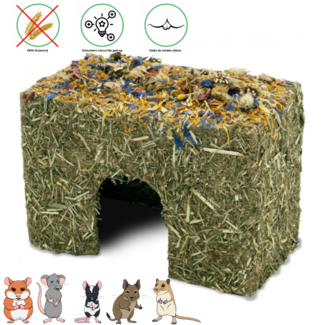


Gerbil house: a hiding place above ground
Gerbils prefer to sleep in a nest chamber they have dug themselves deep under the bedding. So why a house anyway? Because a gerbil, as a prey animal, wants a place everywhere in the enclosure where it can quickly duck away. A house provides that cover above ground. A house also often becomes the fixed point the gerbils dig their tunnels towards, or a storeroom where they hide seeds.
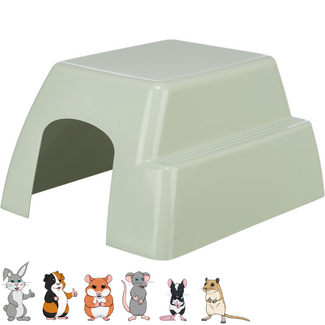
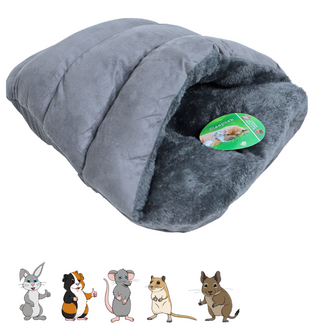
In this category you will find houses made of bark wood, solid wood, birch wood and coconut, edible hay houses, houses with several chambers or levels and soft sleeping houses. A house works best in combination with a thick layer of bedding and enough nesting material. With our own animals we use Zooply for that, our own premium brand for bedding and hay, among other things.
In short
- ✓ Provide at least one hiding place per gerbil and preferably one extra, so no one has to claim a spot.
- ✓ Choose a house with two openings or a large entrance; then gerbils can pass each other.
- ✓ Gerbils gnaw everything: choose untreated natural material and check regularly for sharp edges.
- ✓ Place the house in a stable spot along the edge, so they can dig deep around it.
- ✓ A house does not replace a digging layer; gerbils build the real bedroom themselves.
What will you find in the Houses for gerbils category?
Bark wood houses
Most of the range is made of bark wood, a natural material that gerbils are allowed to gnaw. From Trixie you will find, among others, House Hendrik (20 × 12 × 17 cm), Log Cabin Jerrik in two sizes, House Mette and the Jesper corner houses. According to the product information, the large Jesper corner house of 30 × 13 × 21 cm is made for Syrian hamsters, rats and gerbils and fits nicely in a corner of the enclosure. From Giga Mouse there are House Bella, Corner House Dolly and House Onyx with two levels, all three intended for Syrian hamsters, rats and gerbils. Those roomier sizes are handy if you keep two or more gerbils together.
Houses with several chambers or levels
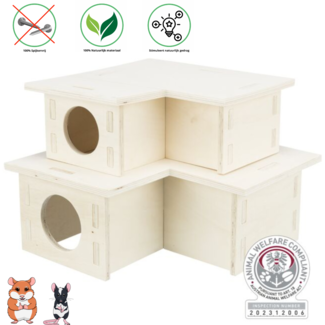
The Trixie multi-chamber house with three rooms (25 × 10 × 25 cm) is made of untreated wood and reflects how gerbils live underground: several connected spaces. You can bury it halfway in the bedding. Play House Tammo with three levels, House Ida with two levels and a swing, House Finn with a little staircase and the Matti castle also offer extra space on a small floor area. The bark wood maze toy is a labyrinth house to scurry through.
Wooden houses and shelters
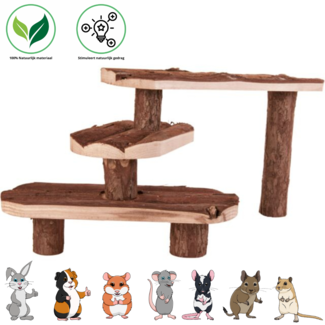
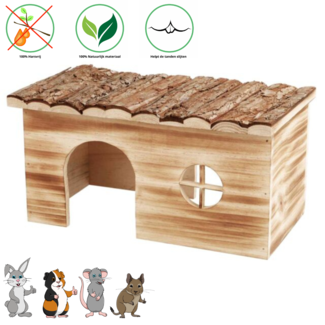
The Trixie wooden houses with pointed roof (15 × 11 × 15 cm) and flat roof (15 × 12 × 15 cm) are simple hiding houses. The flat roof is often used as a lookout post. The bark wood shelters, with or without a step, and the platform with ladder add an extra level to the enclosure with a hiding place underneath.
Natural: birch wood, bark wood and coconut
The birch house of 100% birch wood (ø 10 cm), the oval small animal house (17 cm) and the semicircular small animal houses of 15 and 25 cm are simple, natural hiding places. For gerbils, the 25 cm semicircular one is the roomiest choice. The coconut with hole from Happy Pet (12 × 11 × 11 cm) is a sturdy hiding place that is almost impossible to gnaw to pieces. Trixie also has a coconut house with rope ladder and two coconut houses with a hanging bridge between them; these are mainly fun for climbers. Gerbils use them too, but hang them low.
Edible hay houses
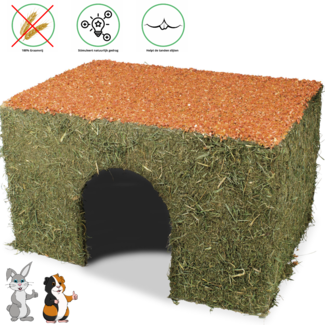
JR Farm offers edible houses made of hay. The 75 gram hay house with carrot and the hay house with flowers of 15 × 9 × 10 cm are a size that suits small rodents. Gerbils usually gnaw such a house to pieces within a reasonable time and use the hay as nesting material. That is exactly the idea. See it as enrichment that you replace now and then, not as a permanent hiding place.
Soft sleeping houses
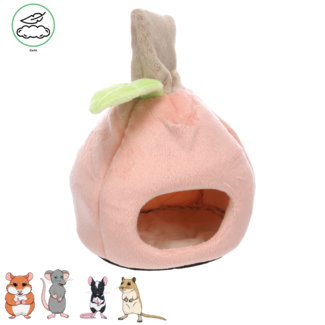
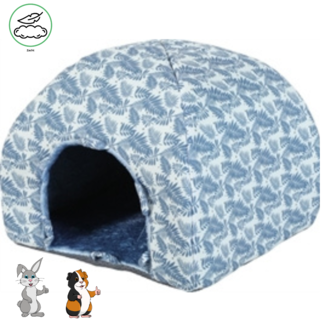
Flamingo makes soft sleeping houses in the shape of an apple, a pineapple and a pumpkin. They are cosy, but gerbils love tearing fabric apart for their nest. So only use such a house if you see that your gerbils do not pull it apart, and remove it as soon as loose threads appear. Loose threads can wrap around little feet.
How do you choose the right gerbil house?
Size and number of animals
Gerbils live in pairs or small groups and like to snuggle up together. A house must be big enough for them to fit in together, but also for an animal to turn around and get out again. For a pair, the roomier models, such as House Bella, the large Jesper corner house or the 25 cm semicircular house, are a good choice. Smaller houses work perfectly as a second or third hiding place.
Openings
A house with two entrances, or with a large opening, brings calm. A gerbil that is inside can then always get out, even if a group mate is standing in the doorway. For gerbils in a group, that is the difference between cosily lying together and an animal that feels cornered.
Material
Gerbils gnaw a lot. So choose natural material without lacquer or paint, such as bark wood, untreated wood, birch wood or coconut. The gnawing itself is healthy: their teeth keep growing throughout their lives. Do check regularly for sharp points or splinters and replace a house that has been badly damaged.
Where do you put a house?
Place a house along the edge or in a corner of the enclosure. Gerbils feel safer along a wall than in the middle of an open space. Choose a firm base, so the house does not sink when the animals start digging underneath it. Many gerbil owners put a house on a platform or a sturdy board and fill a deep layer of bedding all around it. The gerbils then dig tunnels towards it and the house becomes an entrance to their underground system.
Do not place a house on the regular pee spot. Gerbils pee little, but often choose a fixed corner. Keep that free or put the sand bath there. Also do not put a flat-roofed house directly against the bars: it then becomes a stepping stone to places your gerbils do not need to go.
A house as a storeroom
Gerbils drag food to places they consider safe. A house then becomes a storeroom full of seeds. That is natural behaviour and does not need to be removed. Only remove perishable fresh food, such as vegetables. During a big clean, leave part of the nesting material and some clean, old bedding, so the familiar smell stays in the enclosure.
Useful combinations
A house works best together with these parts of the enclosure:
- Bedding: a thick digging layer in which the house becomes a fixed point, with Zooply as our own brand.
- Nesting material: natural material with which gerbils line their nest in or under the house.
- Tunnels: connect houses and provide extra cover along the edge.
- Hay: Zooply hay as building material and to gnaw on.
- Gnawing wood: so the gnawing does not all end up on the house.
Frequently asked questions about houses for gerbils
Why don't my gerbils sleep in the house?
That is completely normal. In a good digging layer, gerbils dig their own nest chamber and prefer to sleep there. They then use the house as a hiding place, lookout post or storeroom. If they do lie in it, the house is often the roof of their nest. Both are fine.
How many houses do I need for two gerbils?
At least two hiding places, and preferably a third. They do not all have to be houses: a cork tunnel or a sturdy bridge with a hollow space underneath also counts. That way each animal can retreat and there is less likely to be a fuss over the best spot.
Can my gerbil gnaw the house to pieces?
Yes, that is exactly what houses made of bark wood, wood and hay are made for. Gerbils naturally gnaw a lot and shred material into nesting material. Do check that no sharp points appear and that the house stays standing firmly. If it has been gnawed so much that it collapses or splinters, replace it.
Are houses for guinea pigs or rabbits also suitable for gerbils?
This category also includes a few large houses and a willow bridge that, according to the product information, are intended for rabbits and guinea pigs. For gerbils they are often bigger than necessary and take up a lot of floor space that you would rather use for the digging layer. For gerbils, it is better to choose a house made to size for small rodents.
Are edible hay houses suitable for gerbils?
The small JR Farm hay houses, such as the 75 gram hay house with carrot and the hay house with flowers, are made for small rodents. Gerbils love gnawing them apart and work the hay into their nest. See such a house as enrichment and a treat, not as main food. Remove leftovers if they get wet or dirty, and always provide a sturdy hiding place that lasts longer as well.
How do I clean a gerbil house?
Usually it is enough to remove old stores and dirty nesting material and brush the house off dry. Do not wet wooden and bark wood houses with cleaning products; they soak into the wood. Leave some clean nesting material behind at every clean, so it still smells familiar.
Buying gerbil houses at Knaagplaza
At Knaagplaza, the webshop of 't Knaagplein, you can choose houses made of natural materials that suit burrowing social animals. Combine them with a thick layer of Zooply bedding and Zooply hay, our own premium brand that we use every day with our own animals, and your gerbils will have cover both above and below ground.