




Dried flowers and grasses for hamsters: a natural landscape
A hamster enclosure with nothing but a flat layer of bedding is rather bare for a hamster. In the wild, it walks among stalks, flowers and moss, and searches for seeds that have fallen between the stems. With dried flowers and grasses you bring that back. You create sheltered routes, hiding spots and a place to sniff around. Many hamsters nibble the seeds off the stalks and carry bits away for their nest or food store.
This category consists entirely of Zooply, our own premium brand. We use the dried flowers, grasses and moss every day when furnishing the hamster enclosures in our shop and breeding facility. Here you will find individual types to combine yourself and ready-made bouquets.
At a glance
- ✓ Dried flowers and grasses are enrichment and decoration, not main food.
- ✓ Push stems into the bedding along edges, tunnels and cork for sheltered walking routes.
- ✓ Grasses with seed heads, such as oats, wheat and millet grass, also give your hamster something to search for and eat.
- ✓ Keep everything dry: remove flowers and grasses that have become wet or dirty.
- ✓ Start with a few types and add more later; an overcrowded enclosure isn't necessary.
What will you find in the Dried flowers & grasses category?
Grains and grasses with seed heads
Zooply Oats (100 grams), Zooply Wheat (100 grams), Zooply Millet Grass (100 grams) and Zooply Canary Grass (100 grams) are stalks with ears. Push them upright into the bedding and your hamster will pull them over, shell out the seeds and carry the stalks away. That is eating, foraging and playing in one. The Zooply Flax Plant (110 grams) adds height to the enclosure. Zooply Foxtail Grass, Zooply Hare's Tail (both 70 grams) and Zooply Babala (5 pieces) are soft plumes that quickly give a natural effect. Zooply Bulrush (10 pieces) are sturdy stems that you place as an accent by an entrance or a piece of cork.
Moss
Zooply Stone Moss (75 grams) and Zooply Rodent Moss (250 grams) are dried moss with a loose structure. Lay moss on the floor around a hideout, along a tunnel or on a piece of cork. It creates a green forest floor and your hamster can rummage through it nicely. The large 250-gram size is handy if you want to decorate a bigger part of the enclosure.
Strawflowers and amaranth
For colour there are Zooply Strawflowers in yellow, white, light pink, pink and red, and Zooply Amaranth in red, orange and green. All in 70-gram bags. Strawflowers keep their colour well and are sturdy. Amaranth has long, dense plumes. Put a few stems together for a colourful tuft, or spread them across the enclosure.
Beach lavender, limonium and daisies
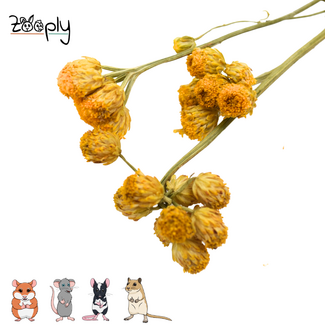
Zooply Beach Lavender comes in dark violet, white, pink and yellow, and you will also find Zooply Sea Lavender Pink and Zooply Limonium in white and pink. They have fine, small flowers on branched stems and give an airy effect. Zooply Daisies in pink and white and Zooply Yarrow are small, cheerful flowers to use in between.
Bouquets
If you don't want to combine things yourself, the 100-gram bouquets are handy: Zooply Summer Bouquet, Zooply Spring Bouquet and Zooply Meadow Grass Bouquet. You can lay a bouquet down loose, divide it into small tufts or work it in between bedding, cork and wooden accessories.
Cotton bolls on the branch
Zooply Cotton Bolls on Branch (80 grams) are dried twigs with soft cotton bolls. They look lovely as decoration and, according to the product information, they are also suitable as nesting material. Your hamster plucks out the cotton and carries it off to its nest.
How do you use dried flowers in a hamster enclosure?
Hamsters feel safest when they can walk along edges and under cover. An open plain is nerve-racking for a prey animal. So push stalks and flowers in along the edge of the enclosure, next to tunnels and by the entrance of hideouts. That creates sheltered routes. You will often see a hamster really start using those routes.
Work in layers. Start with a thick layer of bedding, put some moss or leaves on top and push the stems into that. Make tufts of a few types together instead of scattering everything loosely. That way you keep an overview and there is still room to walk, dig and use the running wheel.
Enrichment and foraging
Dried flowers and grasses are more than decoration. Scatter part of the daily portion of hamster food between the stems and the moss. Your hamster then has to search, sniff and climb to get to its food. The ears of oats, wheat and millet grass are full of seeds. Many hamsters shell them out with great patience. That is good work for an animal that naturally covers kilometres at night to gather food.
Rotate regularly. After a week or two, remove a few tufts and replace them with other types. Don't change the whole enclosure in one go. Hamsters like a familiar layout, with something new here and there.
What should you look out for?
Only use flowers and grasses intended for rodents. Flowers from the garden or a florist may have been sprayed or may be poisonous to your hamster. Also keep the basics in order: dried flowers are decoration and enrichment, hamster food remains the main menu.
Keep everything dry. Don't push flowers into the pee corner or directly under the water bottle. If a tuft becomes damp or dirty, remove it. Damp plant material can go mouldy. During a big clean-out, also pay attention to what your hamster has dragged into its store. Only remove what is damp or mouldy and leave the rest.
Syrian hamster and dwarf hamster
A Syrian hamster easily pulls over larger stalks and stems and drags them along. It needs more space between the tufts, so it can get past them easily. A dwarf hamster is smaller and likes finer textures. Moss, daisies, limonium and fine grasses suit it well. Because the grasses and flowers in this category contain no fruit, they are also a good way to provide sugar-free enrichment for dwarf hamsters.
An example: how to set up a corner
Choose a corner of the enclosure where the bedding is extra thick. Lean a piece of cork at an angle against the wall, so a sheltered opening forms underneath. Cover the floor around the cork with a layer of Zooply Rodent Moss. At the back, push a few stalks of Zooply Oats and Millet Grass upright, with some Beach Lavender and a few Strawflowers in front for colour. Finally, scatter part of the hamster food between the moss. Your hamster then has a hiding place, a foraging spot and something to nibble, all in one place.
Useful combinations
Flowers and grasses come into their own in a well-furnished enclosure. Combine them with:
- Bedding: a thick layer of Zooply bedding to push the stems into.
- Hamster scaping: cork, roots and hiding places between which you work in flowers and moss.
- Nesting materials: Zooply Nesting Material for the nest, alongside the cotton bolls and stalks.
- Snacks: Zooply Fields and millet sprays to hide between the flowers.
- Tunnels: decorate them with stalks for a sheltered route.
Frequently asked questions about dried flowers and grasses for hamsters
Is my hamster allowed to eat the flowers and grasses?
Your hamster will nibble on them, especially the seeds of oats, wheat and millet grass. That is all part of it. The flowers are mainly intended as decoration and enrichment, not as food. If you see your hamster eating a lot of one type, remove some of it and give more grasses with seed heads instead.
How many flowers do I need for an enclosure?
That depends on the size of the enclosure and how full you want it. Start with a few bags, for example one grain, one moss and one or two types of flower, or with one bouquet. You can always add more later. An enclosure doesn't have to be packed to look natural.
How long do dried flowers stay nice?
As long as they stay dry and your hamster doesn't gnaw them up, dried flowers last a long time. A tuft by the nest or the walking route gets trampled and dragged away faster. Replace whatever is broken, dirty or damp and keep the rest in the bag, dry and out of the sun.
Can I also use dried flowers in a regular cage?
Yes, but in a cage with a shallow base you have less room to push stems into the bedding. In that case, put them as tufts in the corners or around the hideout. In an enclosure with a deep base and a thick layer of bedding, you can work the flowers in most beautifully.
My hamster drags all the flowers to its nest. Is that normal?
Yes. Hamsters gather things and build their nest with whatever they find. Leave the nest alone and give a little more often rather than a lot at once. That way there is also something to discover outside the nest.
Are dried flowers also suitable for other rodents?
The Zooply dried flowers and grasses are made for hamsters, gerbils, mice and rats. On this page we focus on hamsters. If you also keep other animals, look in the category for that animal for suitable tips.
Buying dried flowers and grasses at Knaagplaza
At Knaagplaza, the webshop of 't Knaagplein, you will find a large range of dried flowers, grasses and moss from Zooply, our own premium brand. We use them every day when furnishing our own hamster enclosures. Combine them with a thick layer of bedding and some cork, and your hamster will have an enclosure in which it can really forage, hide and explore.