


Tunnels for rats: routes, hiding places and play
A rat running across the floor prefers to dive straight into something at an unexpected sound. In the wild, rats live in burrow systems, and you can see that in how they use a tunnel: as an escape route, a sleeping spot, a larder and a toy. In a rat cage, tunnels also connect the different levels, so your rats can get from top to bottom safely without jumping.
In this category you will find tunnels made of cork, willow and soft fabric, extendable play tunnels, hanging tunnels and flexible bridges that you can set up as a tunnel or an arch. Combine them with Zooply bedding and Zooply moss or dried flowers, and you turn a bare cage into an environment in which your rats really go exploring.
In short
- ✓ Choose a diameter that even your largest rat can walk through comfortably; narrow tunnels are for mice and hamsters.
- ✓ Create more than one route between the levels, so rats can avoid each other.
- ✓ Do not put tunnels on the regular toilet spot; that way they stay clean longer.
- ✓ Cork and willow may be gnawed; do check them regularly for sharp edges.
- ✓ Also use tunnels outside the cage during the daily free-roam time.
What will you find in the Tunnels category?
Cork tunnels
The cork tunnels from Trixie are made of 100% natural, untreated cork. Cork is light, feels warm and rats are allowed to gnaw on it. Because of its natural shape, every tunnel is slightly different. They are available up to ø 14 × 40 cm, up to ø 19 × 55 cm and up to ø 30 × 75 cm. The middle size is also mentioned for rats in the product information; the largest is roomy enough to lay on the floor as a cave in which a small group lies together.
Willow tunnels
Willow tunnels are woven from natural willow branches. Rats love to gnaw on them, and that is allowed. According to the product information, the ø 15 × 33 cm tunnel and the ø 20 × 38 cm tunnel are also intended for rats. There is also a small willow tunnel of ø 10 × 25 cm; it is mainly for hamsters, gerbils and mice and is a tight fit for an adult rat.
Soft tunnels and hanging tunnels
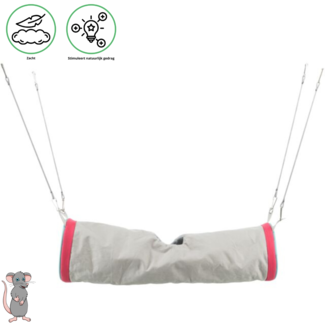
Soft tunnels are a favourite as a sleeping spot. The Trixie Sunny relax tunnel (ø 19 × 70 cm) is made of plush and is also mentioned for rats in the product information. The ø 15 × 35 cm relax tunnel has a soft plush inside and a crinkly outside, which rats find interesting. The hanging relax tunnel (ø 14 × 45 cm) is washable and is hung high up in the cage, where many rats prefer to sleep. There is also the Zolux Neolife tunnel of 40 × 15 × 15 cm.
Extendable play tunnels
The extendable tunnel from Trixie in grey and blue is intended for guinea pigs, rats and ferrets. You pull it out to the length that suits you, in the cage or on the floor during free-roam time. Extendable tunnels rustle and change shape, and that makes them extra fun for curious rats. There are also long play tunnels of ø 18 cm, including one with three exits, which are particularly handy for a play session outside the cage.
Flexible bridges, willow bridges and corner elements
The flexible bridges from Trixie consist of wooden slats on a flexible connection. You set them up as an arch, as a tunnel on the floor or as a walkway between two platforms. They are available in 22 × 10, 28 × 17, 51 × 30 and 65 × 40 cm. For rats, the larger sizes are the most practical. The willow bridges (24 × 13 × 25 cm and 30 × 16 × 30 cm) are a willow arch to shelter under and gnaw on. The willow corner elements provide a sheltered corner in the cage.
Which tunnel size suits a rat?
A tunnel must be roomy enough for your largest rat to walk through without squeezing and to turn around in. An adult buck is considerably bulkier than a young doe. A ø 10 cm tunnel is a tight fit for a big buck; the tunnels of ø 14 cm and larger give clearly more room. With a mixed group of young and adult rats, choose the size based on the largest.
With tunnels that you hang up or place between levels, pay attention to sturdiness. A tunnel that rolls away or sags when a rat walks in it gives a fright. Fix it with the hooks supplied or wedge it between platform and bars, so it cannot shift.
How to use tunnels in the rat cage
Connect the levels with several routes. If there is only one way up, a dominant rat can block it. With two or three routes, for example a tunnel, a bridge and a ladder, everyone can get out of the way. That gives noticeably more peace in the group.
Put a tunnel on the floor as a hiding place, preferably a little way from the toilet spot. Rats often pee in fixed spots; a tunnel standing there soon gets dirty and starts to smell. Put a litter tray with toilet pellets in that spot instead.
Also use tunnels to hide food. Put a few pieces of Zooply Rat Food or a Zooply cricket at the back of a tunnel and add some Zooply moss or nesting material. Your rats will start searching, sniffing and digging, and that is exactly the challenge these clever animals need. Keep the amount small, so it does not become a point of conflict and your rats do not get too heavy.
Tunnels during free-roam time
Rats need daily free-roam time outside the cage, in a safe space without cables, poisonous plants or gaps. Tunnels make that space more interesting and give your rats a feeling of safety when they enter an open space for the first time. A long play tunnel or an extendable tunnel on the floor then serves as a familiar hiding route.
You can also use a tunnel to pick up your rats calmly. Let a rat walk into the tunnel, close off both ends and lift the tunnel. Especially with young or shy rats, that is more pleasant than catching them in a corner.
Cleaning and replacing
When cleaning out, first remove food leftovers and hidden stashes from the tunnels. Wash plastic tunnels with warm water. Rinse cork and willow and let them dry thoroughly in an airy place, so they do not go mouldy. Wash soft tunnels according to the washing instructions. Do not use strong cleaning products or fragrances; rats have sensitive airways and avoid a spot that smells strongly.
Replace a tunnel if it develops sharp edges or loose threads, if it keeps smelling musty or if the structure becomes weak. Some gnawing damage to cork and willow is part of the deal: that is exactly what they are for.
Useful combinations
Tunnels work best as part of a well-furnished cage:
- Hammocks & hanging bridges: together with tunnels, you create safe routes and sleeping spots up high.
- Rat scaping: tunnels connect the zones of a naturally furnished cage.
- Dried flowers & grasses: Zooply moss and flowers to scatter in and around tunnels.
- Snacks: Zooply insects to hide in a tunnel.
- Houses: a tunnel as a route to a quiet sleeping spot.
Frequently asked questions about tunnels for rats
Do rats really need tunnels?
Rats can manage without, but you can see the difference. Tunnels provide hiding places, safe routes between the levels and challenge. In a cage with a group of rats, several routes mean less pushing and less chasing. For a clever and curious animal like the rat, a cage without places to hide and explore is simply boring.
My rats are gnawing their tunnel to pieces. What now?
Gnawing is normal, and with cork and willow it is even the intention. Do check regularly that no sharp edges or splinters appear. With plastic or fabric tunnels, remove loose pieces and threads; if the tunnel is badly damaged, replace it. Also offer gnawing material, such as Zooply Apple Branches, so your rats have a regular outlet.
My rat always sleeps in the tunnel. Is that OK?
Yes, many rats like to lie in a sheltered, soft tunnel. If you notice rats squabbling over that one tunnel, add an extra sleeping spot, such as a second tunnel, a hammock or a house. Then everyone can find a spot of their own.
Which tunnel can I hang up?
The hanging relax tunnel from Trixie is made to be hung up and is washable. Hang it so that a rat can get in and out easily, for example right next to a platform. Check the fixings regularly, because rats pull and gnaw at hooks and strings.
Can a tunnel be dangerous?
A tunnel that is too narrow can cause a rat to get stuck, and a tunnel that rolls away can fall off a level. So choose a generous diameter, fix tunnels securely and check soft tunnels for loose threads that little claws could get caught in. If you see a rat limping or favouring a leg, have it checked by a vet with knowledge of small rodents.
How often should I clean tunnels?
Remove food leftovers and wet bedding from them every time you clean out the cage. A thorough clean is usually done weekly, together with the rest of the cage. Wash soft tunnels that serve as a sleeping spot as often as the hammocks.
Buying tunnels for rats at Knaagplaza
At Knaagplaza, the webshop of 't Knaagplein, you will find tunnels made of cork, willow and fabric for a cage full of routes and hiding places. Complete your cage with Zooply, our own premium brand: bedding, moss, dried flowers and snacks that we use every day for our own animals. That way your rats have something to discover every day.