

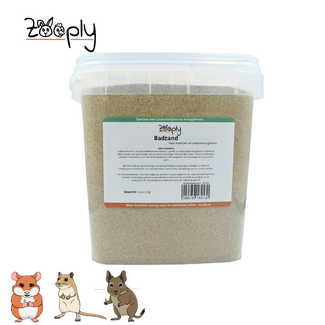
Bathing sand: coat care the way nature intended
Many small rodents do not wash with water, but with sand. They roll, twist and burrow in it and then shake it out of their coat. That removes excess grease and dirt, keeping the coat fluffy and the skin in good condition. Dwarf hamsters, Syrian hamsters, gerbils, degus and chinchillas do this naturally. At home they can only do it if you provide a sand bath.
That is what Zooply Bathing Sand is for, the bathing sand from our own premium brand. We use it every day in the sand baths of our own animals in our shop and breeding facility. For each product group, Zooply deliberately sticks to one option: the option we fully stand behind.
At a glance
- ✓ Zooply Bathing Sand is 100% natural sand, filtered and quality-checked, sourced from Europe.
- ✓ Suitable for dwarf hamsters, Syrian hamsters, gerbils, degus and chinchillas.
- ✓ Offer the sand bath at all times, in a container that suits your animal and the enclosure.
- ✓ According to the product information, clean the sand bath about twice a week, or more often if it is visibly dirty.
- ✓ Do not use play sand, calcium sand or dusty sand.
What will you find in the Bathing sand category?
Zooply Bathing Sand 1 kg
Zooply Bathing Sand is natural sand which, according to the product information, comes from Europe and is specially filtered and quality-checked before it is packed. It is intended for animals that naturally bathe in sand: dwarf hamsters, Syrian hamsters, gerbils, degus and chinchillas. The sand is fine, so it gets right in between the hairs and can absorb grease and dirt from the coat. It comes in a 1 kg pack, enough to fill a sand bath for a hamster or gerbil several times.
Why a sand bath is important
A sand bath has two functions. The first is coat care. The coat of these animals naturally produces grease. Without a sand bath, the coat can become greasy and sticky. By rolling in fine sand, the sand absorbs that grease and the animal then shakes it out again.
The second function is behaviour. Rolling, digging and burrowing in sand is natural behaviour. Many animals take their sand bath at a set time, often just after waking up. You will then see them roll around extensively and afterwards calmly groom their coat. So a sand bath is also a form of enrichment in the enclosure.
The right sand bath for each animal
Dwarf hamsters and Syrian hamsters
Hamsters use the sand bath to roll in, but often also as a digging spot or toilet. Choose a container with a high rim, so the sand does not immediately fly all over the enclosure, and large enough for your hamster to turn and roll in. For a dwarf hamster the container can be smaller than for a Syrian hamster. A shallow dish or a glass container with an opening works well.
Gerbils
Gerbils are desert animals and like things dry. A sand bath is therefore part of their standard set-up. Place the container where it will not immediately disappear under the bedding, because gerbils are enthusiastic diggers. A heavy dish or a container with a high rim stays in place better.
Degus and chinchillas
Degus and chinchillas are larger and roll extensively. They need a roomier container in which they can turn right round. For chinchillas, the sand bath is essential for their dense coat. Some owners put the sand bath in the enclosure for a while every day with these animals and then take it out again, so it stays clean.
Where do you put the sand bath?
Put the sand bath in a fixed, quiet spot in the enclosure, not right next to the food bowl or water bottle. That way no sand gets into the food or water. A corner is fine, but many animals also use a sand bath in a corner as a toilet. If that happens, move the container to another spot and give your animal a clear toilet spot elsewhere.
Cleaning and refreshing
According to the product information, you clean the sand bath about twice a week, or more often if it is visibly dirty. Scoop out droppings and wet clumps with a small sieve or spoon. If the sand gets wet, smells or a lot of dirt stays in it, refresh the whole container. Clean sand works better and stays more appealing to your animal.
Why not play sand or calcium sand?
Play sand from the DIY store is often coarse, can be damp and has not been checked for what it contains. Calcium sand can dry out and irritate the skin. And very dusty sand is not good for the sensitive airways of small rodents. So use special bathing sand that is fine and clean, such as Zooply Bathing Sand.
Handy combinations
- Zooply bedding as a deep burrowing layer next to the sand bath.
- Zooply rodent food for hamsters, gerbils and degus, put together for each species.
- Zooply dried herbs to hide in the enclosure for some extra foraging.
Frequently asked questions about bathing sand
Does every hamster need a sand bath?
It is a valuable addition for every hamster, and for dwarf hamsters it is extra important. They use it for coat care and as enrichment. A hamster without a sand bath misses out on a natural way of keeping its coat clean. So put a sand bath in every enclosure, even if your hamster seems to make little use of it at first.
How much sand do I put in the container?
Put in enough sand for your animal to roll and burrow in comfortably, but not so much that it immediately spills over the rim. For a hamster or gerbil, a layer of a few centimetres is enough. For degus and chinchillas it can be a bit more, because they are larger and roll more extensively.
My hamster wees in the sand bath. What now?
That happens a lot, especially with dwarf hamsters. Some animals choose the sand bath as a toilet because it is dry and in a fixed spot. Scoop out the wet patches every day. You can also put a second container of sand in the spot where your hamster prefers to wee, and move the other sand bath. That way it has a toilet and a clean sand bath.
My animal does not use the sand bath. What can I do?
Give it time. Some animals need to get used to a new element in the enclosure. Put the container in a quiet, easily accessible spot and do not change too much at once. If it still does not work after a few weeks, try a different spot or a container with a lower rim, so your animal can get in more easily.
Can bathing sand replace the bedding?
No. Bathing sand is intended for a separate sand bath, not as the floor of the whole enclosure. Hamsters, gerbils and degus need a deep layer of bedding to dig tunnels that hold their shape, and loose sand is not suitable for that. So combine a burrowing layer of bedding with one fixed spot for the sand bath. That way your animal has both.
Zooply Bathing Sand at Knaagplaza
With Zooply Bathing Sand you give your hamster, gerbil, degu or chinchilla a natural way to care for its coat. We use it ourselves every day in the sand baths of our own animals. Combine it with a suitable sand bath container, a deep layer of Zooply bedding and the right Zooply food for a complete, naturally furnished enclosure.