









Hammocks and hanging bridges for rats: sleeping and climbing up high
Anyone who keeps rats knows it: the favourite sleeping spot is almost always the highest and softest place in the cage. That's where they lie in a heap together, with a tail dangling over the edge here and there. Hammocks match that behaviour perfectly. Hanging bridges, ropes and nets turn a cage with separate levels into a connected climbing course in which rats can safely get from top to bottom.
In this category you will find hammocks in various sizes, double hammocks, sleeping bags and hanging houses, as well as hanging bridges, knotted ropes, climbing nets, platforms and a ladder. With Zooply Nesting Material and low-dust Zooply bedding under the hammocks, you complete the cage.
In short
- ✓ Hang several hammocks at different heights, so that no single rat claims the best spot.
- ✓ Choose hammocks that fit a few rats at the same time; rats like to sleep together.
- ✓ Connect the levels with bridges, ropes or a ladder, so rats don't have to jump.
- ✓ Wash hammocks regularly and keep spares on hand.
- ✓ Check fabric, rope and hooks for loose threads and gnawing damage; rats can get their little claws caught in them.
What will you find in the Hammocks & Hanging Bridges category?
Hammocks for rats
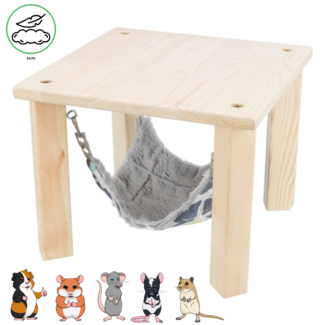
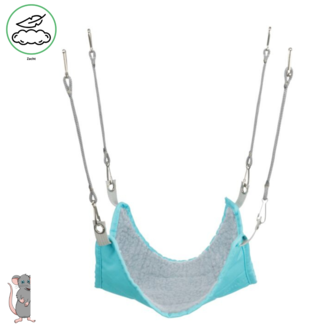
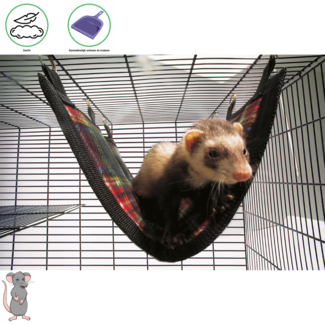
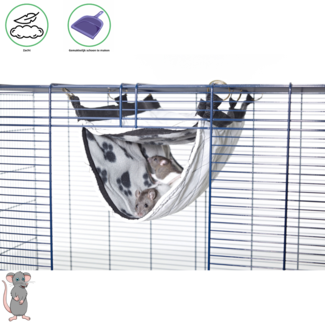
The luxury hammocks from Savic are made for rats and ferrets. They come with a panther print and with a paw print, in sizes of 31 × 24 × 24 cm and 44 × 24 × 24 cm, and as a flat hammock of 31 × 44 cm. The double hammock from Savic (35 × 21 × 21 cm) has two layers, so rats can lie on top of or between the layers. From Trixie there is a washable hammock for rats of 30 × 30 cm and a two-tier hammock of 22 × 15 × 30 cm. The Sunny hammock from Trixie comes in 30 × 30 cm and in a roomier size of 41 × 27 × 23 cm. The Clavio hammock from Flamingo of 37 × 37 cm is made of padded fabric and is hung up with hooks.
Sleeping bags, hanging tunnels and hanging houses
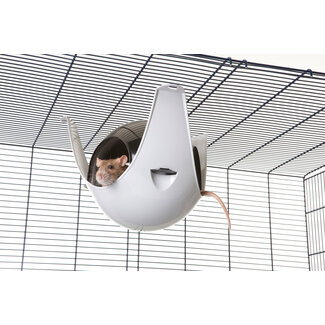
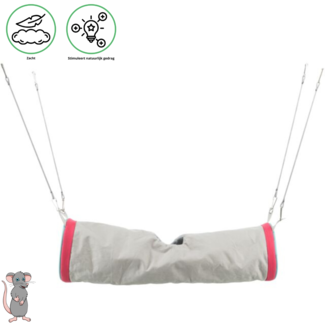
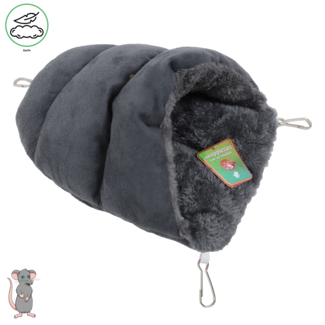
Some rats prefer to crawl into something rather than lie on top of it. For them there are the 25 cm plush sleeping bag for rats and ferrets, the hanging house of 28 × 20 cm and the Clavio hanging tunnel with three exits (45 × 20 cm). The hanging relax tunnel from Trixie (ø 14 × 45 cm) is also washable and popular as a sleeping spot. The Sputnik from Savic (29 × 26 × 19 cm) is a plastic hideout for rats and ferrets that is easy to clean.
Hanging bridges and ladders
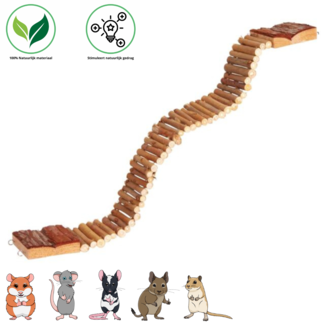
Hanging bridges connect two platforms or a platform with a hammock. The sturdy rope bridge of 100 × 7.5 × 3.5 cm is intended for rats and ferrets and can be hung in a curve or a straight line. From Trixie there are the bark hanging bridge with chain (27 × 17 × 7 cm), the flexible bark hanging bridge (61 × 8 cm), the hanging bridge with rope ladder (35 × 15 × 15 cm) and a hanging bridge with rope ladder and toy (29 × 25 × 9 cm). The bark ladder (55 × 7 cm) makes a steep transition between two levels easier to manage.
Ropes and climbing nets
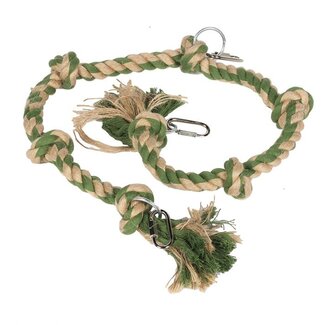
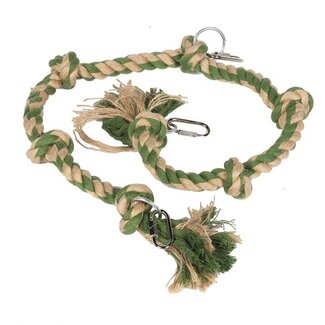
Ropes and nets are both a route and a play feature for rats. The sturdy knotted ropes from Happy Pet come in 60, 100 and 180 cm and are made for rats and ferrets. The knots give grip when climbing. Hang the sturdy knotted net (35 × 35 cm) and the knotted cargo net (35 × 20 cm) horizontally as a place to lie or vertically as a climbing wall.
Hanging platforms
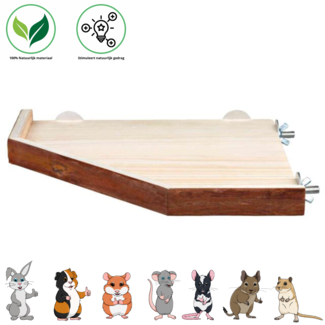
Hang the bark platforms from Trixie (28 × 28 cm and 33 × 33 cm) on the bars as an extra level. They provide a stopover between two levels and a place to sit for a moment and look around.
How many hammocks do you need?
More than you think. Rats are group animals and should live at least in pairs. They like to sleep together, but also want to be able to choose. A good guideline is at least as many sleeping spots as rats, plus one extra. Some of those are hammocks, the rest houses, sleeping bags or tunnels.
Hang the hammocks at different heights and in different places in the cage. A hammock high up in a corner is often the most popular, but older rats sometimes prefer to lie a little lower. In warm weather you will see rats lying in an open hammock more often, in cold weather in a sleeping bag or double hammock instead.
Safe routes between the levels
Young rats jump from one level to another without thinking. That usually goes well, but a misstep onto a hard floor can cause an injury. Older rats become stiffer and often see less well; for them, jumps become a real risk. So create several routes with bridges, ropes and ladders, and hang hammocks under the highest platforms as a safety net.
Don't hang bridges too steeply. A gentle slope is more comfortable to walk than an almost vertical transition. Two short routes are often better than one long, steep bridge. Multiple routes also ensure that a dominant rat can't block the way up.
Hanging and securing
Rats are strong and pull, push and gnaw at everything. Hang hammocks with sturdy hooks or clips and check at every clean-out whether everything is still securely attached. A hammock that comes loose on one side can make a rat fall or get trapped.
Pay attention to the height under a hammock. There must be room to walk underneath it, but a hammock that hangs too low becomes an obstacle. Also leave space between hammock and bars, so a rat can't get stuck in between.
Check ropes and nets for fraying and loose threads. Rats can get their little claws caught in loose threads. Cut off loose threads or replace the rope if it is too frayed.
Washing and cleaning hammocks
Hammocks get dirty quickly, because rats spend a lot of time in them and sometimes also wee in them or take food there. Shake them out in between and wash them regularly. A handy approach is to have two sets: one hangs in the cage, the other is clean and ready. That way your group always has a familiar sleeping spot.
Wash hammocks without perfume or fabric softener. Rats have sensitive airways and gain little from a strongly scented hammock. Rinse well and let everything dry completely before you hang it back up. Clean wooden bridges and platforms dry or with a slightly damp cloth.
If your rats often wee in the hammock, check whether there is a litter tray in their favourite wee spot. A fixed toilet spot with litter pellets keeps the hammocks noticeably cleaner.
Handy combinations
Together with these categories, hammocks and bridges make a complete rat cage:
- Tunnels: sheltered routes between the levels and extra sleeping spots.
- Houses: a hiding place on the floor alongside the sleeping spots up high.
- Litter pellets & Corner toilets: a fixed wee spot, so the hammocks stay cleaner.
- Nesting materials: Zooply Nesting Material to drag into a sleeping bag or house.
- Cages: a tall cage with enough room to hang several hammocks and bridges.
Frequently asked questions about hammocks and hanging bridges for rats
Why do rats love sleeping in a hammock so much?
Rats look for a place that is high, sheltered and soft, and where they can lie close together. A hammock combines all of that. From a high hammock, rats also have an overview of the cage. So it is perfectly normal for your rats to spend most of the day lying in a hammock.
My rats gnaw holes in the hammock. What can I do?
Gnawing is normal behaviour, especially in young rats. Check the hammock regularly: holes that a paw or head can get through, and loose threads, are a risk. Replace a hammock that is damaged like that. Also offer plenty of gnawing material and toys, such as Zooply apple branches, so your rats can put their energy into something else.
How often should I wash hammocks?
That depends on the number of rats and how clean they are. Many rat owners wash the hammocks weekly, together with the bigger clean of the cage, and swap a dirty hammock in between. If a hammock still smells musty after washing, it is time to replace it.
Are ropes safe for rats?
Yes, provided you maintain them properly. The knotted ropes in this category are made for rats and ferrets. Cut off loose threads and replace a rope that is badly frayed. Hang ropes so that no loop forms in which a rat could get its head or body caught.
Do older rats need different hammocks?
Older rats become stiffer and are less good at climbing. For them, hang a hammock a little lower, close to a platform, so they can get into it easily. Make the routes less steep with extra bridges or a ladder, and choose hammocks with a low entry. If you see that an older rat has difficulty walking or eating, contact a vet with knowledge of rodents.
Can I also use a ferret hammock for rats?
Yes. Many hammocks in this category are intended for both rats and ferrets. Pay particular attention to the size: a large ferret hammock is actually nice for a group of rats. Small hammocks and pouches for hamsters are too small for rats.
Buying hammocks and hanging bridges at Knaagplaza
At Knaagplaza, the webshop of 't Knaagplein, you will find hammocks, bridges, ropes and nets to turn your rat cage into a safe climbing course. Complete the set-up with Zooply, our own premium brand: nesting material, low-dust bedding and rat food that we use every day for our own animals. That way your rats sleep up high and climb safely.