








Sand bath for your hamster: natural coat care
Hamsters don't wash with water, but with sand. They roll, wriggle and dig in it, and that is how they remove dirt and excess grease from their coat. A sand bath therefore belongs in every hamster enclosure, for dwarf hamsters and Syrian hamsters alike. It is also a place where your hamster loves to dig, and many hamsters also choose the sand bath as their fixed toilet spot. That makes keeping the enclosure clean a lot easier.
In this category you will find the bathing sand from Zooply, our own brand, and sand baths made of ceramic, wood with acrylic and glass. With a suitable bath and good bathing sand, your hamster has everything it needs for a healthy coat.
In short
- ✓ Use fine bathing sand intended for rodents, such as Zooply Bathing Sand; no play sand, calcium sand or dusty sand.
- ✓ Choose a sand bath in which your hamster can lie down completely and roll around.
- ✓ According to the packaging, you offer the bathing sand without limit.
- ✓ Scoop out dirty spots daily and change the sand about twice a week.
- ✓ Place the sand bath away from the nest and the feeding spot.
What will you find in the Sand & Sand baths category?
Zooply Bathing Sand
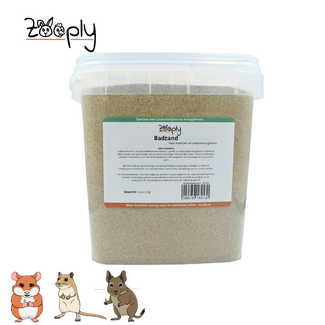
Zooply Bathing Sand is 100% natural sand, especially for dwarf hamsters, Syrian hamsters, gerbils, degus and chinchillas. The sand comes from Europe, is filtered and checked for quality and, according to the product information, is free from harmful substances. Your hamster uses it to care for its skin and coat. According to the packaging, you offer the bathing sand without limit, in a sand bath that suits the dimensions of the enclosure. You can choose from a 1 kg bag, handy to start with or for one hamster, or a 3 kg bucket, which lets you change the sand regularly without constantly having to buy more. We use this sand ourselves for our own animals.
Trixie ceramic sand baths
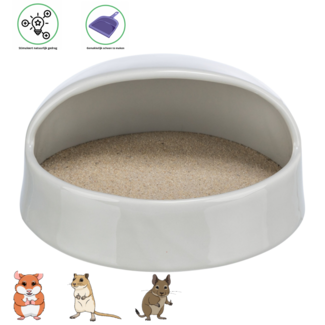
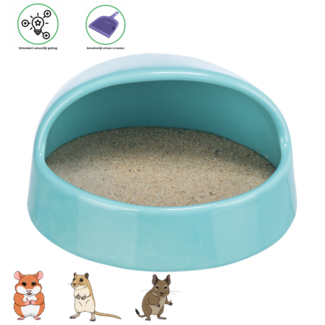
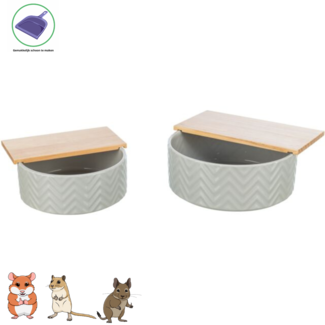
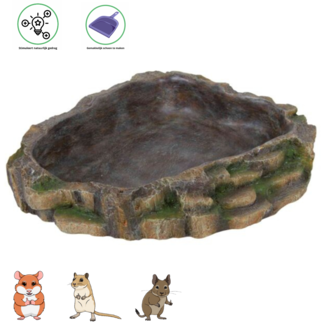
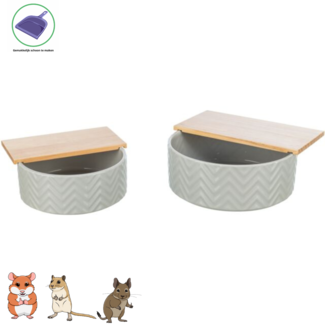
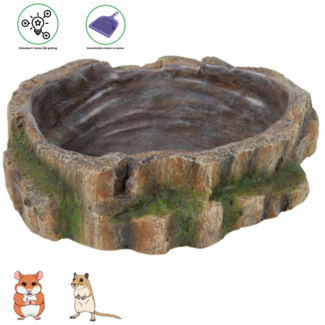
Ceramic sand baths are heavy, don't tip over and are easy to clean. Trixie offers them in an open shape with a high back wall: in 16 × 8 × 14 cm (turquoise) and 20 × 10 × 16 cm (grey). There are also two low, wide sand baths with a rainforest look: 18 × 4.5 × 17 cm and 24 × 5.5 × 20 cm. The smaller sizes suit a dwarf hamster, the larger ones a Syrian hamster.
Wooden sand baths with acrylic
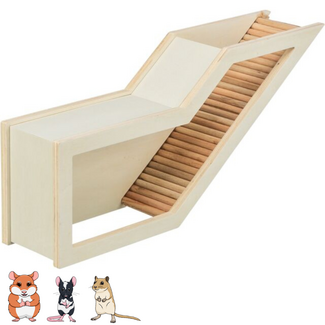
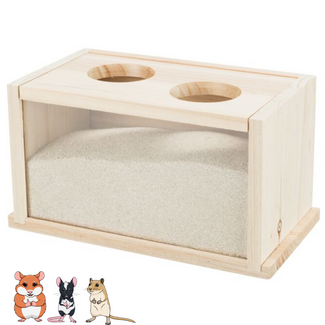
Trixie also makes covered wooden sand baths with an acrylic viewing window and two entrances. They come in 22 × 12 × 12 cm and 28 × 15 × 15 cm. Thanks to the closed top, the sand stays in the bath better, and through the window you can watch your hamster bathe. With two entrances, your hamster can easily walk through it. Bear in mind that wood absorbs moisture: if your hamster uses the sand bath as a toilet, scoop it out extra often.
Glass bowls on a wooden base
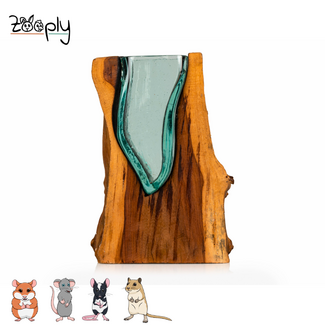
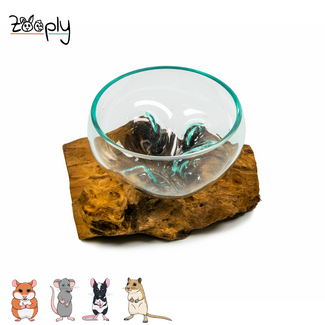
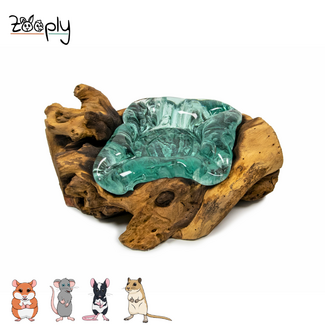
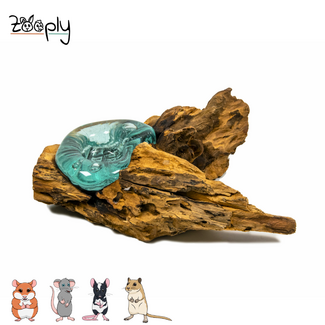
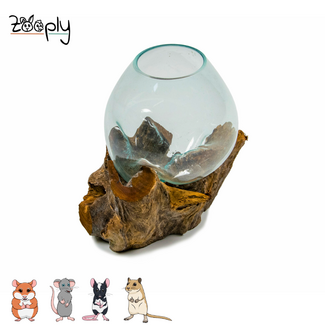
The Gigan Garden & Deco glass digging and feeding bowls stand on a base made of Gamal root and come in sizes including 12, 15, 20 and 25 cm. They look lovely as a sand bath in a naturally furnished enclosure. Choose a size in which your hamster can lie comfortably; the smallest bowls are mainly suitable for dwarf hamsters.
Why does a hamster need a sand bath?
A hamster's coat produces a little grease. By rolling in sand, the sand absorbs that excess grease and dirt. This keeps the coat loose and clean. In the wild, hamsters live in dry, sandy areas, and sand bathing is natural behaviour for them. Without a sand bath, the coat can become greasy and sticky.
A sand bath is also enrichment. Many hamsters dig in it enthusiastically. And because hamsters like to use a fixed spot to wee, they often choose the sand bath. That is handy: you scoop out the wet patches and the rest of the enclosure stays dry.
Which sand is suitable?
Not every sand is suitable for a hamster. Play sand and building sand can be too coarse or damp and are not intended for animals. Calcium sand and dusty chinchilla dust are not a good choice either: hamsters keep their nose close to the sand, and fine dust can irritate the airways. Use bathing sand made especially for rodents, such as Zooply Bathing Sand. Also don't use sand with scents or additives. Hamsters have a sensitive nose.
Which size sand bath suits your hamster?
A sand bath must be big enough for your hamster to lie down in it completely and roll over. Your hamster often won't use a bath that is too small, or the sand flies straight over the edge when it rolls. For a dwarf hamster, a smaller sand bath will do, such as the 16 cm ceramic bath or the 22 cm wooden sand bath. A Syrian hamster needs a larger bath, such as the 20 or 24 cm ceramic baths or the 28 cm wooden sand bath. Put in a layer of a few centimetres of sand, so your hamster can dig as well.
Where do you place the sand bath?
Place the sand bath on a flat, firm spot in the enclosure, so it doesn't sink into the bedding. A platform close to the floor or a flat piece of cork works well. Choose a spot away from the nest and the food bowl. If the sand bath is used as a toilet, you don't want urine near the food or the nest. Also don't put it directly under the water bottle: wet sand clumps and can start to smell.
Does your hamster use a different corner as its toilet? Then you can put the sand bath there. Many hamsters will then start using it of their own accord.
Keeping the sand bath clean
Every day or every other day, scoop the dirty spots and droppings out of the sand, for example with a small sieve or spoon. According to the Zooply Bathing Sand packaging, you clean the sand bath about twice a week, or more often if it is visibly dirty. Change the sand then and rinse a ceramic or glass bath with warm water. Let the bath dry thoroughly before adding new sand. Clean a wooden sand bath dry; if the wood has become wet or keeps smelling, it is better to replace it.
Store the bathing sand dry and well sealed. Damp sand clumps and is less suitable for coat care.
Keeping an eye on coat and skin
A sand bath helps your hamster keep its coat clean, but it doesn't solve health problems. While caring for your hamster, look at its coat now and then. If you see bald patches, flakes, scabs, a lot of scratching or a coat that stays greasy despite the sand bath, have your hamster checked by a vet with rodent expertise. The same applies if its rear end is wet or dirty: that may point to diarrhoea and calls for quick help.
Useful combinations
- Bedding: Zooply bedding for the rest of the enclosure, so only the sand bath is the toilet spot.
- Hamster scaping: cork and natural materials to blend the sand bath nicely into the landscape.
- Houses: a hideaway away from the sand bath, so the nest stays dry.
- Cages: a roomy enclosure with space for a sand bath of the right size.
Frequently asked questions about sand and sand baths for hamsters
Does a dwarf hamster need a sand bath?
Yes. Dwarf hamsters, such as the Campbell's, the Russian dwarf hamster and the Roborovski, love to use a sand bath to groom their coat. Syrian hamsters do too. So offer the sand bath to every hamster, with fine bathing sand made especially for rodents.
How often should I change the bathing sand?
Scoop out dirty spots daily or every other day. According to the Zooply Bathing Sand packaging, you clean the sand bath about twice a week, or more often if it is visibly dirty. If your hamster uses the sand bath heavily as a toilet, change the sand more often.
Can I use chinchilla sand or play sand?
Play sand and building sand are not suitable; they can be damp, contaminated or too coarse. Use bathing sand made especially for rodents. Zooply Bathing Sand is suitable for hamsters, gerbils, degus and chinchillas. Avoid products that are very dusty or contain calcium, because fine dust can irritate the airways.
My hamster sleeps in the sand bath. Is that a problem?
You see this now and then, especially in warm weather: sand feels cool. If your hamster also uses a nest as usual, there is nothing to worry about. If it only sleeps in the sand bath, check whether its nesting spot is warm, dry and sheltered enough, and whether there is enough nesting material.
My hamster uses the sand bath as a toilet. Is that OK?
Yes, that is actually handy. Hamsters like to wee in a fixed spot. If that is the sand bath, you scoop out the wet patches and the rest of the enclosure stays dry and fresh. Do change the sand more often, though, so it stays clean for coat care. You can also add a second sand bath: one for bathing and one as a toilet.
Sand and sand baths at Knaagplaza
At Knaagplaza, the webshop of 't Knaagplein, you will find Zooply Bathing Sand and sand baths in various shapes and sizes for Syrian hamsters and dwarf hamsters. Zooply is our own premium brand, which we use every day for our own animals in the shop and at our breeding facility. With a roomy sand bath and good bathing sand, your hamster keeps its coat clean the natural way.