





Tunnels for rabbits: running, hiding and exploring
In the wild, rabbits live in a network of burrows and passages. They dart from one safe spot to the next and dive underground at lightning speed when danger threatens. A tunnel taps into that behaviour. It is both a play route to race through and a hiding place to crawl into. Many rabbits become visibly more active with one: you see more sprints, leaps and curious sniffing.
In this category you will find fabric play tunnels, tunnels and bridges made of willow, cork and wood, edible hay tunnels and the Ferplast Metró tunnel system. Hide a handful of Zooply hay or some Zooply herbs at the end of a tunnel and your rabbit immediately has a reason to go in.
At a glance
- ✓ Choose a diameter that suits your rabbit: a dwarf rabbit fits through a narrower tunnel than a medium or large breed.
- ✓ A tunnel is also a hiding place; count it towards the number of hiding places in the enclosure.
- ✓ Natural willow and cork tunnels may be gnawed; do check them for sharp bits.
- ✓ Check fabric tunnels regularly for loose threads and holes, and wash them according to the product information.
- ✓ Do not put tunnels in the wet toilet corner, but on a route your rabbit already uses.
What will you find in the Tunnels category?
Fabric play tunnels
Trixie offers several foldable fabric play tunnels. There is a long tunnel of ø 18 × 130 cm and one of ø 19 × 117 cm, a tunnel with three exits (3 × ø 18 × 47 cm) and one with five exits (5 × ø 18 × 47 cm). With several exits your rabbit can choose where to go in and out, and two rabbits can avoid each other. There are also softer relax tunnels to lie in: the plush relax tunnel of 27 × 21 × 80 cm and the Sunny relax tunnel (ø 19 × 70 cm). Trixie's triangular soft hideaway is in this category too. With a diameter of 18 to 19 cm, these tunnels are mainly suitable for dwarf rabbits and small rabbits.
Willow tunnel and willow bridges
The Trixie willow tunnel (ø 20 × 38 cm) is made of willow branches. Willow is a safe wood to chew on, so your rabbit may slowly nibble away at the tunnel. The willow bridges of 30 × 16 × 30 cm and 24 × 13 × 25 cm are arches to shelter under or climb over. For a rabbit, the largest size is the most suitable.
Cork tunnels
The tunnels made of 100% natural cork come in sizes up to ø 19 × 55 cm and up to ø 30 × 75 cm. Cork is a natural product, so every tunnel has its own shape and size. The material is light, rough and may be gnawed. The large cork tunnel gives even a medium-sized rabbit enough room; the smaller one is more suitable for a dwarf rabbit.
Flexible wooden bridges
Trixie's flexible bridges consist of wooden slats linked together. You bend them into an arch, a tunnel or a sloping little bridge. For a rabbit, the 51 × 30 cm and 65 × 40 cm sizes are suitable. The smaller sizes (22 × 10 and 28 × 17 cm) are intended for small rodents. This category also includes a bark wood ramp (63 × 18 × 15 cm), which makes it easy for your rabbit to walk in and out of an enclosure with a raised level.
Edible tunnels
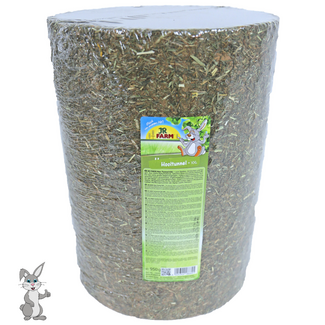
JR Farm makes hay tunnels of 750 grams and 950 grams from pressed mountain meadow hay. Trixie has a hideaway with carrot (21 × 16 × 30 cm). Your rabbit can crawl inside and slowly nibble the tunnel away. Think of it as enrichment and a treat alongside the normal hay; carrot is sweet, so you do not give the carrot version every day.
Ferplast Metró tunnel system
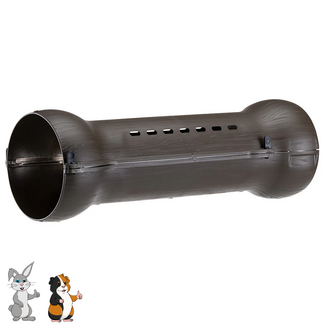
The Ferplast Metró system consists of separate tunnels of ø 29 × 78.5 cm (in brown and transparent), a connector (ø 27 × 22 cm) and the Metró Station (43 × 48 × 44 cm). You can connect the parts to each other and to certain Ferplast enclosures. That way you build a network of passages that resembles a rabbit warren. With a diameter of 29 cm, this tunnel is roomy enough for larger rabbits too. In the transparent tunnel you can watch your rabbit walk through.
What size tunnel suits your rabbit?
Your rabbit must be able to pass through the tunnel without squeezing, with its back straight and without its ears or body getting stuck. A dwarf rabbit of just over a kilo can get through tunnels of 18 to 20 cm in diameter. A medium-sized rabbit is more comfortable in a tunnel of 25 to 30 cm, such as the Metró tunnel or the large cork tunnel. For a large breed, a flexible bridge in the biggest size or a tunnel with a 30 cm diameter is the minimum. If in doubt, choose the larger size. A tunnel that is too narrow will not be used, or can startle a rabbit if it cannot turn round easily.
Placing tunnels cleverly
Put a tunnel in a spot your rabbit already passes, for example between the house and the hay rack, or as a link between two parts of the run. That way it naturally becomes part of the daily route. Do not put a tunnel in the corner where your rabbit pees; fabric and wood then get wet and dirty.
With a pair or small group, tunnels with two or more exits work best. A rabbit sitting in a tunnel can then always leave at the other end if its companion blocks the entrance. Change the layout now and then: a tunnel in a new spot makes a familiar enclosure interesting again. Do this in moderation, because rabbits also like a stable base.
Tunnels for indoor rabbits
A rabbit that lives indoors or roams freely around the house has just as much need to run and hide. A tunnel gives it its own play route indoors and keeps your rabbit away from places it should not be, such as behind the sofa or among cables. Put a fabric tunnel on a rug or mat so it does not slide around on a smooth floor. A tunnel near the house or the litter tray gives your rabbit a safe route through the room.
Getting your rabbit used to a tunnel
Most rabbits shoot straight through. A cautious rabbit watches for a while first. Put some hay or a few pellets at the entrance and further into the tunnel, and sit quietly nearby. Never push your rabbit in. With a foldable fabric tunnel it helps to make it shorter for the first few days, so your rabbit can see the light at the other end.
Cleaning and replacing
Shake out fabric tunnels regularly and wash them according to the product information. Let them dry thoroughly before putting them back. Wipe out natural tunnels made of willow, cork and wood and, if needed, clean them with warm water, without cleaning products. Replace a tunnel if it has sharp bits, splinters or loose threads, if it becomes unstable or if it keeps smelling musty.
Useful combinations
A tunnel is the most fun as part of a varied enclosure. Combine it with:
- Houses: a permanent hiding place for the tunnel to lead to.
- Toys: even more to do and more enrichment.
- Dried herbs: a pinch of Zooply herbs in the tunnel makes foraging fun.
- Hay: a handful of Zooply hay at the entrance tempts your rabbit inside.
- Runs: enough space to use tunnels as a racetrack.
Frequently asked questions about tunnels for rabbits
Is an 18 cm tunnel big enough for my rabbit?
For a dwarf rabbit or a small rabbit, usually yes. A medium or large rabbit often only just fits and would then rather not use it. Watch your rabbit: if it can pass through the opening without ducking and squeezing, the size is right. For larger rabbits, tunnels of 25 to 30 cm, such as the Metró tunnel or the large cork tunnel, are better.
Can my rabbit chew the tunnel?
Willow, cork, untreated wood and the hay tunnels, yes; they are made for it. Fabric tunnels, preferably not: your rabbit could swallow bits of fabric or thread. If you notice your rabbit chewing a fabric tunnel to pieces, remove it and choose a natural model.
Can I use a tunnel outside in the run too?
Yes, but put it in a sheltered, dry spot. Fabric tunnels and cork get wet in the rain and dry slowly. Bring them inside in wet weather or put them under a shelter. The plastic Metró tunnels are easier to keep dry and clean.
Is a tunnel enough as a hiding place?
A tunnel is a good extra hiding place, but most rabbits also want a house where they can lie fully sheltered. Provide at least one hiding place per rabbit and preferably one extra; a tunnel counts towards that.
How long does a hay tunnel last?
That depends on your rabbit. Some rabbits eat it in a few days, others nibble at it for weeks. Remove it if it has become dirty or wet. A hay tunnel is a treat; loose hay in the rack remains the foundation.
Buying tunnels at Knaagplaza
At Knaagplaza, the webshop of 't Knaagplein, you will find tunnels in many sizes and materials, for indoors and in the run. Choose a diameter that suits your rabbit and turn it into a treasure hunt with a handful of Zooply hay or Zooply herbs, our own premium brand that we use every day for our own rabbits.