





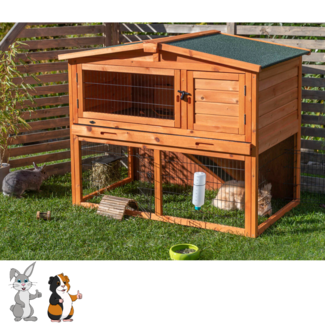

Outdoor hutch for rabbits: sheltered and safe in the garden
Rabbits can live outdoors perfectly well, as long as their accommodation is properly arranged. An outdoor rabbit grows a thick winter coat and enjoys fresh air, daylight and the smell of grass. To do so, though, it needs an outdoor hutch that is dry, draught-free and predator-proof, and that protects against strong sun and frost. The hutch is the bedroom and hiding place. The real living space is a spacious run in which your rabbits can run, jump and dig every day.
In this category you will find wooden outdoor hutches from Trixie, some with their own run or a second storey, an insulated hutch, separate outdoor runs and an outdoor hideout for the run. Put a thick layer of straw and fresh Zooply hay, our own premium brand, in the sleeping compartment: that is a warm place to lie and food at the same time.
At a glance
- ✓ An outdoor hutch must be waterproof, draught-free and predator-proof, with a sheltered, dry sleeping compartment.
- ✓ Always combine the hutch with a spacious run for daily exercise.
- ✓ Place the hutch in the shade, out of the wind and slightly raised off the ground.
- ✓ Rabbits live at least in pairs: that also keeps them warmer in winter.
- ✓ In winter, give extra straw and hay and check every day that the water has not frozen.
What will you find in the Outdoor Hutches & Cages category?
Outdoor hutches with a run
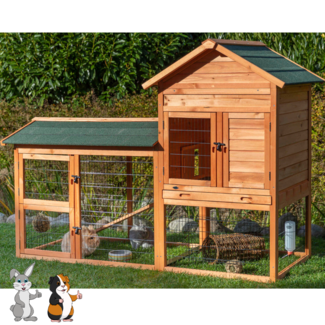
A number of hutches have their own run attached. The rabbit and guinea pig hutch of 199 × 146 × 93 cm is the most spacious model, with a separate hutch and a run for exercise outdoors. The rabbit hutch of 151 × 80 × 107 cm has a run and a sloping roof that rainwater runs off. A fixed run makes it easy to let your rabbits outside every day, but these runs are usually smaller than what rabbits really want. Where possible, extend them with an extra run.
Outdoor hutches with two storeys
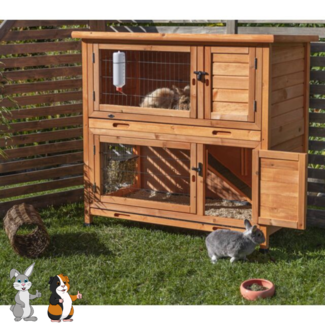
The Trixie Natura rabbit hutch (135 × 115 × 112 cm) has two storeys. That way your rabbit can choose between a sheltered section and a lighter part. There are also compact hutches of 124 × 102 × 78 cm and 116 × 111 × 65 cm. A second storey increases the floor area, but does not replace a run: rabbits mainly move about on the ground.
Insulated outdoor hutch
According to the product information, the Trixie insulated rabbit and guinea pig hutch (116 × 113 × 65 cm) has insulation that offers better protection against weather and cold. That is pleasant in winter and gives a little more buffer against heat in summer. An insulated hutch should also be placed in the shade and out of the wind.
Outdoor runs
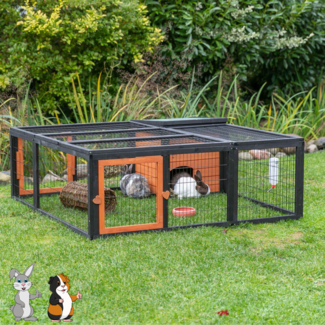
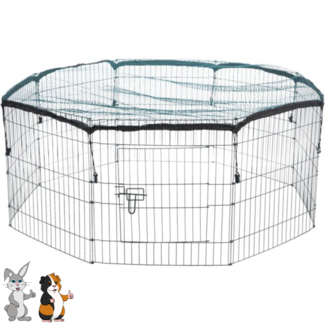
For room to move there is the Trixie Natura run with cover XL (233 × 79 × 116 cm) made of pine, the wooden run with hideout (150 × 53 × 150 cm), a metal run with a protective net (ø 150 × 57 cm) and a metal run with a roof (114 × 58 × 116 cm). Runs with a roof or net also protect against birds of prey and cats from above. You will find more options in the Runs category.
Outdoor hideout for the run
The Trixie Natura rodent house (60 × 47 × 50 cm, grey-green) is a roomy hideout for the outdoor run. That way your rabbit always has a place to shelter from rain, sun and sudden frights, even in the run.
What should you look for in an outdoor hutch?
Dry and draught-free
Damp and draughts are worse for a rabbit than cold. A good outdoor hutch has a waterproof roof with a slight overhang, an enclosed sleeping compartment without gaps and yet enough ventilation, so it doesn't get clammy inside. Put the hutch on legs, on paving slabs or on a raised base, so that water doesn't collect underneath and the wood stays dry.
Predator-proof
Foxes, martens, cats and birds of prey can bother a rabbit during the day too. Check that doors close with a good catch; a simple hook can sometimes be prised open by a marten or fox. If in doubt, add an extra bolt or carabiner. A run should also be closed off from above. Rabbits dig; lay mesh or paving slabs on the ground under or around a run, so they cannot dig their way out underneath and predators cannot get in from below.
Big enough
A rabbit must be able to lie stretched out, sit up straight and do a few hops in the hutch. With two rabbits you therefore need a spacious hutch. An outdoor hutch from the shop is usually the minimum basis. The bigger the hutch and run together, the better. Many rabbit owners place the hutch inside a larger, home-built or connected run, or make part of the garden rabbit-safe.
The right spot in the garden
Choose a spot that is in the shade for most of the day, for example under a tree or on the east or north side of a fence. Rabbits cope badly with heat. Position the hutch with the closed side facing the prevailing wind and rain. A spot you can see from the house is handy: you will quickly notice if something is wrong. Avoid a spot next to a busy street or the children's play equipment.
The outdoor hutch through the seasons
In summer, heat is the biggest danger. Provide shade throughout the day, check the water several times a day and put a cool tile or cooling plate in the shade. During warm spells, also keep an eye on your rabbits' rear ends and clean the hutch often; flies like to lay their eggs on a dirty coat.
In winter, put a thick layer of straw and hay in the sleeping compartment, so your rabbits can burrow in. In strong wind or frost, cover part of the mesh with a blanket or board, but always leave ventilation free. Water can freeze: check several times a day and, if needed, swap between two water bottles. Don't move a rabbit that has been living indoors outside in the middle of winter; it won't have a winter coat yet.
Cleaning
Remove wet patches and droppings every few days and replace the bedding and straw at least once a week. A litter tray in a corner of the hutch or run makes this easier. While cleaning, also check the wood for gnawing damage, rot and loose parts. After illness, clean the hutch thoroughly and, if necessary, use a disinfectant for animal enclosures, exactly as directed on the packaging. Don't treat a wooden hutch with paint or stain on the inside where your rabbit can reach it.
Useful combinations
An outdoor hutch is only complete with the right furnishings:
- Runs: extra room to move alongside the hutch.
- Bedding: a dry, absorbent layer on the floor of the hutch.
- Hay: Zooply hay as food and as a warm place to lie in winter.
- Water bottles: with a cooler for summer and a second bottle for frosty days.
- Hideouts: an extra hiding place in the run.
Frequently asked questions about outdoor hutches for rabbits
Can rabbits stay outdoors in winter?
Yes, healthy adult rabbits that already live outdoors and have grown a winter coat cope well with cold. The condition is a dry, draught-free sleeping compartment with a thick layer of straw and hay, and preferably a companion to snuggle up to. Young, old or sick rabbits and rabbits that have been living indoors find winter harder; if in doubt, consult a vet with rabbit experience.
Is an outdoor hutch big enough as the only accommodation?
No. An outdoor hutch is a place to sleep and shelter. Rabbits also need plenty of exercise every day in a safe run. A hutch with a small run attached is often the minimum basis; the larger the total space, the better.
How do I protect my rabbits from predators?
Choose a hutch with sturdy catches and add an extra bolt if necessary. Close off the run at the top too, and stop predators from digging underneath with mesh or paving slabs on the ground. Let rabbits sleep in a securely closed hutch at night.
What should I do in hot weather?
Put the hutch and run in the shade, give extra water, put down a cool tile or cooling plate and check on your rabbits more often. If a rabbit lies limp and flat with rapid breathing, move it to a cool place immediately and call a vet.
Can rabbits and guinea pigs live together in one outdoor hutch?
We advise against it, even though many hutches are sold as rabbit and guinea pig hutches. Rabbits and guinea pigs have a different language and different nutritional needs. A rabbit can accidentally injure a guinea pig badly with a kick of its hind legs, and guinea pigs need vitamin C every day. So keep rabbits with rabbits and guinea pigs with guinea pigs, each in their own enclosure.
How often should I clean the outdoor hutch?
Remove wet patches and droppings every few days and change the bedding and straw weekly. In summer, do this more often so that flies don't get a chance. A few times a year, clean the whole hutch thoroughly and let it dry well.
Buying outdoor hutches at Knaagplaza
At Knaagplaza, the webshop of 't Knaagplein, you will find outdoor hutches and runs to give your rabbits a safe place in the garden. Furnish the hutch with a dry floor, straw and fresh Zooply hay, our own premium brand that we use every day for our own rabbits. Add a spacious run and your rabbits will have everything they need outdoors.